From 288 vCPUs to Global AI: Scaling AlloyDB, Spanner, and Cloud SQL (Weekly Update)
INSIDE GOOGLE CLOUD DATABASES
The latest GCP database updates and what they mean for your production systems, dev workflows, and architecture.
### The Architect’s Elevator: From Milliseconds to Meaning
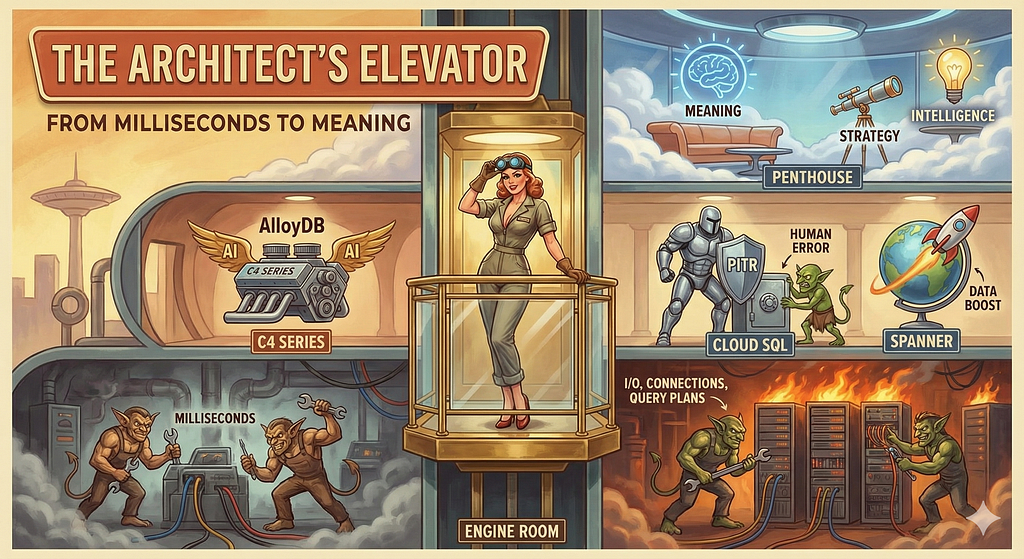
In the world of enterprise architecture, we often talk about the “Architect’s Elevator.” As architects, we must be able to ride the lift from the penthouse — where business strategy and user experience reside — down to the engine room, where we worry about I/O variance, connection limits, and query plans. This week’s updates across Google Cloud’s database portfolio represent a significant upgrade to the elevator itself. We aren’t just adding floors; we are shortening the distance between raw data and actionable intelligence while simultaneously hardening the foundation that keeps the whole building standing.
The trend I’m observing is a fundamental shift in the “contract” between the database and the application. Historically, a database was a passive repository, a digital filing cabinet that waited for a specific instruction. Today, we are seeing the database evolve into an active participant. By embedding Data Agents and LLMs directly into the data layer, we are moving from a world of “Data Retrieval” to one of “Data Reasoning.” We are abstracting away the plumbing — the connection pools, the manual backups, the complex ETL pipelines — so that engineers can focus on the “why” of their data rather than the “how” of its storage.

### This Week’s Engineering Deep Dive
On AlloyDB, we are seeing a dual-track strategy of “Hardening and Humanizing.” For the engine-room residents, the introduction of Query Plan Management (QPM) is a watershed moment for PostgreSQL stability. Think of it as a governor on a high-performance engine; it prevents the optimizer from “going rogue” after a statistics update, ensuring that a critical query doesn’t suddenly decide to perform a full table scan in the middle of a peak period. We are pairing this operational rigor with the C4 machine series, which essentially gives us a bigger, faster engine (up to 288 vCPUs) for those massive monolithic migrations that demand raw vertical scale. Meanwhile, the elevator is hitting the penthouse with the GA of managed connection pooling and Gemini-integrated SQL editing. By moving connection management into the platform and letting AI “auto-heal” syntax errors, we are removing the friction that usually slows down the development lifecycle. The rollout of Data Agents and Gemini 3.0 Flash means AlloyDB isn’t just storing rows; it’s providing a high-speed, low-latency reasoning engine for generative AI apps, moving the complexity of the RAG stack directly into the database kernel.

Cloud SQL is doubling down on “Career Insurance” and Identity. The General Availability of Enhanced Backups across MySQL, PostgreSQL, and SQL Server — specifically the ability to perform Point-in-Time Recovery (PITR) even after an instance has been deleted — is the ultimate safety net. In the digital postal service of data, this is the “return to sender” policy for when the mailbox itself gets knocked over. It recognizes a hard truth: human error is the greatest threat to uptime. Furthermore, bringing Microsoft Entra ID integration to SQL Server is a significant strategic move for our hybrid-cloud peers. It acknowledges that in a modern enterprise, identity is the new perimeter. By unifying database access under the same identity provider used for the rest of the Microsoft ecosystem, we are collapsing the silo between “DBA tasks” and “Identity Management.”
For Spanner, the mission continues to be “Global Scale with Local Precision.” The introduction of Data Agents to Spanner allows organizations to build conversational interfaces that can reason over globally distributed datasets — a feat that was historically an architectural nightmare involving complex synchronization and caching. However, what excites me as a platform lead is the “quiet” update to Data Boost: milli-operations per second quotas. In a multi-tenant environment, resource contention is the enemy of predictability. By allowing for finer-grained slicing of the Data Boost “cake,” we enable teams to run heavy serverless analytics without starving their neighbors. We’ve also improved visibility by adding Client IP and User Agent headers to the `SPANNER_SYS` tables. It’s a simple addition, but for a DBA trying to figure out which microservice is pinning a transaction at 3 AM, it’s the difference between a quick fix and an hour of log hunting.

Finally, we see the portfolio’s reach expanding through Bigtable and our regional growth. The new Dataflow job builder for Bigtable is a classic Hohpe-style abstraction: it replaces the “low-level” complexity of writing Apache Beam code with a “high-level” visual intent. It’s about making the ingestion of high-velocity event streams from Pub/Sub a configuration task rather than a coding project. Combined with Memorystore for Valkey landing in Johannesburg and Oracle Database@Google Cloud expanding globally, we are ensuring that the “engine room” is located exactly where the business needs it to be, minimizing the latency tax on global commerce.

— –
### A View From the Penthouse
As we look toward the horizon, the “Data Agent” pattern is signaling a quiet revolution in our field. We are rapidly approaching a day where SQL — much like assembly language before it — will become a specialized tool used by the platform’s “inner circle,” while the rest of the organization interacts with data through high-level intent and conversational reasoning. My advice to my fellow architects: don’t just look at these agents as a “feature” to be enabled. Look at them as a new layer of abstraction that will redefine your application’s relationship with the truth. The database is no longer just the basement of your architecture; it’s becoming the brain.

🗓️ Upcoming Events
Don’t miss our 1 upcoming events, covering key topics like AI agents, Bigtable’s SQL interface, and Firestore’s MongoDB compatibility.
Build Your Generative AI Skills at Cloud Hero Week 2025
Date: December 22, 2025
Category: CloudOnAir
High-impact hands-on labs. Master Gemini, Vertex AI, and multimodal RAG with Google Cloud experts.Join us for the annual Google Cloud developer challenge! Four days of competitive, hands-on labs where you will dive deep into advanced applications of Gemini, Vertex AI, and critical infrastructure solutions. Compete for the top spot on the leaderboard, and walk away with Google Cloud Skill Badges and valuable practical knowledge.December 22–25, 20259:30 AM–1:15 PM IST
Register to Build Your Generative AI Skills at Cloud Hero Week 2025
📚Top Articles & Summaries
If there is one theme hitting the radar this week, it is that we are finally treating AI as a serious database workload, not just a sidecar project. We are seeing the gap close between “cool demo” and “production reality” with Gemini 3 Flash now Built-in to AlloyDB!, which basically removes the network hop for inference, while Getting AI to write good SQL proves that prompt engineering is really just query optimization in disguise. 🧠
But it is not all shiny AI objects; we have some serious engineering chops on display with Tombstones: An overlooked reason your Spanner query performance degrades. This is a must-read for anyone who thinks `DELETE` actually frees up resources immediately (spoiler: it doesn’t, and your scans are paying for it). From hardening AlloyDB Omni on Kubernetes to automating Cross-regional backups, this batch is about taking your data layer from “it works” to “it scales.”
Getting AI to write good SQL: Optimizing the AlloyDB AI natural language API for your use case
We all know LLMs hallucinate, but when they hallucinate SQL, production breaks. This piece dives into the ‘hinting’ mechanism in AlloyDB AI. It’s essentially cost-based optimization for prompts — feeding the model just enough schema context without blowing up the token window.

Tombstones: An overlooked reason your Spanner query performance degrades (and how to solve it)
In LSM-tree based systems like Spanner, a delete is just a write that says ‘this is gone.’ These ‘tombstones’ linger until compaction. This article explains why your scans might be slow even after deleting data and how to manage the lifecycle of these ghost records.

Gemini 3 Flash now Built-in to AlloyDB!
Latency is the enemy of in-database AI. By integrating Gemini 3 Flash directly into the AlloyDB engine, we bypass the usual application-layer round trips. It’s faster, cheaper, and lets you run inference as part of your standard SQL transactions.

Beyond the For-Loop: Generating Database-Driven Embeddings at Scale with AlloyDB
Stop pulling data out of your DB just to generate embeddings in Python loop. This guide shows how to push that logic down into the database layer using batch processing, effectively turning AlloyDB into a vector factory.

Build Blazing-Fast, Tool-Smart Agents with Gemini 3 Flash and MCP Toolbox for Databases
The Model Context Protocol (MCP) is becoming the standard for connecting LLMs to data. This explores using the Google Cloud MCP Toolbox to let Gemini agents interact with your databases safely and intelligently.

AlloyDB Omni on Kubernetes
A solid primer on running Google’s PostgreSQL-compatible engine on your own K8s clusters. It covers the architecture of the Operator and how it handles the tricky bits of stateful sets for you.

AlloyDB Omni K8s Operator 1.6.0 release
Keeping up with the changelog: version 1.6.0 brings tighter security contexts and better resource management. Essential reading if you are self-hosting AlloyDB Omni.

Automate cross-regional backups of AlloyDB with Cloud Workflows
Disaster recovery isn’t optional. This is a practical recipe for using Cloud Workflows to orchestrate backups across regions, ensuring you survive a zonal (or regional) failure without manual intervention.

Quick & Easy AlloyDB AI Setup Tool
Setting up the AI extensions and vertex integrations can be fiddly. This introduces a CLI tool to automate the configuration, getting you to the ‘building’ phase faster.

Zero Cost, Infinite Possibility: Jumpstart Your AI Journey with Google Cloud’s Free Database Trials
A quick reminder that you don’t need a credit card to test drive Spanner or AlloyDB. Great for validating those architectural spikes before committing budget.

🚀 Latest Release Notes
This week, the line between “database engineering” and “science fiction” got a little blurrier — and I am absolutely here for it. 🚀
We are seeing a massive, coordinated rollout of **Data Agents** across AlloyDB, Cloud SQL, and Spanner. We aren’t just querying data anymore; we are literally building conversational interfaces *into* the database layer. But what I love about this release cycle is the balance. While the AI folks are partying with Gemini 3.0 Flash in AlloyDB, the hardcore DBAs got some serious armor: **Query Plan Management** in AlloyDB is finally here (goodbye, random optimizer regressions! 🛡️) and Cloud SQL Enhanced Backups now support Point-in-Time Recovery even *after* you accidentally delete an instance. It’s a perfect mix of future-tech and “save-your-hide” operational resilience.

The Usual Suspects: SQL Reports
What it is: AlloyDB performance snapshot reports now include a dedicated SQL Report section highlighting the top 50 queries by time, I/O, and variance.
Why it matters: Observability is often about noise reduction. By automatically surfacing the top offenders in your snapshot reports, AlloyDB saves you from hunting through logs.
Real-world problem it solves: Your app is slow, but you don’t know *why*. This report instantly points a finger at the specific query eating 90% of your I/O.
Learn more: Optimize Database Performance Compare Snapshots

Pool Party (Managed Edition)
What it is: Managed connection pooling for AlloyDB is now Generally Available. It works seamlessly with Auth Proxy and Language Connectors.
Why it matters: Connection handling in PostgreSQL usually requires a sidecar like PgBouncer. Having this fully managed and integrated means less infrastructure to maintain and fewer “sorry, too many clients” errors.
Real-world problem it solves: A sudden traffic spike from a marketing campaign exhausts your database connections, crashing the app. This feature queues and manages those connections automatically.
Learn more: Configure Managed Connection Pooling

Gemini 3.0: The Need for Speed
What it is: You can now call the `gemini-3-flash-preview` model directly within AlloyDB using `AI.GENERATE`.
Why it matters: In-database AI needs to be fast to keep transactions snappy. Gemini 3.0 Flash is optimized for exactly this — high frequency, low latency tasks.
Real-world problem it solves: You’re generating vector embeddings or summaries on the fly during a transaction, and the old model was adding too much latency to the user experience.
Learn more: Evaluate Semantic Queries Ai Operators

AlloyDB Data Agents
What it is: A Preview feature allowing you to build agents that interact with your AlloyDB data using natural, conversational language.
Why it matters: This moves the “RAG” (Retrieval-Augmented Generation) complexity stack down into the database. It empowers apps to ask questions rather than just run queries.
Real-world problem it solves: Building a customer support bot that knows your inventory usually requires a complex application layer. Now, the database acts as the agent tool directly.
Learn more: Data Agent Overview | PJByTWfenZAWbaXo7

The Heavy Lifters: C4 Series
What it is: AlloyDB now runs on the C4 machine series (Intel Xeon Granite Rapids), supporting massive instances up to 288 vCPUs and 2TB+ RAM.
Why it matters: Sometimes, you just need raw power. The C4 series raises the ceiling for vertical scaling, perfect for massive monoliths migrating from legacy on-prem hardware.
Real-world problem it solves: Your financial analytics workload is maxing out the previous generation’s CPU limits, causing end-of-month reporting to crawl.
Learn more: Choose Machine Type

Auto-Heal Your SQL
What it is: Gemini is now integrated into the AlloyDB Studio query editor to help fix SQL errors automatically.
Why it matters: It reduces the “context switch” tax. Instead of Googling a syntax error, the editor suggests the fix immediately.
Real-world problem it solves: You missed a comma or messed up a `JOIN` syntax, and instead of spending 5 minutes debugging, you click a button and keep coding.
Learn more: Write Sql Gemini

Lock Down Your Query Plans
What it is: Query Plan Management (QPM) for AlloyDB is in Preview. It captures query plans and lets you force the optimizer to use specific, approved plans.
Why it matters: This is the holy grail for enterprise stability. It prevents the “optimizer went rogue” scenario where a query suddenly changes execution paths and tanks performance.
Real-world problem it solves: A critical report that usually takes 2 seconds suddenly takes 20 minutes because the database decided to do a full table scan after a minor stats update.
Learn more: Query Plan Management

Bigtable: Drag, Drop, Ingest
What it is: A new Dataflow job builder integration in the Console makes importing data (like from Pub/Sub) into Bigtable much easier.
Why it matters: It lowers the barrier to entry. You don’t need to be a Dataflow/Apache Beam expert just to get data into your Bigtable instance.
Real-world problem it solves: You have a stream of events in Pub/Sub and want to dump them into Bigtable, but writing a custom Java/Python pipeline feels like overkill.
Learn more: Job Builder | Import Export

Cloud SQL MySQL: Agentic Era
What it is: Data Agents are now in Preview for Cloud SQL for MySQL, enabling conversational interaction with your database.
Why it matters: Bringing AI capabilities to the world’s most popular open-source database engine on Google Cloud.
Real-world problem it solves: Enabling non-technical users to query sales data in natural language without needing a data analyst to write SQL for them.
Learn more: Data Agent Overview | PJByTWfenZAWbaXo7

Cloud SQL MySQL: The “Oops” Button
What it is: Enhanced Backups are GA, featuring centralized management and — crucially — Point-in-Time Recovery (PITR) even after instance deletion.
Why it matters: This is career insurance. Standard backups often die with the instance; these persist, allowing you to resurrect a deleted database to a specific second.
Real-world problem it solves: A script goes haywire and deletes the production database instance. With this feature, you can restore it to the state it was in 5 minutes before the deletion.
Learn more: Backup Disaster Recovery | Restore | Backup Options | Pricing

Cloud SQL PG: Talking to Postgres
What it is: Data Agents arrive for Cloud SQL for PostgreSQL (Preview), allowing conversational AI integration.
Why it matters: Postgres is the darling of the developer world; adding native agentic capabilities makes it an even stronger backend for modern AI apps.
Real-world problem it solves: Rapidly prototyping a chatbot that needs to reason over structured user data stored in Postgres.
Learn more: Data Agent Overview | PJByTWfenZAWbaXo7

Cloud SQL PG: Immortal Backups
What it is: Enhanced Backups for PostgreSQL are GA, offering PITR after instance deletion and centralized Backup & DR service integration.
Why it matters: Centralized backup management is key for compliance (GDPR, HIPAA), ensuring retention policies are enforced regardless of what a developer does to the instance.
Real-world problem it solves: Auditors require proof that data is retained for 7 years, even if the original database server was decommissioned.
Learn more: Backup Disaster Recovery | Restore | Backup Options | Pricing

Cloud SQL Server: Safety Net
What it is: Enhanced Backups for SQL Server are GA, including the critical PITR-after-deletion capability.
Why it matters: SQL Server workloads are often mission-critical enterprise apps. Losing an instance due to human error is not an option; this feature guarantees recovery.
Real-world problem it solves: An operational error wipes out a legacy SQL Server instance. You can now bring it back exactly as it was.
Learn more: Backup Disaster Recovery | Restore | Backup Options | Pricing

SQL Server + Entra ID: Finally!
What it is: Preview support for integrating Cloud SQL for SQL Server with Microsoft Entra ID (formerly Azure AD).
Why it matters: This is a massive win for hybrid enterprises. You can now manage database access using the same identity provider you use for everything else in the Microsoft ecosystem.
Real-world problem it solves: Stop managing separate SQL authentication credentials for every user. Just add their corporate Entra ID group to the database.
Learn more: Integration With Microsoft Entra Id

Valkey in Jo’burg
What it is: Memorystore for Valkey is now available in the `africa-south1` (Johannesburg) region.
Why it matters: Low latency caching is critical. For users in Africa, this means significantly faster application response times.
Real-world problem it solves: Users in South Africa experiencing lag because their cache hits had to travel to Europe.
Learn more: Locations

Oracle: Going Global
What it is: Oracle Database@Google Cloud expands to new regions (Iowa, São Paulo, Sydney, Mumbai) and adds Console-based restore capabilities.
Why it matters: This partnership is moving fast. Expanding regional support is vital for data sovereignty and latency requirements for global enterprises.
Real-world problem it solves: You wanted to move your Exadata workload to Google Cloud but were blocked because the service wasn’t available in your specific compliance region.
Learn more: Regions And Zones

Spanner Data Agents
What it is: Spanner joins the party with Data Agents (Preview), enabling conversational interfaces for your globally distributed data.
Why it matters: Spanner holds your most critical, massive datasets. Being able to build AI agents that can reason over this scale of data is a game changer.
Real-world problem it solves: Creating a global inventory assistant that can answer questions about stock levels in real-time across 5 continents.
Learn more: Data Agent Overview | PJByTWfenZAWbaXo7

Slicing the Data Boost Cake
What it is: Spanner Data Boost now supports a finer-grained quota: milli-operations per second.
Why it matters: Data Boost allows serverless analytics on transactional data. This change prevents one greedy query from eating the entire project’s quota.
Real-world problem it solves: Multiple teams are running analytics on Spanner. Previously, one team’s heavy job could starve the others. Now, you can slice the resources much more precisely.
Learn more: Databoost Overview | Databoost Quotas | Quotas

Spanner: Who Is Running That?
What it is: New columns in the `SPANNER_SYS` oldest active queries table, including Client IP, User Agent, and API Client Header.
Why it matters: It closes the loop on observability. Seeing a slow query is one thing; knowing exactly which server or client sent it is another.
Real-world problem it solves: You see a query locking up resources, but you don’t know if it’s coming from the legacy app or the new microservice. The `USER_AGENT` field now tells you instantly.
Learn more: Oldest Active Queries | Monitor Active Queries
That’s a wrap for this week. We’re always interested to hear how these updates apply to real-world projects. The comments section is open if you have questions or want to share your perspective on the new features released this week.
If you found this post useful, we encourage you to share it in your network and stay tuned for next week’s digest!
This digest was brought to you by Andrew Feldman and the Google Cloud Database UK Team.
For more specific or private inquiries, you can reach our team directly at db-eng-uk@google.com.
From 288 vCPUs to Global AI: Scaling AlloyDB, Spanner, and Cloud SQL (Weekly Update) was originally published in Google Cloud – Community on Medium, where people are continuing the conversation by highlighting and responding to this story.
Source Credit: https://medium.com/google-cloud/from-288-vcpus-to-global-ai-scaling-alloydb-spanner-and-cloud-sql-weekly-update-21af3162663b?source=rss—-e52cf94d98af—4
About the Author