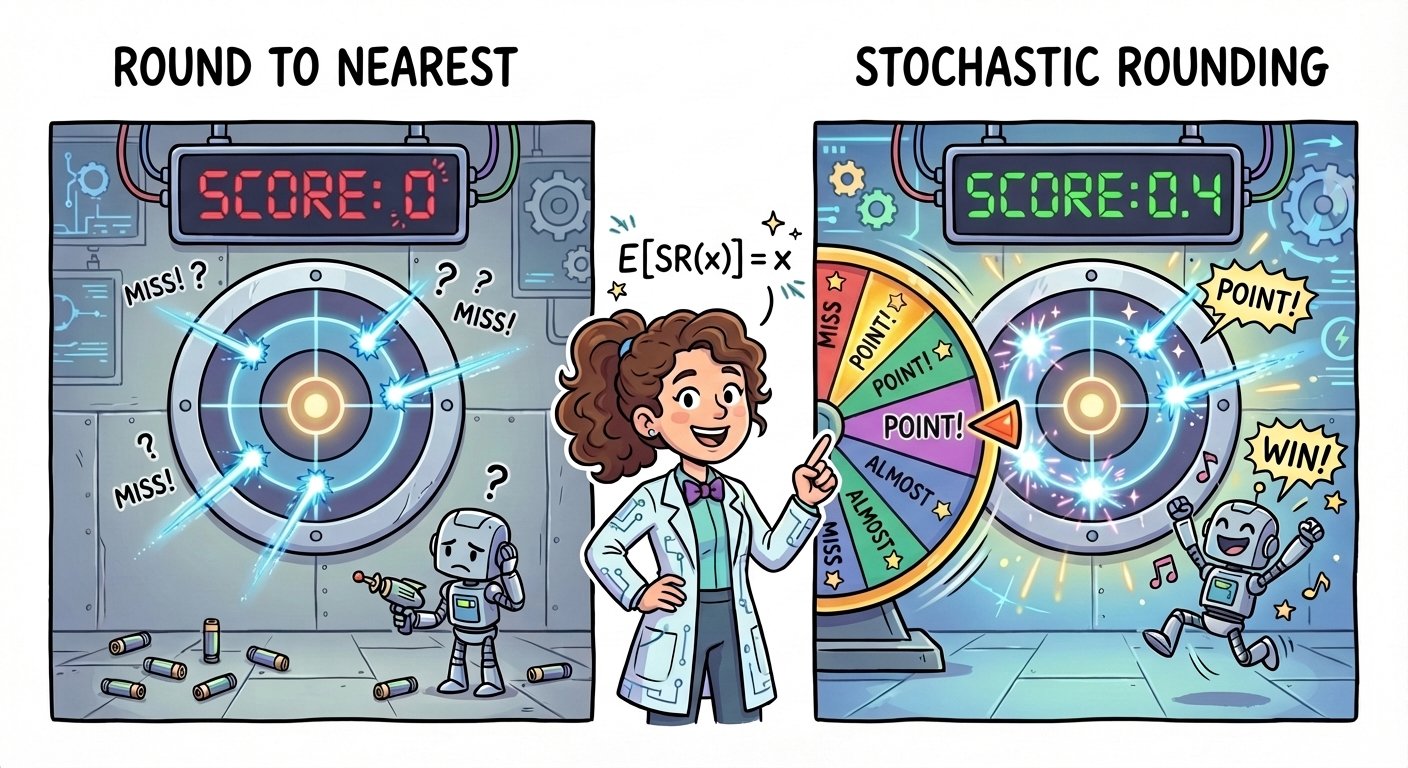
The defining property is that SR is unbiased in expectation:
To see the difference, look at our 1.4 example again. RTN is deterministic: it outputs 1 every single time. The variance is 0. It is stable, but consistently wrong. SR, however, produces a noisy stream like 1, 1, 2, 1, 2.... The average is correct (1.4), but the individual values fluctuate.
We can quantify the “cost” of zero bias with the variance formula:
Var(SR(x))=p(1-p) where p=x-⌊x⌋
In contrast, RTN has zero variance, but suffers from fast error accumulation. In a sum of N operations, RTN’s systematic error can grow linearly (O(N)). If you consistently round down by a tiny amount, those errors stack up fast.
SR behaves differently. Because the errors are random and unbiased, they tend to cancel each other out. This “random walk” means the total error grows only as the square root of the number of operations O(√N).
While stochastic rounding introduces noise, the tradeoff can often be benign. In deep learning, this added variance often acts as a form of implicit regularization, similar to dropout or normalization, helping the model escape shallow local minima and generalize better.
Implementing on Google Cloud
Google Cloud supports stochastic rounding through its latest generation of AI accelerators, including Cloud TPUs and NVIDIA Blackwell GPUs. These accelerators can also be used in AI-optimized Google Kubernetes Engine clusters.
Native Support on TPUs
Google’s TPU architecture includes native hardware support for stochastic rounding in the Matrix Multiply Unit (MXU). This allows you to train in lower-precision formats like INT4, INT8 and FP8 without meaningful degradation of model performance.
You can use Google’s Qwix library, a quantization toolkit for JAX that supports both training (QAT) and post-training quantization (PTQ). Here is how you might configure it to quantize a model in INT8, explicitly enabling stochastic rounding for the backward pass to prevent vanishing updates:
Source Credit: https://cloud.google.com/blog/topics/developers-practitioners/why-stochastic-rounding-is-essential-for-modern-generative-ai/
About the Author