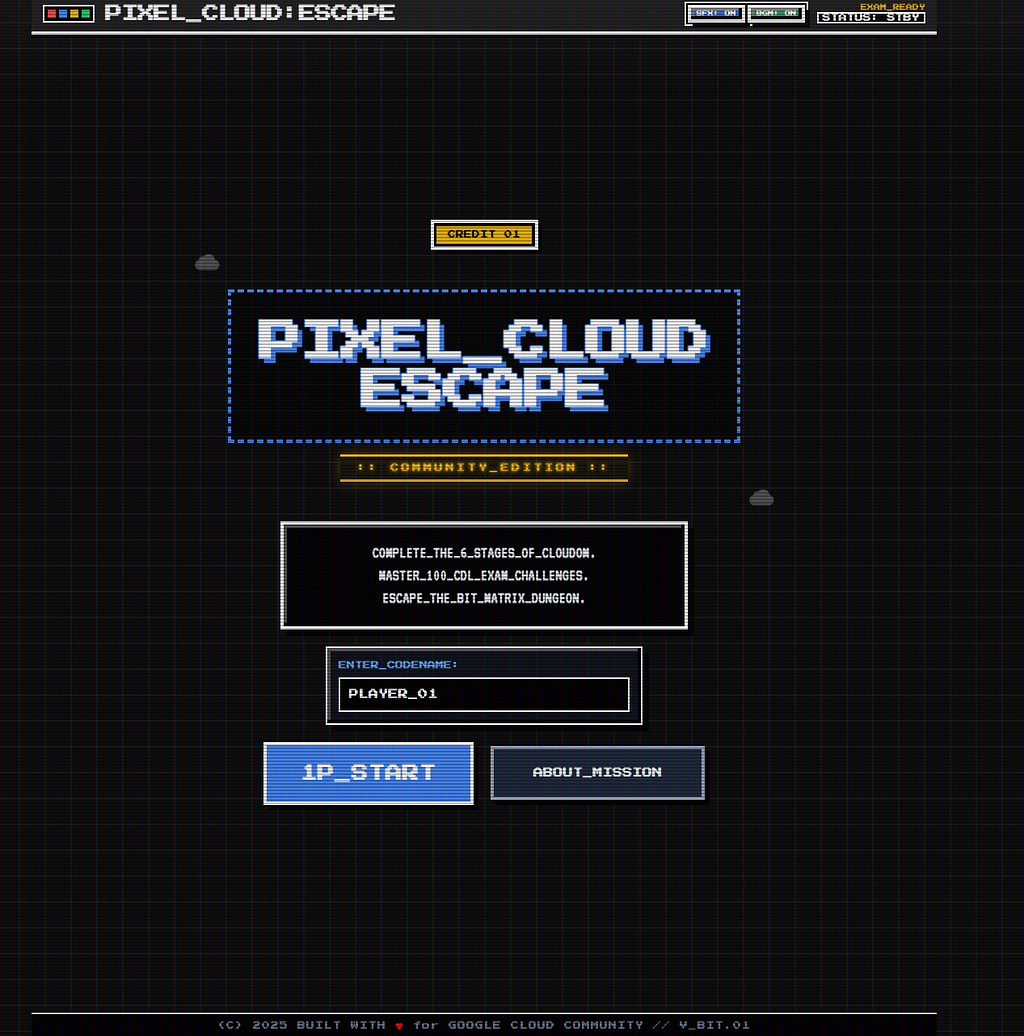
Documentation is boring (but you have to read it anyway). So I built a Retro Pixel-art like game to teach Google Cloud concepts — without writing a single line of code myself.
Intro:
I am a Google Cloud GDE (Google Developer Expert). My world is built around infrastructure, architectures and strategies, and that is cool. But I also have a dark side: I don’t code applications.
Of course I’m able to write simple Python or Go code or more advanced shell scripts, but for sure I’m not a developer. For a long time, I thought this was a limitation. Because how good is an Cloud Engineer or Cloud Architect who can’t write Python code, right? Well, that’s not a question for me, tho. And as long as I was able to automate either way my job ( better or not, it would not matter). But as GDE I wanted to help community.
However, without knowing how to code, I wouldn’t be able to make cool apps and websites. Especially if we talking about helping pass Google Cloud certifications. Of course, I could create YouTube playlist videos about Cloud Digital Leader or such, but there is a lot of such stuff already and I didn’t wanted to create yet another learning video. But we are living at GenAI era, where “not knowing how to code” is no longer an excuse. The barrier to entry has crumbled. So I’ve used Gemini as my Junior Developer, while I focused on the vision. And this is how Pixel Cloud Escape — a fully playable, browser-based retro game that teaches Cloud concepts has been made.
Here is the story of how I turned the official documentation into an 8-bit adventure.
It Started with an e-book.
Before I’ve even wondered about a game ( btw I have degree in Game Design ), there was a story. Around eight moths ago, I released a project on Github called The Etherlight Legacy.
My goal was simple: take the abstract concepts of Cloud Digital Leader exam scope and turn them into a fantasy novel. So I’ve tooked each chapter and placed it on fantasy world.
- The Metaphor: Instead of “Cloud Computing,” I wrote about “The Etherlight” — a vast, boundless force enabling innovation.
- The Conflict: I described the “Kingdom of Transformia,” a place stuck in the “Land of Stagnation” because they feared failure and refused to innovate.
- The Lesson: I wanted readers to feel the difference between CapEx and OpEx. In the book, Master Veylin laments investing fortunes in “rusting hulls and empty coffers” (CapEx) instead of paying only for the energy they consume (OpEx).
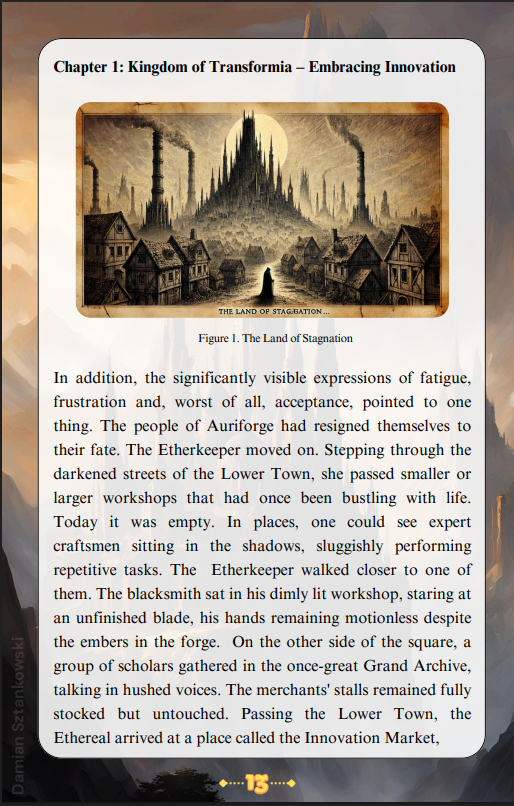
The book was a success in its own right, hosted on GitHub to embrace the “Docs-as-Code” philosophy. But reading is passive. To really prepare for an exam, you need to be challenged. I’ve tooked it under consideration, that regardless of placing this under fantasy world and giving new “spirit”, it’s still requiring READING. I’ve started asking myself question : “As a newbie, why I should read some weard ebook, if I can utilize official study guides from vendor?” That’s a fair question tho.
I’ve found an answer few months later.
Gamifying the Experience
I wanted to create a funnier way to learning basic stuff. I’ve always known that we memorize information better when the process is fun, rather than a chore. And this is why I’ve started design work for a game.
My goal wasn’t to build a complex, AAA title with hyper-realistic graphics. I wanted to focus 100% on the exam content, wrapping it in a world that is pleasant but not distracting. That’s why Pixel Art won the battle. Combined with retro music, it hits that sweet spot of nostalgia. After all, who doesn’t love pixels and old-school gaming?
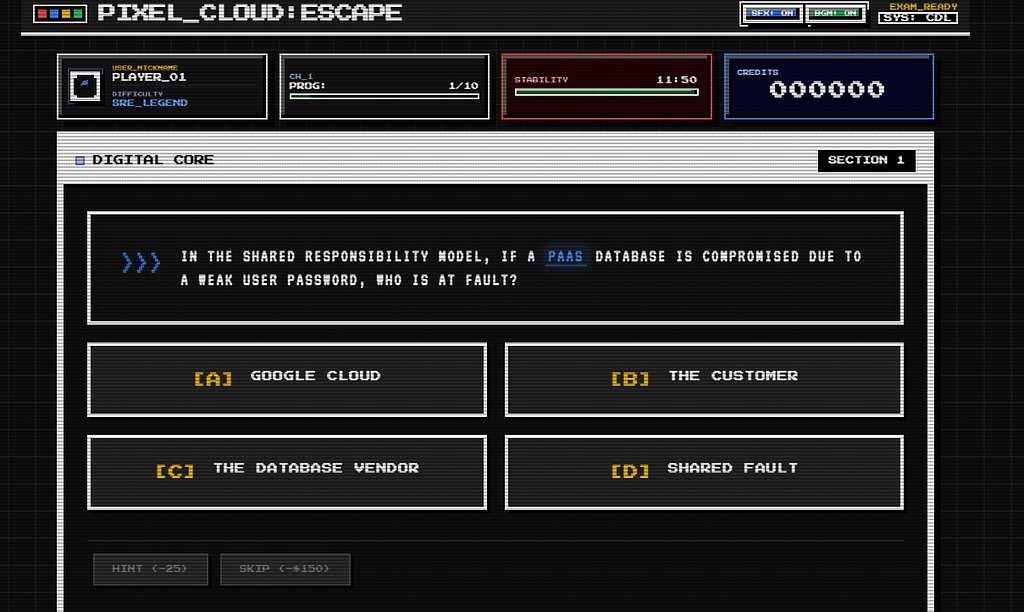
So, I had an idea, I knew what I wanted to make it and how it should work. But how to make it live? Well, I’ve asked Gemini. You should do it too.
“Coding” with AIStudio
The biggest challenge was moving beyond static text and move ideas from paper to real code. As I’ve said, I’m not an developer. But, I had access to one of Google’s AI tool called AIStudio. If you are not familiar with this tool,
Google AI Studio is a web-based prototyping environment designed for developers to quickly build, test, and experiment with Google’s Gemini models. Instead of writing code immediately to test an AI model, you use this graphical interface to perfect your prompts and settings. Once you are happy with the result, you can export the code to use in your actual application.
So, I’ve asked AIStudio:
“Build Google Cloud Quest Build role-specific expertise webapp game. It has to be scoped within Cloud Digital Leader official exam prep guide. It has to be 80s retro pixel-art like styled.”
AIStudio generated the code. I verified the output. The results?
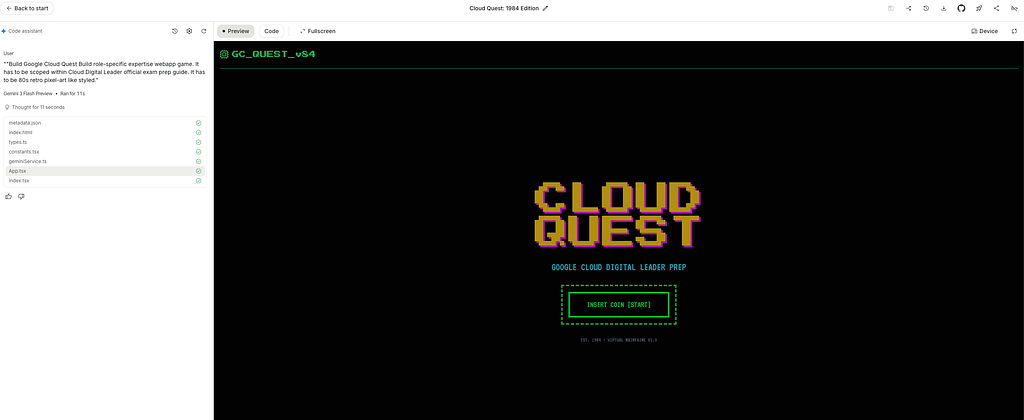
So cool, isn’t ? Of course, my idea and vision evolved, so I’ve iterated multiple times to achieve actual results. But it does not matter at this point.
The Reality Check: AI is the Tool, You are the Architect
AIStudio did a great job, but it is important to be honest here: AI Studio is just a tool. Like all AI-like tools it is not a magic wand that guarantees perfection.
While Gemini generated the JavaScript logic, it didn’t automatically make the application secure or optimized.
- Security: AI-generated code is not 100% secure by default. It might leave vulnerabilities (like Cross-Site Scripting gaps or poor data handling) if you don’t know what to look for.
- Context: AI doesn’t know why a specific architectural decision matters. It just predicts the next token.
Take a specific example from my development process. Initially, I wanted the game to generate questions on the fly using the Gemini Flash model. I asked AI Studio for the integration code, and it delivered it.
However, the AI didn’t warn me about the architectural risks. It didn’t secure my application against API Key overutilization or protect the endpoint from malicious curl calls. If I had copied that code blindly, I would have exposed my quota and wallet to the public internet.
This is where my experience was crucial. I had to audit the code, and approach, identify potential gaps, and ensure the logic aligned with best practices ( at the end of the day, I’ve redesign my approach ).
You still need the knowledge to ask the right questions and verify the answers. AI accelerates the build, but the responsibility for security and quality remains with the human in the loop.
Why This Matters
Domain Knowledge is rapidly becoming more valuable than Syntax Knowledge.
I didn’t need to know the syntax for a JavaScript loop. I needed to know the architecture of the Cloud. My role was to provide the “Why” and the “What,” while the AI handled the “How.”
Pixel Cloud Escape is one of many examples, that with the right vision and the expertise to guide the result, the gap between idea and execution is gone — or at least, it has become super small.
Play the Game
If you are studying for the Cloud Digital Leader exam, or just want to see what happens when a Cloud Architect makes a retro Pixel-art game, check it out below.
- 🎮 Play the Game: https://pixel-cloud-escape.damiansztankowski.cloud/
- 📖 Read the Book: https://github.com/damian-sztankowski/The-Etherlight-Legacy-Google-Cloud-Adventures
Do not forget the 👏✌️❤️ if you like this content!
Also, I will be glad if you hit the follow button so you get notified of my new posts.
You can also follow me on LinkedIn or Github.
Thank you!
No Code? No Problem. How I used AI Studio to turn official exam docs into a Pixel Art Game. was originally published in Google Cloud – Community on Medium, where people are continuing the conversation by highlighting and responding to this story.
Source Credit: https://medium.com/google-cloud/no-code-no-problem-how-i-used-ai-studio-to-turn-official-exam-docs-into-a-pixel-art-game-cee843db91cd?source=rss—-e52cf94d98af—4
About the Author