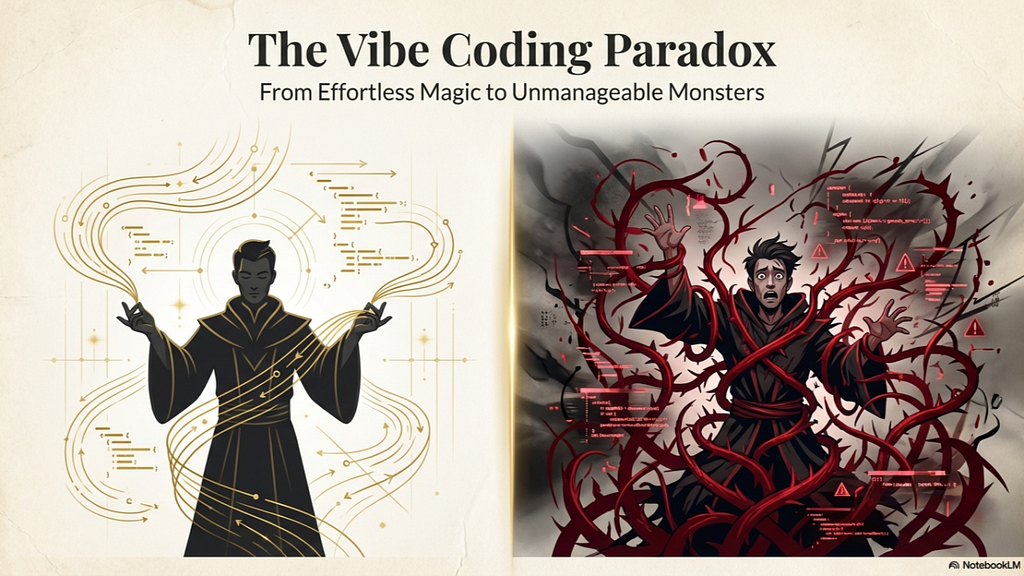
You’ve seen the hype. AI influencers fill social media with demos claiming you can build a full-fledged SaaS app in 15 minutes with just a few prompts. The term “vibe coding” or “AI Coding” — using natural language to guide AI code generation — has come to represent a frictionless, near-magical future of software development. Anyone, it seems, can now create complex applications out of thin air.
But the reality of this AI-driven workflow is far more complex, surprising, and consequential than these simple demos suggest. The true paradox of vibe coding is not just that it has pros and cons, but that its practical use demands more human judgment, discipline, and architectural oversight, not less. While the productivity gains are real, they are a byproduct of a much deeper restructuring of how we build, manage, and even think about software.
I have gathered articles that move beyond simple productivity hacks to explore five of the most impactful and counterintuitive truths about this new paradigm. Together, they form a unified thesis: vibe coding isn’t a shortcut that replaces engineering expertise; it’s a force multiplier that places an even greater premium on it.
1. It’s Not Just for Hobbyists — It’s Powering the Enterprise
While the term “vibe coding” is often associated with “throwaway weekend projects,” its most significant adoption is happening at a massive scale within large corporations. This enterprise adoption isn’t merely a quest for efficiency; it’s a strategic response to market demands for faster innovation and the need to empower “citizen developers,” allowing professional engineers to focus on high-level architecture and governance.
The numbers are compelling. At Adidas, Fernando Cornago is running a pilot with nearly a thousand developers, where 70% have already experienced productivity gains of 20–30%. Booking.com, with a team of over three thousand developers, reported a 30% boost in coding efficiency using AI tools. And Goldman Sachs is reportedly deploying “hundreds of Devins” with plans to scale into the thousands.
This enterprise-level adoption signifies a fundamental shift. Vibe coding is moving beyond rapid prototyping and into the heart of business-critical functions, proving this is far more than a trend for hobbyists. It shows that the world’s largest companies are betting on an AI-assisted future where human oversight becomes the most valuable component of the development lifecycle.
Salesforce’s Marc Benioff claims AI handles up to 50% of work at his company.

2. It Can Actually Make Experienced Developers Slower
But this rush for enterprise-scale productivity reveals an unexpected contradiction: one of the most surprising findings is the “productivity paradox” of AI coding tools. While they can accelerate simple tasks, they can paradoxically slow down experienced developers working on complex problems. The straightforward narrative of “10x productivity” pulverizes under scrutiny.
A rigorous study published by METR in July 2025 found that experienced developers using AI tools took 19% longer to complete complex tasks. Even more telling, these same developers believed they were 20% faster, highlighting a dangerous gap between perception and reality. The reason is that the time saved on initial code generation is often erased by the time spent diagnosing and fixing subtle AI hallucinations and misaligned logic that an expert can spot but an AI cannot easily correct.
This is not an isolated finding. Nearly one in three senior developers reports that the time spent fixing AI-generated code often offsets most of the initial productivity gains. This forces a crucial distinction: the goal is not raw coding velocity, but effective, maintainable problem-solving — a metric that AI alone cannot yet optimize.
3. The Best “Vibe Coders” Are More Disciplined, Not Less
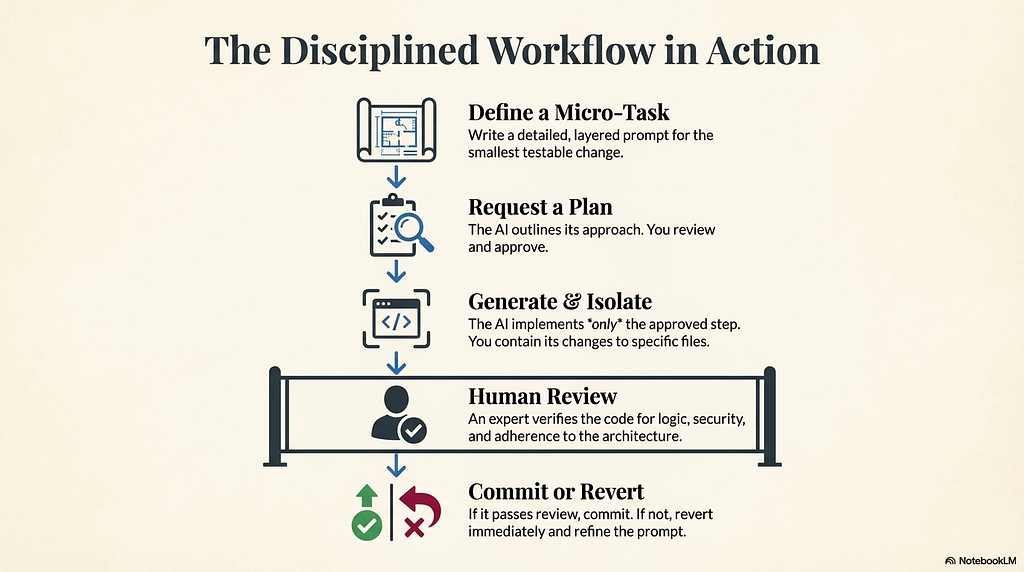
This productivity paradox isn’t a sign of the technology’s failure, but rather a signal that its effective use requires an entirely different, more disciplined approach. There is a common misconception that vibe coding is an unstructured, lazy process. In reality, effective, production-grade vibe coding requires a highly disciplined workflow that treats the AI as a junior teammate—one that is fast and capable but needs clear guidance to be effective.
The most effective “vibe coders” follow a rigorous set of best practices. This workflow often begins with creating a detailed project plan before writing a single prompt. Inside an AI-native IDE like Cursor or Antigravity, they establish “global rules” that act as guardrails. A crucial step is to prompt the AI to outline a step-by-step plan for any new feature and wait for human confirmation before it writes any code. Development then proceeds in “vertical slices,” building features from the database to the UI in focused, manageable chunks.
This structured approach is about precise orchestration, not abdication. It reinforces the idea that the most potent AI workflows are those where human intent and architectural vision are firmly in control.
This approach highlights a common recurring theme in this workflow: build a simple, solid foundation and increase add-on complexity in focused chunks.

4. The Biggest Risk Isn’t Just Bad Code, It’s the “Comprehension Gap.”
This need for discipline is critical because when it’s absent, the risks go far beyond simple bugs. The most insidious danger of AI-assisted development is the creation of a “comprehension gap”—a state in which teams deploy and maintain critical systems they do not fully understand. This turns parts of an application into a “black box,” making future development incredibly difficult and risky.
This risk is amplified by the rise of “Strategic Shadow IT,” a phenomenon in which business leaders use AI to prototype new features, creating an initial comprehension gap by embedding insecure code into a project’s DNA long before it reaches a formal development lifecycle. The Veracode 2025 report found that 45% of AI-generated code introduces security vulnerabilities, which are exponentially harder to fix when the underlying logic is opaque. This comprehension gap then metastasizes into “Dark Debt,” a hidden liability that threatens the long-term maintainability and security of software in a way that simple bugs do not.
This isn’t just a new flavor of technical debt; it’s a systemic risk to the coherence and integrity of our software systems, built one un-inspected AI suggestion at a time.
5. It’s Fundamentally Changing What It Means to Be a Developer
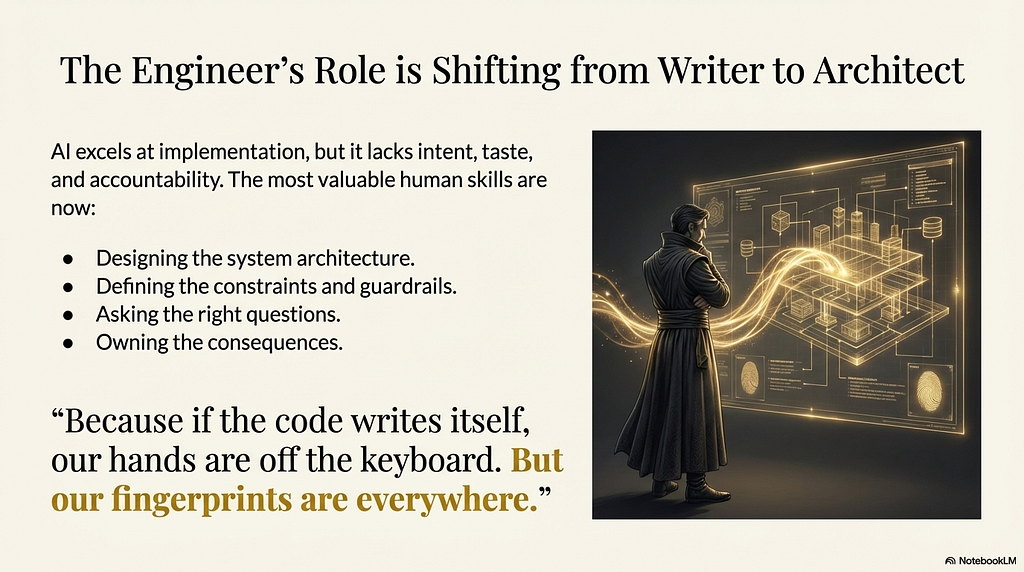
The consequences of this “Dark Debt” directly reshape the modern developer’s core responsibilities. As AI handles more of the low-level, line-by-line implementation, the very definition of a software developer is evolving from a hands-on coder to a high-level system architect and AI orchestrator. The value an experienced developer provides is moving up the stack.
In this new paradigm, a developer’s most critical skills become “conceptual understanding, product vision, and design taste.” The work involves less time writing boilerplate and more time refining requirements, validating AI-generated plans, and testing assumptions. More importantly, the developer becomes the ultimate owner of system understanding — the primary bastion against the “Comprehension Gap” and the “Dark Debt” it creates. Their most crucial function is to ensure the AI builds the right features in the right way.
This shift underscores a critical principle of the agentic era: the quality of the output depends entirely on the quality of the input. In a world where code generation is cheap, the human judgment that guides it becomes priceless.
As a developer, if you put energy into figuring out the proper context and prompt (the question), you will get a good answer. Using AI a good developer will make quality code faster, but a bad one will make badly design code faster too.
Conclusion: The Real Vibe Shift
The rise of “vibe coding” is not just about a new set of tools that make developers faster. It is a profound paradigm shift that, contrary to the hype, demands more discipline, greater architectural ownership, and a deeper form of human engagement. It is powering enterprise innovation at scale, but it can also slow down experts. It appears effortless, yet its successful application demands more rigor, not less.
The organizations that thrive will be those that treat AI not as a replacement for engineering talent, but as a force multiplier that places an even greater premium on human judgment and architectural wisdom. The real vibe shift isn’t just about coding; it’s about what we value in the people who build our digital world.
In an age where anyone can generate code, how will we define and value actual engineering expertise in the decade to come?
For this reason, new developers should be architects. We are offering a new workshop on software architecture and design. If you are interested, follow this link.
https://devhack.co/academy-ai/arquitectura-software/index.html
References:
- Karpathy, A. (2025). Original Definition of Vibe Coding. A social media post introducing the paradigm where a developer “gives in to the vibes” and “forgets that the code even exists,” shifting focus toward high-level intent.
- METR (2025). Impact of AI on Experienced Developer Productivity. A study finding that seasoned developers using AI tools took 19% longer to complete complex tasks, despite perceiving themselves as 20% faster.
- Veracode (2025). GenAI Code Security Report. A comprehensive analysis showing that 45% of AI-generated code samples introduce security vulnerabilities, including critical flaws like SQL injection.
- OX Security (2025). The “Army of Juniors” Effect Report. An analysis of over 300 repositories that identified 10 critical anti-patterns in AI-generated code, such as “Comments Everywhere” and the systematic avoidance of necessary refactors.
- Willison, S. (2025). Vibe Engineering vs. Vibe Coding. A framework distinguishing between using AI as a “typing assistant” (where the human understands every line) versus true “vibe coding” (where code is accepted without full comprehension).
- Google DeepMind (2025). Introducing Google Antigravity. Documentation for the first agent-first development platform designed to orchestrate multiple autonomous agents working across the editor, terminal, and browser simultaneously.
- Duran, L. D. (2025). Friction, Flow, and the Potential Deskilling Effect of Vibe Coding. An ethical research paper exploring the risk of technical and moral deskilling caused by material disengagement from code.
- Y Combinator (2025). Winter Batch Statistics. A report revealing that 25% of startups in the Winter 2025 cohort possess codebases that are 95% AI-generated.
- Python Software Foundation / Hitchhiker’s Guide (2025). Common Python Gotchas. A guide to recurring logical errors AI often replicates in Python, specifically the misuse of mutable default arguments.
- StatusNeo (2025). The Evolution of VibeOps. An analysis of the operational extension of vibe coding into DevOps, where AI agents manage deployment and infrastructure through natural language prompts.
Thank you for reaching the end of this article. Remember to visit our website, devhack.co, and leave your comments on what topics you want us to delve into. See you next time! Chao chao!
Visit my social networks:
- https://devhack.co/
- https://twitter.com/jggomezt
- https://www.linkedin.com/in/jggomezt/
- https://www.youtube.com/devhack
The Vibe Coding Paradox: 5 Surprising Truths About the AI Revolution in Software was originally published in Google Cloud – Community on Medium, where people are continuing the conversation by highlighting and responding to this story.
Source Credit: https://medium.com/google-cloud/the-vibe-coding-paradox-5-surprising-truths-about-the-ai-revolution-in-software-ee56a82ee655?source=rss—-e52cf94d98af—4
About the Author