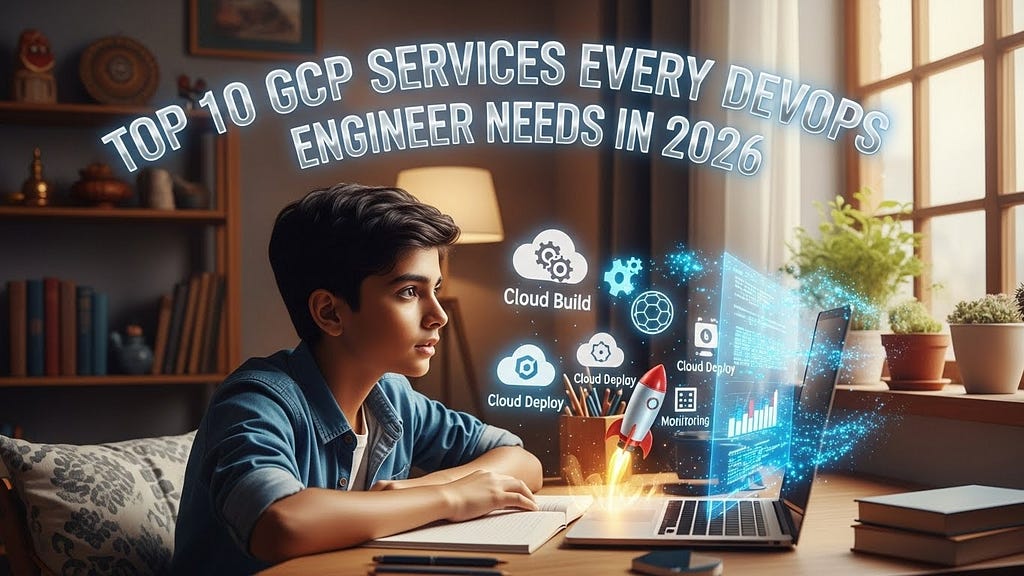
Top 10 GCP Services Every DevOps Engineer Needs in 2026 : Observability to Automation
Introduction
DevOps engineers on Google Cloud Platform (GCP) face mounting pressure to deliver secure, scalable applications faster while maintaining rock-solid reliability amid AI-driven workloads and global regulations. In 2026, the best teams leverage GCP’s serverless CI/CD, Kubernetes-native tools, and unified observability to automate everything from code commits to incident response.
This comprehensive guide details the top 10 GCP services forming the ultimate DevOps toolkit, optimized for Indian enterprises and global operations. Expect detailed architectures, best practices, integrations, and real-world patterns to build future-proof pipelines.
Why GCP Dominates DevOps in 2026
GCP excels for DevOps due to its native Kubernetes origins, serverless defaults, and deep AI/observability integrations that reduce toil by up to 70%.
Key advantages include autoscaling infrastructure, policy-as-code security, and cost controls via FinOps-ready billing APIs. For regions like India, GCP’s Mumbai and Delhi zones ensure low-latency compliance with DPDP Act standards through granular IAM and encryption.
Modern stacks prioritize GitOps, zero-trust security, and AIOps for predictive scaling — trends accelerating in 2026.
1. Cloud Build: Serverless CI/CD Core
Cloud Build powers automated builds, tests, and deployments across languages like Java, Go, Node.js, and Python, scaling to hundreds of concurrent jobs without servers.
Core features: YAML-defined pipelines, GitHub/Cloud Source Repositories triggers, and built-in vulnerability scanning via Container Analysis. Integrate with Artifact Registry for image pushes and Cloud Deploy for rollouts.
Production pattern: Trigger builds on merge to main; parallelize unit tests, security scans, and image builds; promote to staging via approvals. Costs drop 50% with caching and preemptible workers.
India-specific tip: Use asia-south1 regions for sub-50ms Mumbai latencies in CI/CD for BFSI apps.
2. Google Kubernetes Engine (GKE): Container Orchestration King
GKE, Google’s managed Kubernetes, handles cluster provisioning, upgrades, and scaling with Autopilot mode eliminating node management.
Standouts: Automatic node upgrades, Workload Identity for secretless pods, and Istio integration for service mesh. GKE Enterprise adds Anthos for hybrid/multi-cloud.
DevOps workflow: Deploy via Helm charts from Cloud Build; use Horizontal Pod Autoscaler (HPA) with custom metrics from Cloud Monitoring. Achieve 99.99% uptime with multi-zone clusters.
Best practice: Enable Binary Authorization for policy-enforced image pulls, blocking vulnerabilities pre-deployment.
3. Cloud Deploy: Progressive Delivery Mastery
Cloud Deploy automates safe rollouts to GKE, Cloud Run, or VMs with canary, blue-green, and multi-stage strategies.
Key capabilities: Skaffold integration for local dev-to-prod parity, render YAML from configs, and pause points for manual gates. Rollbacks happen in seconds via job history.
Pipeline integration: Chain from Cloud Build — build image, push to registry, deploy to dev/staging/prod sequentially. Reduce MTTR by 80% with automated promotions.
4. Artifact Registry & Container Registry: Secure Artifact Management
Artifact Registry stores Docker images, Helm charts, and package managers (npm, Maven) with vulnerability scanning and geo-replication.
Why essential: Immutable tags, fine-grained IAM, and automatic cleanup policies prevent supply chain attacks. Migrate from deprecated Container Registry for multi-format support.
Usage: Cloud Build pushes signed images; GKE pulls only from authorized repos. Integrate with Binary Authz for air-gapped security.
Cost hack: Regional repositories in Mumbai cut egress fees for India-based teams by 30%.
5. Cloud Operations Suite: Unified Observability Pillar
Formerly Stackdriver, this suite unifies metrics, logs, traces, and dashboards across GCP, on-prem, and multi-cloud.
Pillars: Cloud Monitoring (SLOs, alerts), Logging (centralized queries), Trace (distributed request paths), Profiler (CPU/memory hotspots). AIOps features predict incidents via ML.
DevOps loop: Alert on >500ms p95 latency → trigger Cloud Functions for autoscaling → log remediation actions. Export to BigQuery for long-term analysis.
India edge: Low-cost Logging buckets in asia-south1 for high-volume app logs from Mumbai datacenters.
6. Cloud Monitoring & Logging: Proactive Alerting Engine
Cloud Monitoring dashboards track CPU, custom metrics, and uptime checks; Logging indexes petabytes for SQL-like queries.
Advanced: Uptime probes for global endpoints, anomaly detection, and notification channels (Slack, PagerDuty). Group logs by severity for noise reduction.
Automation: Alerts invoke Eventarc → Cloud Run functions for auto-remediation like pod evictions.
Pro tip: SLO definitions ensure 99.9% commitments, with burn rates alerting on reliability debt.
7. Cloud Functions & Cloud Run: Serverless Automation
Cloud Functions (Gen2) for event-driven scripts; Cloud Run for containerized microservices with autoscaling to zero.
DevOps power: Eventarc triggers on Monitoring alerts, Git pushes, or Pub/Sub; deploy via Cloud Build. Run handles concurrent requests at <1s cold starts.
Pattern: Function scales GKE nodes on high load; Run hosts webhooks for CI/CD extensions.
8. Terraform & Cloud Deployment Manager: IaC Standards
Terraform (via GCP provider) declaratively manages resources; Deployment Manager for YAML-based GCP-only IaC.
Best for DevOps: State locking in Cloud Storage, modules for reusable VPCs/GKEs, and plan/apply workflows in Cloud Build.
Secure practice: Remote state with encryption; integrate with OPA/Gatekeeper for policy checks. Drift detection prevents config rot.
9. IAM & Cloud Asset Inventory: Zero-Trust Security
IAM enforces least-privilege with workload identity federation; Asset Inventory catalogs all resources for audits.
Essentials: Service accounts for workloads, Access Context Manager for contextual policies, VPC Service Controls for data exfiltration blocks.
Pipeline guardrails: Bind roles in Cloud Build; scan for over-privileged accounts via Forseti or Policy Analyzer.
Compliance for India: Align with DPDP via audit logs exported to BigQuery for residency proofs.
10. Eventarc & Cloud Scheduler: Event-Driven Orchestration
Eventarc routes events from 100+ sources (Audit Logs, Storage) to Functions/Run; Scheduler handles cron jobs.
Unlocks AIOps: Pub/Sub fanout for multi-target alerts; dead-letter queues for resilience.
Advanced flow: Monitoring alert → Eventarc → Function scales resources → Scheduler rechecks post-action.
Integrated DevOps Architecture Overview
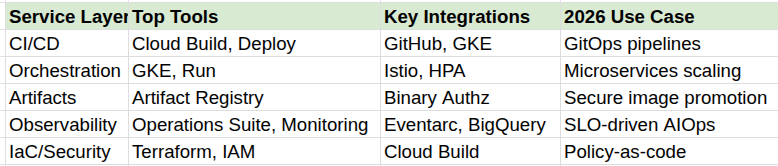
This stack automates 90% of deployments, cuts MTTR to minutes.
Best Practices for GCP DevOps Mastery
- GitOps everything: Store manifests in Git; Cloud Deploy renders and applies.youtube
- SRE alignment: Define SLOs in Monitoring; automate toil reduction.
- FinOps integration: Tag resources; use Billing APIs in dashboards for cost alerts.
- Multi-region resilience: Replicate artifacts; use global load balancers.
- AIOps shift: Leverage Vertex AI on logs for anomaly prediction.
Essential Skills Roadmap
Master these for 2026: CKAD cert, Terraform Associate, GCP Professional DevOps Engineer. Focus on GitHub Actions + Cloud Build hybrids, eBPF tracing in GKE, and policy engines like Kyverno.
FAQ: GCP DevOps Essentials
What replaces Jenkins in GCP DevOps 2026?
Cloud Build for serverless CI, with Cloud Deploy for advanced CD — faster, cheaper, integrated.
GKE vs. Cloud Run for workloads?
GKE for stateful/long-running; Run for HTTP/event-driven serverless.
How to achieve zero-downtime deploys?
Blue-green via Cloud Deploy + GKE rolling updates with readiness probes.
Terraform state security?
Remote backend in encrypted Cloud Storage buckets with IAM conditions.
Ready to automate? Start with a Cloud Build trigger today — scale your DevOps career on GCP.
Connect with me on LinkedIn if you need any guidance!
Top 10 GCP Services Every DevOps Engineer Needs in 2026 : Observability to Automation was originally published in Google Cloud – Community on Medium, where people are continuing the conversation by highlighting and responding to this story.
Source Credit: https://medium.com/google-cloud/top-10-gcp-services-every-devops-engineer-needs-in-2026-observability-to-automation-04c08ad5f233?source=rss—-e52cf94d98af—4
About the Author