When I started experimenting with parallel tool calling in Agent Development Kit (ADK), I assumed the takeaway would be straightforward: lower latency and a more responsive agent.
That part held true. But what I didn’t expect was how much parallelism would act as a diagnostic tool for my architecture.
When Parallelism Removes the Safety Net
When tools are called sequentially, it’s easy to hide architectural debt. Everything “works” because execution order masks poor design choices:
- Context Dependency: Tool B quietly expects Tool A to have already updated the conversation context.
- Shared State Mutation: One tool changes a global variable that another tool relies on five seconds later.
- Leaky Logic: The agent relies on the timing of execution rather than the logic of the request.
Parallel execution removes that safety net. Once tools run concurrently, any hidden coupling becomes a race condition.
Tools as Contracts, Not Just Functions
Parallel tool calling reframes tools as strict contracts. For a tool to be “parallel-safe,” it needs to be:
- Atomic: It does one thing completely.
- Idempotent: Running it doesn’t cause unexpected side effects if triggered alongside others.
- Independent: It has no implicit dependencies on the “neighboring” tool in the same turn.
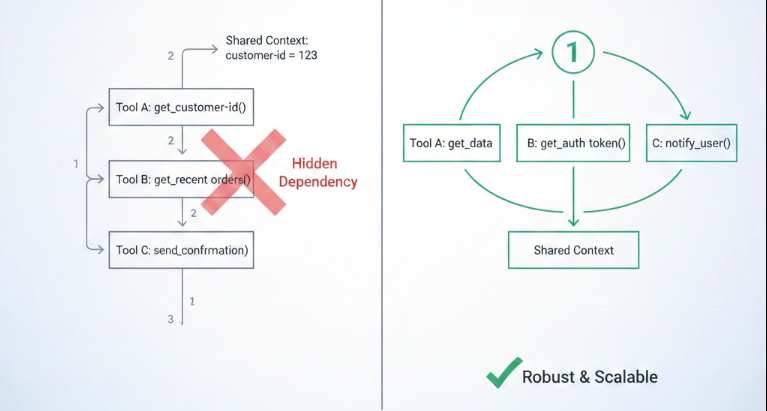
If two tools cannot safely run at the same time, you have to ask a hard question: Is this actually a tool, or is it part of the agent’s control flow? If Tool B needs Tool A’s output, that sequencing belongs in the orchestrator, not buried in the tool implementation.
Latency was the Hook — Design was the Discovery
The performance gains were the initial goal, but the clarity was the real prize. It forced me to revisit my abstractions.
The “Aha” Moment: I realized I had a get_customer_id tool and a get_recent_orders tool. In a sequential world, the agent called them 1-2. In a parallel world, the second failed because the ID wasn't "ready" yet.
The Fix: I combined them into a single, robust get_customer_summary tool. The architecture became cleaner because the tools became more purposeful.
Why This Matters for Agent Evolution
As we move toward the Model Context Protocol (MCP) and complex Agent-to-Agent (A2A) handoffs, concurrency stops being an optimization and starts becoming a constraint.
Thinking about tools as parallel-safe units:
- Reduces Fragility: You stop building “brittle” agents that fail if the model decides to reorder its thoughts.
- Honest Abstractions: It forces a clear boundary between what the tool does and what the agent knows.
Closing Reflection
Parallel tool calling is often introduced as a performance feature.
In practice, it’s also a design lens — one that quickly reveals how clean (or tangled) your abstractions really are.
And sometimes, that architectural clarity turns out to be more valuable than the latency improvement that led you there in the first place.
What Parallel Tool Calling Revealed About My Agent Design was originally published in Google Cloud – Community on Medium, where people are continuing the conversation by highlighting and responding to this story.
Source Credit: https://medium.com/google-cloud/what-parallel-tool-calling-revealed-about-my-agent-design-7bd7e0f5f523?source=rss—-e52cf94d98af—4
About the Author