
👋 A Bit of Backstory
I’ve spent the last few months head-down in enterprise workflow automation, and honestly? It’s been a reality check. I realized halfway through a project that I was still stuck in a “command-and-control” mindset — building tools that just sit there waiting for a human to tell them exactly what to do. It’s a hard habit to break, but I’ve had to force myself to stop designing reactive tools and start thinking about autonomous partners that actually understand the mess of systems we deal with every day.
📘 The “NexusAgent” Concept
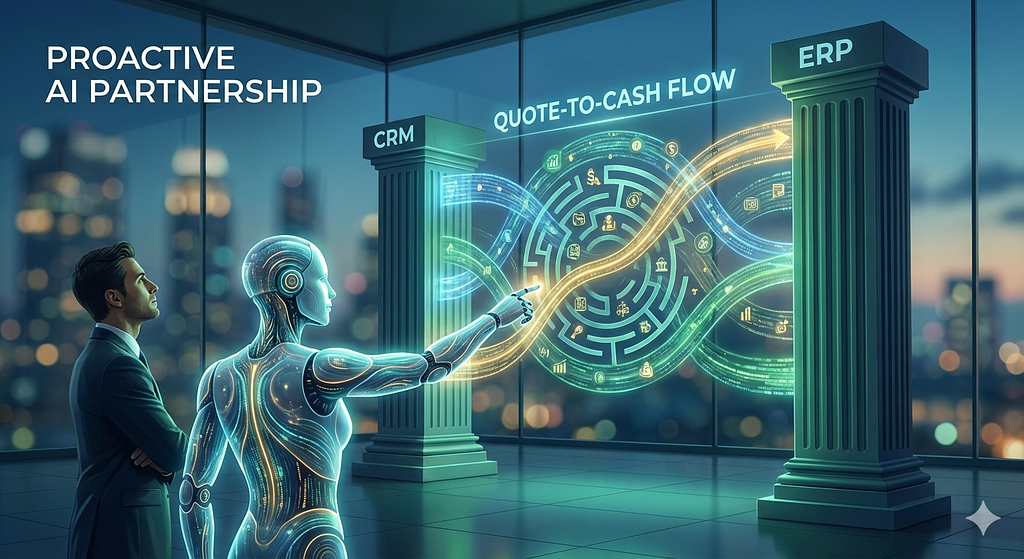
To make this concrete, let’s look at something I call NexusAgent. It’s a theoretical orchestrator for the “Quote-to-Cash” cycle — the stuff that happens between a salesperson closing a deal in Salesforce and the operations team fulfilling it in SAP. Usually, a human has to jump between five tabs to make this happen. NexusAgent lives between those systems, connecting the dots so the human doesn’t have to.
💡 The Problem: We’re Stuck in “Search Bar” Thinking
For a long time, our relationship with software has been transactional. You type a query, you get a table. You click “Update,” a record changes. It’s basically just a digital filing cabinet where the human still does 90% of the heavy lifting.
But we’re moving past that. We’re entering the era of the Proactive Partner.
With NexusAgent, I stopped asking the system to “show me a list” and started asking it to “help me win”. That might sound like marketing fluff, but it’s actually a massive technical shift. It means the AI isn’t just fetching data; it’s looking for the finish line.
🛣️ The Mental Shift: How I’m Changing My Approach
Building an “agentic” architecture isn’t about using a shinier model; it’s about changing how you think as a developer.
1. Focus on the “Why,” Not Just the “What”
In traditional dev, the goal is often: “Fetch the opportunities”. In an agentic mindset, the goal is: “The user needs to close deals today”.
If a user asks, “How’s my day looking?”, a basic bot might just pull a calendar. An Agentic Partner should see that as a cue to check the whole pipeline, look for credit risks in the ERP, and find the “path of least resistance” to get things moving before the user even realizes there’s a bottleneck.
2. Partners, Not Just Routers
A lot of early AI implementation was just “routing” — sending Step A to System X. That’s not enough. We should be building Autonomous Partners.
NexusAgent shouldn’t just sit around waiting for a “Create Quote” command. It should be watching the environment. If it sees a credit limit block in the ERP, it shouldn’t wait for a human to stumble upon it. It should flag the risk, suggest a fix, and draft the approval email to the manager while the salesperson is still finishing their coffee.
🏢 Real-World Use: The “Quote-to-Cash” Mess
If you’ve ever worked with Q2C, you know it’s a disaster of spreadsheets, CRM notes, and ERP IDs. It’s the perfect place to test this mindset.
By “agentifying” this, we move from copy-pasting data to intent-based execution:
- Actual Context: The agent understands that a product mentioned in a chat isn’t just text — it’s a specific Product Code that needs to map to a native Material ID for shipping.
- Smart Guardrails: It doesn’t just blast emails to everyone; it dynamically finds the right manager based on the user’s role and keeps sensitive data in the right channels.
🏆 The Real Win
The biggest win for us as developers in 2026 isn’t going to be writing a 1,000-line API connector. It’s going to be this Mindset Shift.
When we stop building tools that wait for orders and start building partners that understand the mission, we create something actually useful. The code is just how we get there; the intent is what matters.
The goal isn’t just to automate tasks — it’s to give people their time back so they can do work that actually matters.
I’m still figuring some of this out as I go. If you’re building something similar, I’d love to hear how you’re handling the transition.
🚀 The Agentic Mindset: Engineering Autonomous Partners, Not Just Fancy Chatbots was originally published in Google Cloud – Community on Medium, where people are continuing the conversation by highlighting and responding to this story.
Source Credit: https://medium.com/google-cloud/the-agentic-mindset-engineering-autonomous-partners-not-just-fancy-chatbots-df3a1ab75271?source=rss—-e52cf94d98af—4
About the Author