Are you getting the most out of your AI coding assistant, or are you burning context and tokens on trial-and-error?
Building production-grade software with Claude Code isn’t about throwing long prompts at an LLM. It’s about Agentic Engineering—structuring your workflows, context, and guardrails so the agent executes with precision.
Here is your masterclass breakdown of the core principles every developer & AI practitioner needs to master:
🔑 Key Principles Preview:
1️⃣ Cost-Aware Effort Tuning
Default to Medium Effort for 80% of routine tasks. It gives you maximum intelligence per token dollar without hitting expensive deep-reasoning loops.
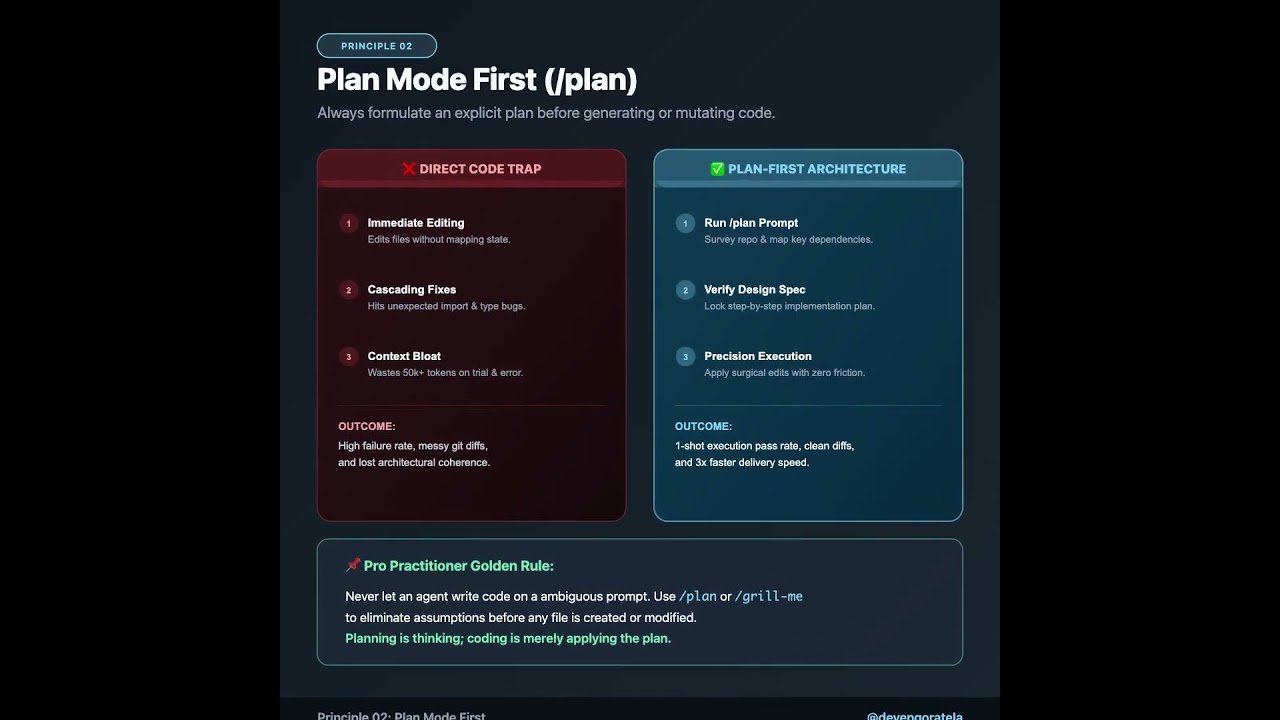
2️⃣ Plan Mode First (`/plan`)
Never let an agent write code on an ambiguous prompt. Decouple architectural planning from file generation to achieve 1-shot execution passes.
3️⃣ Persistent Context & `CLAUDE.md`
Anchor your lint rules, test commands, and safety boundaries in `CLAUDE.md`. Every subagent session inherits this memory automatically.
4️⃣ The 4 Loop Engineering Pillars
Reliable autonomous agent loops require 4 pillars: Trigger, Task Scope, Deterministic Success Check, and Data Log. Without empirical verification, agents will hallucinate success on broken builds.
5️⃣ Dynamic Subagent Fan-Out
Protect your primary conversation context by delegating heavy doc search, code exploration, and test verification to parallel subagent workers.
💬 Which Claude Code principle has had the biggest impact on your AI workflow? Let’s discuss in the comments below!
#ClaudeCode #AIEngineering #AgenticAI #SoftwareDevelopment #DeveloperTools #AIAutomation #TechLeadership #CodingBestPractices #BuildInPublic
Video Source
About the Author