Anthropic’s Fable 5.1 model embeds a subtle, machine-readable watermark in every text output it generates.
If you rely on raw AI output for publishing, documentation, or client work, compliance regulators can now detect it with statistical certainty.
Swipe through the carousel to see how it works under the hood and how to cleanly scrub it:
📌 Inside this carousel:
1. The EU AI Act Mandate: Why frontier AI labs (Anthropic, OpenAI, Google) signed binding watermarking compliance agreements.
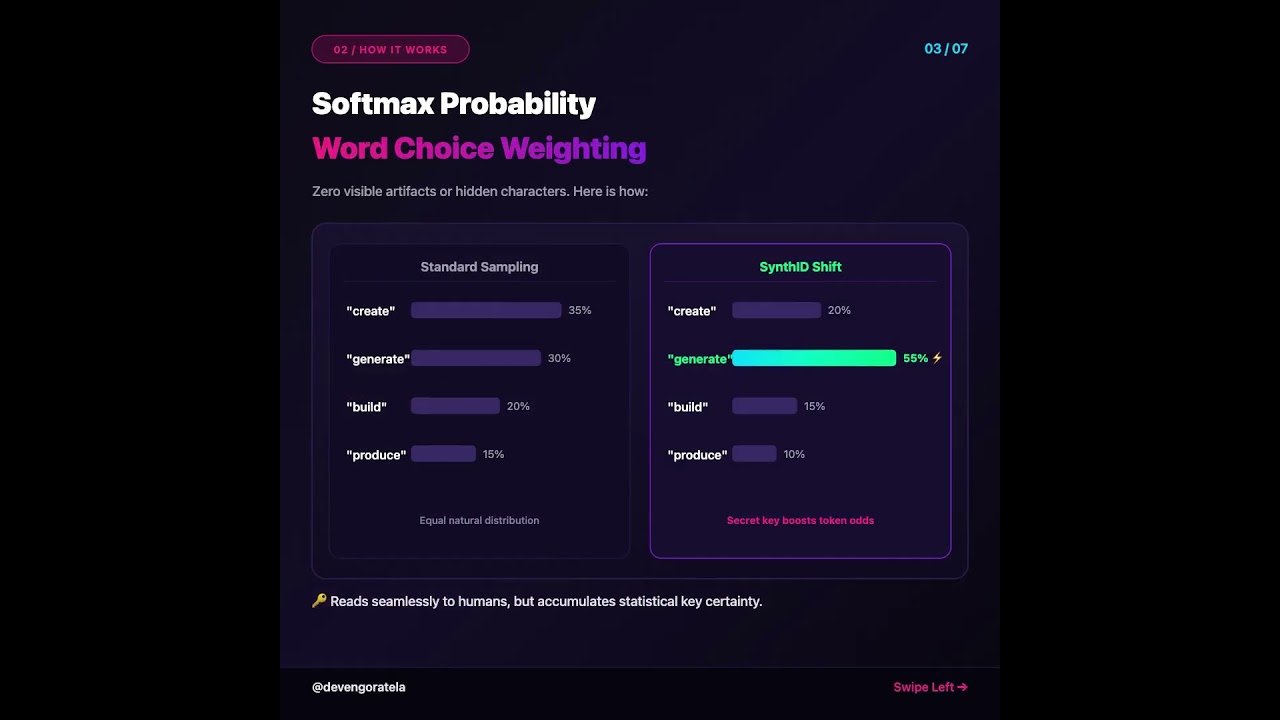
2. Softmax Probability Weighting: How Google SynthID tournament watermarking shifts word choice odds without visible artifacts or special code characters.
3. The AI Detector Myth: Why public detectors (ZeroGPT, Turnitin) remain blind while secret key holders verify output with 99.9% precision.
4. Sample Size Thresholds: Why short posts ( less than 100 words) remain inconclusive while long-form posts ( greater than 500 words) carry permanent signatures.
5. The Removal Pipeline: How running Claude outputs through open-source local LLMs via Ollama completely resets word frequency distributions cleanly.
Key Takeaway for AI Engineers & Creators:
Light human editing (swapping 10-20% of adjectives) fails to erase statistical tournament watermarks on long text. Running a local LLM rewrite pipeline completely decouples your text from cloud compliance keys while preserving 100% of original depth and meaning.
♻️ Repost this to help your network understand how AI watermarking actually works under the hood!
➕ Follow Deven Goratela (https://www.linkedin.com/in/devengoratela/) for daily actionable insights on AI engineering, local LLMs, and automation pipelines.
#ArtificialIntelligence #Claude #LocalLLM #Ollama #AIEngineering #SynthID #AIAutomation #TechTrends #ContentPipeline
Video Source
About the Author