Building Cloud AI Copilots: Multi-Agent Systems on Google Cloud Run with Gemini 2.5, ADK, and the A2A Protocol
The Problem: DevOps Complexity is Real
If you’ve ever managed Kubernetes clusters in production, you know the drill. You’re juggling multiple terminals, switching between kubectl commands, checking Grafana dashboards, and diving into GCP billing reports to understand why your cloud bill jumped 30% last month.
The reality? Most DevOps tasks require expertise across multiple domains:
- Kubernetes orchestration
- Cloud cost optimization
- Security and compliance
- Observability and monitoring
What if we could have specialized AI agents handle each domain — and let them collaborate when needed?
That’s exactly what I built for the Google Cloud Run Hackathon.
Introducing Cloud AI Copilots
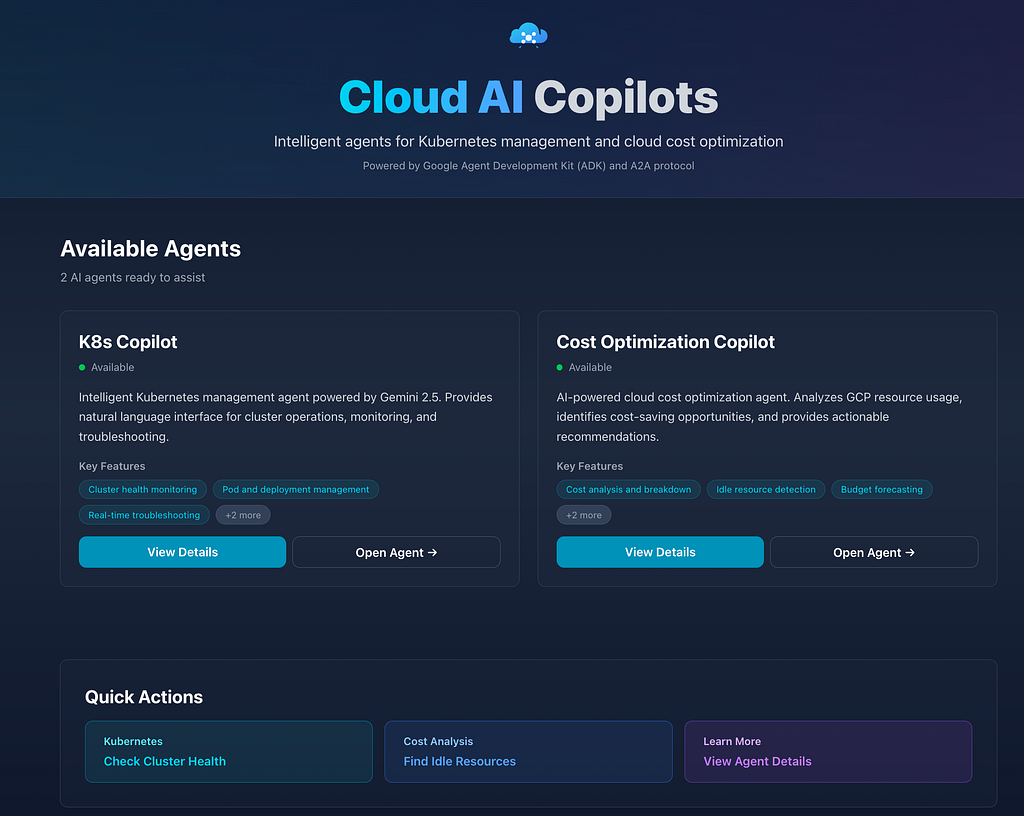
Cloud AI Copilots is a multi-agent platform powered by Google’s Agent Development Kit (ADK) and Gemini 2.5 Flash, deployed entirely on Cloud Run. Think of it as having a team of expert DevOps engineers available 24/7 through natural language conversation.
The platform consists of three services:
- K8s Copilot — Your Kubernetes management expert
- Cost Optimization Copilot — Your cloud cost analyst
- Copilot Dashboard — A unified interface to interact with both agents
But here’s what makes it special: these agents can talk to each other using Google’s A2A (Agent-to-Agent) protocol.
Architecture: Serverless Multi-Agent System
Let me break down the technical architecture:
User → Dashboard (Cloud Run)
         ↓
    ┌────┴────┐
    ↓         ↓
K8s Copilot  Cost Copilot (both on Cloud Run)
    ↕         ↕
    A2A Protocol (Agent Collaboration)
    ↓         ↓
  GKE API   GCP Billing API
Each service runs independently on Cloud Run:
- Auto-scales from 0 to 3 instances
- 512Mi memory, single CPU
- Deployed in europe-west1
- Docker images stored in Artifact Registry
- Secrets managed via Google Secret Manager
CI/CD Pipeline: GitHub → Cloud Build → Artifact Registry → Cloud Run
The Magic: Agent-to-Agent Communication
Here’s where things get interesting. The A2A protocol enables agents to discover and communicate with each other seamlessly.
Example workflow:
You ask K8s Copilot:
“Are there any pods consuming excessive resources that might be increasing our costs?”
What happens behind the scenes:
- K8s Copilot recognizes this query spans both Kubernetes and cost domains
- It discovers Cost Copilot via the A2A protocol (/.well-known/agent-card.json)
- K8s Copilot queries the Kubernetes API for resource usage
- It sends the data to Cost Copilot via A2A protocol
- Cost Copilot analyzes the financial impact
- Both agents collaborate to provide a comprehensive answer
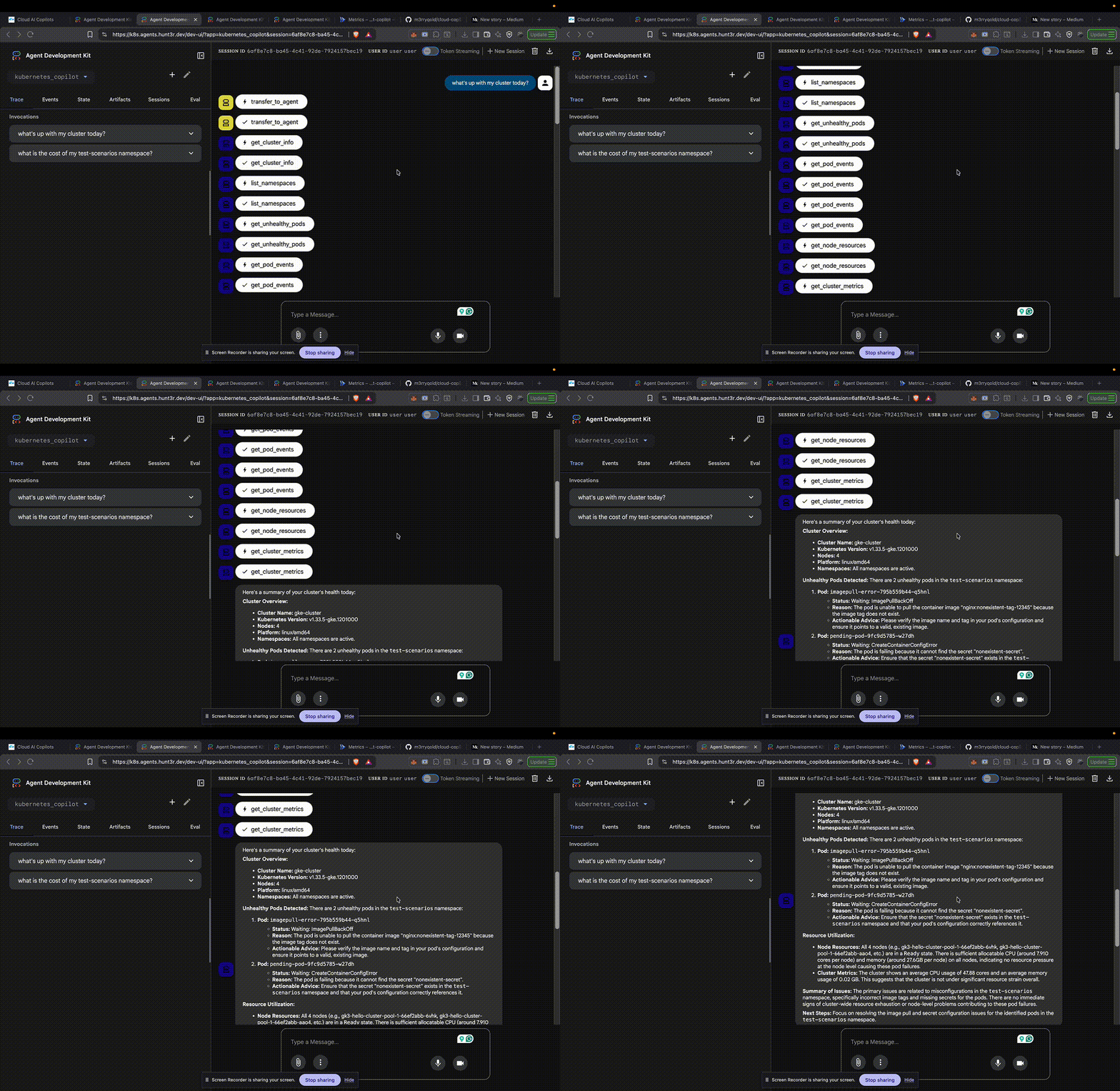
This is true multi-agent collaboration — not just multiple chatbots, but specialized agents working together.
Tech Stack Deep Dive
Backend (Python):
- Google ADK — Framework for building production-grade AI agents
- Gemini 2.5 Flash — Fast, efficient LLM for real-time responses
- Kubernetes Python Client — Direct API access to GKE clusters
- GCP Billing API — Real-time cost data retrieval
- Uvicorn — High-performance ASGI server
Frontend (TypeScript):
- TanStack Start — Modern full-stack React framework with SSR
- React 19 — Latest version with improved performance
- TypeScript — Type safety throughout
- Tailwind CSS — Rapid UI development
- shadcn/ui — Beautiful, accessible components
Infrastructure:
- Cloud Run — Serverless container platform
- Artifact Registry — Docker image storage
- Secret Manager — Secure credential management
- Cloud Build — Automated CI/CD pipeline
Building the Agents: A Practical Guide
Let me walk you through building an AI agent with Google ADK:
Step 1: Define Your Agent’s Tools
from adk.tools import tool
from kubernetes import client, config
@tool
async def list_pods(namespace: str = "default") -> dict:
    """List all pods in a Kubernetes namespace."""
    config.load_kube_config()
    v1 = client.CoreV1Api()
    pods = v1.list_namespaced_pod(namespace)

    return {
        "namespace": namespace,
        "pods": [
            {
                "name": pod.metadata.name,
                "status": pod.status.phase,
                "cpu": pod.spec.containers[0].resources.requests.get("cpu"),
                "memory": pod.spec.containers[0].resources.requests.get("memory")
            }
            for pod in pods.items
        ]
    }
Step 2: Create Your Agent
from adk import Agent
from google import genai
agent = Agent(
    name="k8s-copilot",
    model="gemini-2.5-flash",
    tools=[list_pods, get_deployments, scale_deployment],
    system_instruction="""
    You are a Kubernetes expert assistant. Help users manage their
    clusters through natural language. Use the provided tools to
    query and modify cluster resources.
    """
)
Step 3: Enable A2A Protocol
from adk.servers import a2a_server
# Expose A2A endpoint
app = a2a_server(agent)
if __name__ == "__main__":
    import uvicorn
    uvicorn.run(app, host="0.0.0.0", port=8080)
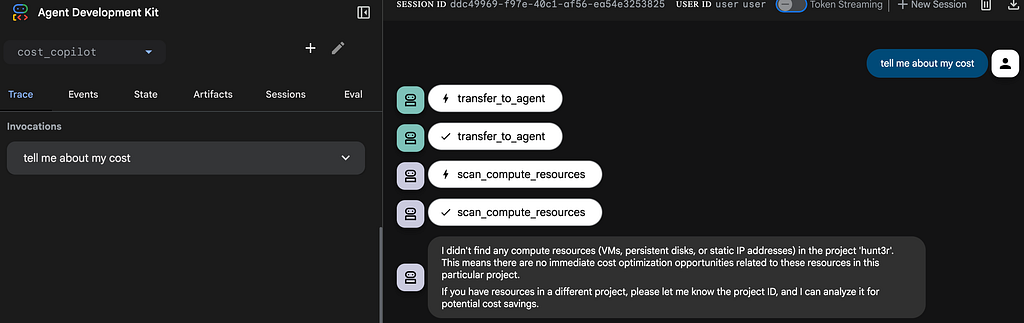
That’s it! Your agent now exposes the A2A protocol at /.well-known/agent-card.json.
Deployment: From Code to Cloud Run
The deployment process is fully automated with Cloud Build:
cloudbuild.yaml:
steps:
  # Build Docker image
  - name: 'gcr.io/cloud-builders/docker'
    args: ['build', '-t', 'europe-west1-docker.pkg.dev/$PROJECT_ID/k8s-copilot-repo/k8s-copilot:$COMMIT_SHA', '.']

  # Push to Artifact Registry
  - name: 'gcr.io/cloud-builders/docker'
    args: ['push', 'europe-west1-docker.pkg.dev/$PROJECT_ID/k8s-copilot-repo/k8s-copilot:$COMMIT_SHA']

  # Deploy to Cloud Run
  - name: 'gcr.io/google.com/cloudsdktool/cloud-sdk'
    args:
      - 'run'
      - 'deploy'
      - 'k8s-copilot'
      - '--image=europe-west1-docker.pkg.dev/$PROJECT_ID/k8s-copilot-repo/k8s-copilot:$COMMIT_SHA'
      - '--region=europe-west1'
      - '--platform=managed'
      - '--allow-unauthenticated'
Trigger deployment:
git push origin main
# Cloud Build automatically builds and deploys
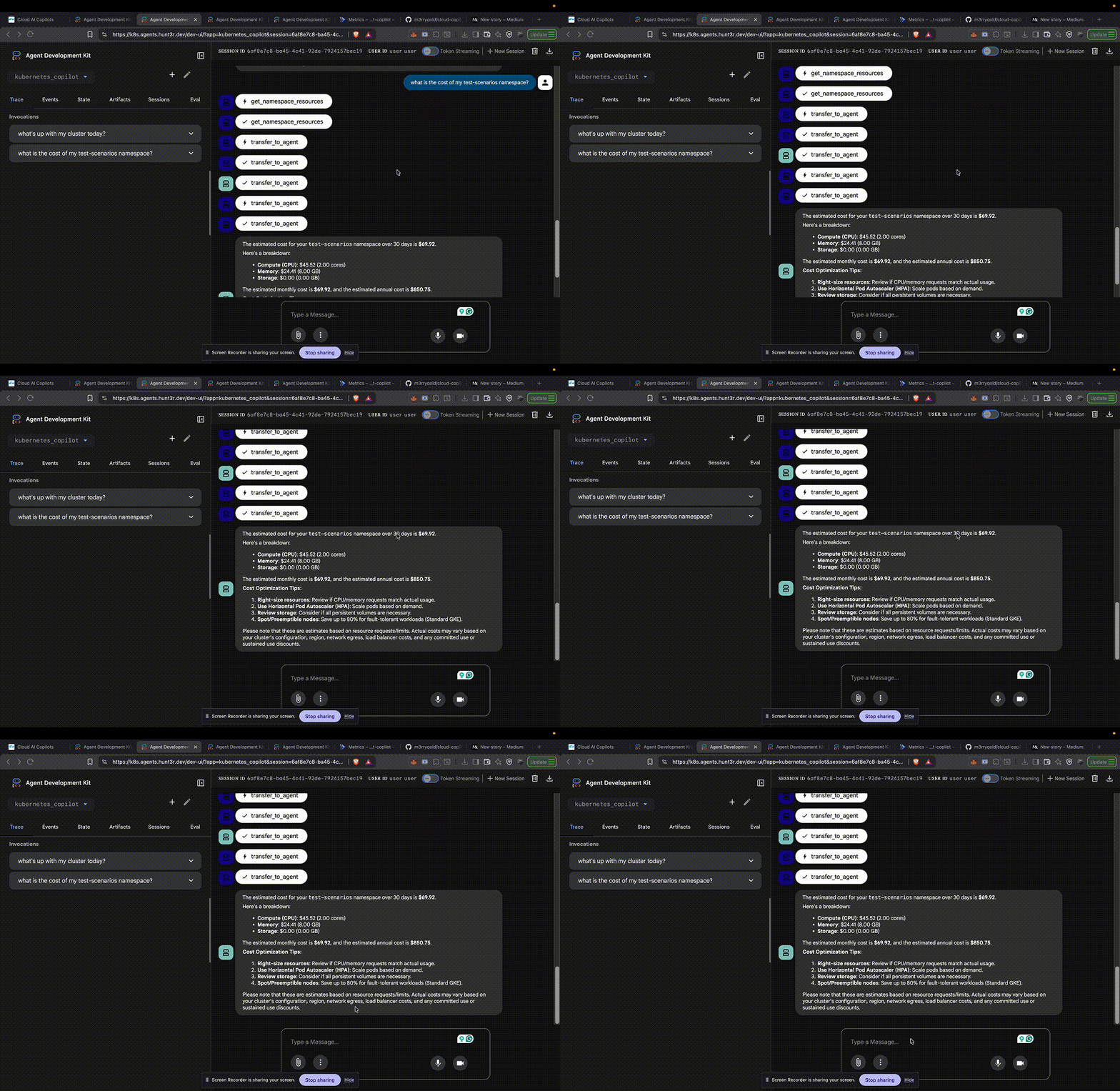
Challenges & Solutions
Challenge 1: Secret Management
Problem: Different agents need different secrets (kubeconfig, API keys)
Solution: Used Google Secret Manager with granular IAM permissions. Each Cloud Run service only mounts the secrets it needs.
Challenge 2: A2A Protocol Implementation
Problem: Limited examples of A2A protocol in production
Solution: Studied the spec thoroughly, implemented agent discovery, and tested cross-agent communication extensively.
Challenge 3: Cost Data Without BigQuery
Problem: Setting up BigQuery billing export requires org-level permissions
Solution: Used GCP Billing API and Cloud Asset Inventory for real-time cost data instead.
Performance & Cost Efficiency
Response Times:
- K8s Copilot: ~2–3 seconds for Kubernetes queries
- Cost Copilot: ~3–4 seconds for billing analysis
- A2A collaboration: +1–2 seconds overhead
Cost Breakdown (Monthly):
- Cloud Run (3 services, light usage): ~$5–10
- Gemini API calls (1M tokens): ~$0.10
- Artifact Registry storage: ~$1
- Secret Manager: ~$0.06
Total: ~$6–11/month for a production-ready multi-agent platform 🎉
Key Learnings
- Specialization > Generalization — Focused agents with domain expertise outperform general-purpose chatbots
- A2A is the future — Agent collaboration opens up entirely new possibilities
- Serverless = Cost-Efficient AI — Cloud Run’s auto-scaling keeps costs low
- Tools are everything — The quality of your agent’s tools determines its usefulness
- Static-first UIs — Pre-configured agent metadata beats dynamic discovery for UX
What’s Next?
Short-term:
- BigQuery billing export integration
- Multi-cluster support
- Conversation history
- Slack/Teams integration
Long-term:
- More specialized agents (Security, Observability, CI/CD)
- Agent orchestration for complex workflows
- Multi-cloud support (AWS, Azure)
- Open-source agent framework
Try It Yourself
The entire project is open source!
🔗 GitHub: [https://github.com/m3rryqold/cloud-copilot] 🎥 Demo Video: [https://youtu.be/RTIN7x1M5zI] 🚀 Live Demo: [https://agents.hunt3r.dev/] 🏆 Hackathon: [https://run.devpost.com/]
Quick Start:
git clone https://github.com/your-username/cloudcopilot
cd cloudcopilot
# Deploy to your GCP project
gcloud builds submit --config cloudbuild.yaml
Conclusion
Building Cloud AI Copilots taught me that the future of AI isn’t about building one giant model that does everything — it’s about creating specialized agents that collaborate to solve complex problems.
With Google ADK, the A2A protocol, and Cloud Run, we can now build production-grade multi-agent systems that are:
- ✅ Cost-efficient (serverless auto-scaling)
- ✅ Intelligent (Gemini 2.5 Flash)
- ✅ Collaborative (A2A protocol)
- ✅ Production-ready (Cloud Run + Secret Manager)
The question isn’t “Can AI agents replace DevOps engineers?”
The real question is: “How can AI agents augment DevOps teams to move faster and make better decisions?”
Cloud AI Copilots is my answer.
Connect & Discuss
I’d love to hear your thoughts on multi-agent systems and AI for DevOps!
💬 Comment below with your questions
Built something with Google ADK or the A2A protocol? Share your project — I’d love to check it out!
Building Cloud AI Copilots: Multi-Agent Systems on Google Cloud Run with ADK was originally published in Google Cloud – Community on Medium, where people are continuing the conversation by highlighting and responding to this story.
Source Credit: https://medium.com/google-cloud/building-cloud-ai-copilots-multi-agent-systems-on-google-cloud-run-with-adk-d4a2a18628e3?source=rss—-e52cf94d98af—4
About the Author