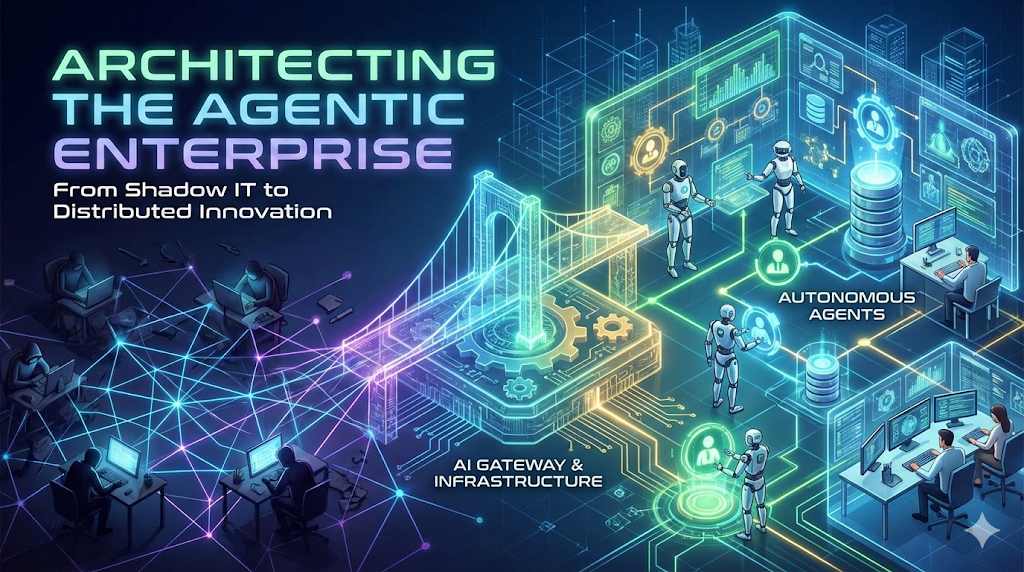
For years, we treated Shadow IT as a bug. In 2025, we need to treat it as a feature.
Your users aren’t just pasting text into chatbots anymore. They are building Autonomous Agents to automate complex work. It is a rational push for efficiency.
We are witnessing a distributed innovation lab emerging inside enterprises. The challenge for Data and Infra Engineers is not to block it, but to operationalize it. We need to build the infrastructure that turns this chaotic energy into a competitive advantage.
Here is how we engineer the stack for the Age of Agency.
From Chatbots to Build and Bring Your Own Agent
We have moved from passive chat to bring your own agent. Unlike a simple chatbot, an agent has three distinct engineering characteristics that change how we support them:
- Autonomy: They plan and execute multi-step workflows without human holding.
- Tool Use: They connect to APIs, databases, and browsers to get things done.
- Statefulness: They maintain long-term memory (Context Stores) to understand user intent over time.
Engineers need to see these as capabilities to support, not vulnerabilities to patch.
1. The Observability Upgrade
Traditional Application Performance Monitoring tools like Datadog are built for deterministic code. They track latency and errors. But an agent is probabilistic. It can return a “Success” while hallucinating a completely wrong answer.
To support agents, we must upgrade our stack from Metrics, Events, Logs, Traces to — adding the semantic dimension.
What to build:
- Cognitive Tracing: Log the Chain of Thought to see why the agent chose a specific tool.
- Token Economics: Track token usage per user to prevent cloud bill shock from inefficient loops.
- Model-as-a-Judge: Use smaller, cheaper models to score the output of your production agents for accuracy.
2. The AI Gateway
You cannot govern what you cannot see. But blocking AI traffic just pushes users to 4G hotspots.
The solution is the AI Gateway. This is a middleware layer that sits between your internal developers and external models. It acts as a unified entry and exit point.
Why Engineers love it:
- Unified Auth: The Gateway handles API keys. Developers don’t manage secrets, and you get full attribution for every request.
- Model Agnosticism: You abstract the backend. If you want to switch from Claude to Gemini to save money, don’t do it in the code.
- Governance as Code: You can enforce PII masking and rate limits programmatically in real-time.
3. The Human-in-the-Loop Flywheel
In a probabilistic system, 100% accuracy is impossible. We need to reframe compliance as Reliability Engineering.
This means implementing Human-in-the-Loop (HITL) workflows. But we don’t just do this for safety; we do it for data.
- The Workflow: When an agent’s confidence score drops (e.g., below 95%), it automatically routes the task to a human.
- The Flywheel: Every human correction becomes gold-standard training data.
This process, known as Reinforcement Learning from Human Feedback (RLHF), makes your agents smarter and more aligned with your specific business needs over time.
Build the Roads
The Shadow is only scary when it is unmanaged.
By growing necessarymuscles like AI Gateways, Semantic Observability, and Orchestration Platforms, or adopting platforms that provides those, we can give our teams the “Infrastructure of Trust” they need.
Let’s architect it together so we can run faster.
Architecting the Agentic Enterprise was originally published in Google Cloud – Community on Medium, where people are continuing the conversation by highlighting and responding to this story.
Source Credit: https://medium.com/google-cloud/architecting-the-agentic-enterprise-d2dce57e842b?source=rss—-e52cf94d98af—4
About the Author