A lesson about clear writing from a technical editor and contributor to the Google developer documentation style guide
Have you ever thought developer documentation felt a little too verbose, hard to understand, or perhaps even dead on arrival? The root cause might be zombies. This post covers how words become zombies, how they kill your writing, and how you can rid yourself of them, saving your readers in the process.
When words become zombies
First coined by Helen Sword, zombie nouns is a playful name for the more academic term nominalization. Originally referring to the grammatical process that transforms everything from verbs, adjectives, or even other nouns into abstract nouns, nominalization can also refer to the abstract nouns (or zombies) themselves. Some examples (in bold) include the following:
- perform → performance
- create → creation
- efficient → efficiency
- fail → failure
- configure → define the configuration of
- analyze → conduct an analysis of
- describe → provide a description about
- shut down → perform a system shutdown
Analyzing these examples, you’ll notice a few patterns. The process makes big words out of smaller ones and turns originally one-word verbs into wordy combos where the abstract noun does the heavy lifting. The result feels dense, lacking the vitality or spunk of the original.
How zombies kill your writing
Let’s explore the specifics of why zombies leave your writing feeling dead:
- Bigger words and wordiness: Nominalization and analogous grammatical processes can create big words and potentially wordier sentences. For example, verbs like “use” can transform into nouns like “usage” or “utilization,” and verbs like “benefit” can turn into a wordy jumbled phrase like “has a beneficial effect on.”
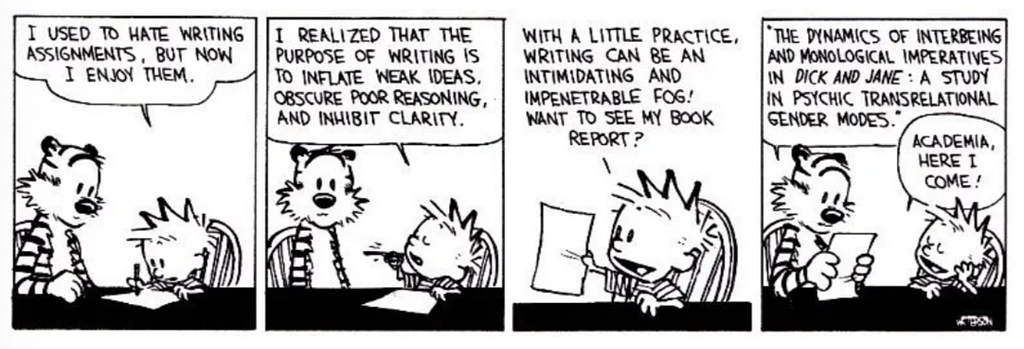
- Conceptually dense and indirect: Zombies affect the entire sentence: they remove human subjects or other concrete subjects and transform actions into abstract concepts, which can be more conceptually dense or harder to process. This process also makes your writing indirect. For example, suppose you change “You can optimize…” to “Optimization can…,” this seemingly simple change causes you to take a U-turn into abstraction or generalization, forgetting to speak directly to the user.
Watterson, Bill. The Complete Calvin and Hobbes. Andrews McMeel Publishing, 2005.
- Reduced readability and clarity: Zombie nouns also have a devastating effect on clarity and reading comprehension. The National Literacy Foundation found a clear association between nominalization overload and poorer readability, having a clear impact on Flesch Reading Ease and Flesch-Kincaid Grade Level scores. Consider this set of examples:
The implementation of new parking regulations will commence on July 1. Compliance with these regulations is mandatory to avoid penalties. The enforcement of these regulations will be monitored by the city authorities, and violations will result in fines. (12th grade reading level, difficult)
New parking rules start July 1. Please follow these rules to avoid penalties. City authorities will monitor these rules. If you break them, the City will fine you. (6th grade reading level, easy)
Both cover the same information, but the difference couldn’t be more obvious: one is dense and abstract, and the other is simple and clear. The 12th grade reading level example consists of complex sentences loaded with abstract nouns like “implementation” and “enforcement,” whereas the 6th grade reading example uses simple sentences with concrete subjects like “parking rules” and “City authorities.” The difference provides an important lesson to remember: If you overload your writing with zombies or sprinkle in a few too many terms, you’ll overwhelm the reader.
Ridding yourself of zombies
Let’s explore a few examples that illustrate how you can avoid using zombie nouns in technical writing. Consider these examples and read on to learn how to quickly spot and fix similar sentences.

You can probably spot a few things. Even when only one zombie shows up, the sentence quickly gets wordy. But, more often, the zombies come in packs and quickly multiply. It’s like a mass contagion event: zombies beget wordiness, which begets more zombies, which begets even more wordiness. But how do you prevent the vicious cycle? By knowing how to spot the signs:
- Suffixes like “-ment,” “-ure,” “-nce,” “-tion,” “-ing,” “-ity,” or “-ness.”
- Weak verbs like “perform,” “provide,” “facilitate,” or “conduct” in combination with zombies.
- Sentences that lack a clear human subject or other concrete subject.
After you spot the signs, the rest comes easy. Turn the zombie back into the verb, adjective, or noun that it should be, remove the weak verbs, and add back the human or other concrete subject where appropriate.
Not leaving your readers for the undead
Nominalization is a powerful tool of English grammar that lets us express complex, abstract ideas like “intelligence,” “inference,” and “authentication,” words essential for documenting the latest technologies. But it’s when your sentence gets overloaded with complex nominalizations like “facilitation,” “utilization,” and “implementation” that you have a problem.
Remember, for all their benefits, zombie nouns can distract you from what really should be your primary goal, writing for the reader. Even though the technology may be complex, your writing doesn’t have to be. Here’s some key takeaways from this post:
- Write to express, not to impress: Don’t fall for the lie that big words and long sentences make you look smart. Use simple words and concise language to keep your message clear.
- Say it with a verb (or adjective): Let verbs be verbs and adjectives be adjectives. There’s no need to turn everything into an abstract concept, noun phrase, or term.
- Find and replace: Scan your docs for suffixes like “-tion,” “-ity,” “-ness,” “-ment,” and “-nce” and verbs like “conduct,” “facilitate,” and “provide” and make the appropriate substitutions.
Want to learn more about technical writing style at Google? Check out the Google developer documentation style guide.
References
- Grey, Ivy B. and Kate Callahan. “How to Spot Nominalizations and Transform Them into Active Verbs,” Wordrake.com.
- Lythgoe, Trent. “Army Writing and the Zombie (Noun) Apocalypse,” Modern War Institute at Westpoint. Published March 22, 2024.
- Pinker, Steven. “Linguistics, Style and Writing in the 21st Century,” The Royal Institution (YouTube). Posted October 28, 2015.
- Scoot, Briant. “Unlocking Readability: The Hidden Pitfalls of Nominalizations,” readabilityformulas.com. Published January 24, 2025.
- Sword, Helen. “Zombie Nouns,” The New York Times (online). Published July 23, 2012.
- Sword, Helen. “Beware of nominalizations (AKA zombie nouns),” TED-Ed (YouTube). Posted October 31, 2012.
About the author
Isaac is a technical editor at Google who works on content for the Cloud Security services and helps maintain the Google developer documentation style guide. Passionate about creating superior content experiences, Isaac enjoys sharing his knowledge about language and grammar to help technical writers and other content creators create a frictionless documentation experience for Google customers.
When writing, beware of zombies! was originally published in Google Cloud – Community on Medium, where people are continuing the conversation by highlighting and responding to this story.
Source Credit: https://medium.com/google-cloud/when-writing-beware-of-zombies-f6450726a9be?source=rss—-e52cf94d98af—4
About the Author