I Built an Agent Skill for Google’s ADK — Here’s Why Your Coding Agent Needs One Too
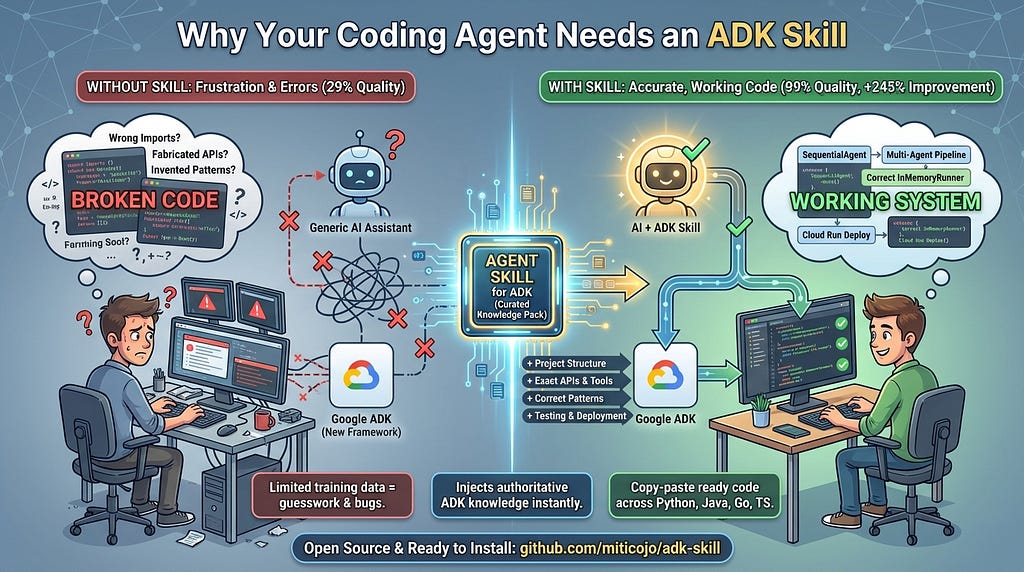
If you’ve tried asking your AI coding assistant to build something with Google’s Agent Development Kit (ADK), you’ve probably noticed the results are… rough. Wrong imports, fabricated APIs, invented patterns that don’t exist. That’s because ADK is relatively new, and LLMs simply don’t have reliable knowledge of its specifics baked into their training data.
I built an Agent Skill to fix that — and the difference is dramatic.
What Are Agent Skills and What Is ADK?
Google’s Agent Development Kit (ADK) is an open-source framework for building AI agents powered by Gemini models. It supports Python, Java, Go, and TypeScript, and provides a clean architecture for single-agent and multi-agent systems with built-in tool integration, state management, orchestration patterns, and deployment options.
Agent Skills are a new open standard (agentskills.io) that lets you give your coding agent — Claude Code, Gemini CLI, Codex, Cursor, or any compatible tool — deep, structured knowledge about a specific domain. Think of them as a curated knowledge pack: when you mention ADK in your prompt, the skill activates and your agent suddenly knows the exact imports, project structure conventions, tool patterns, testing APIs, and deployment commands.
The ADK Skill I built packages everything an agent needs to produce correct, copy-paste-ready ADK code across all four supported languages.
Install It in 10 Seconds
The fastest way to get started depends on your coding agent:
Claude Code (one command):
claude mcp add-skill https://github.com/miticojo/adk-skill/tree/main/adk-skill
Gemini CLI / Antigravity:
git clone https://github.com/miticojo/adk-skill.git
cp -r adk-skill/adk-skill ~/.gemini/skills/        # Gemini CLI
cp -r adk-skill/adk-skill ~/.gemini/antigravity/skills/  # Antigravity
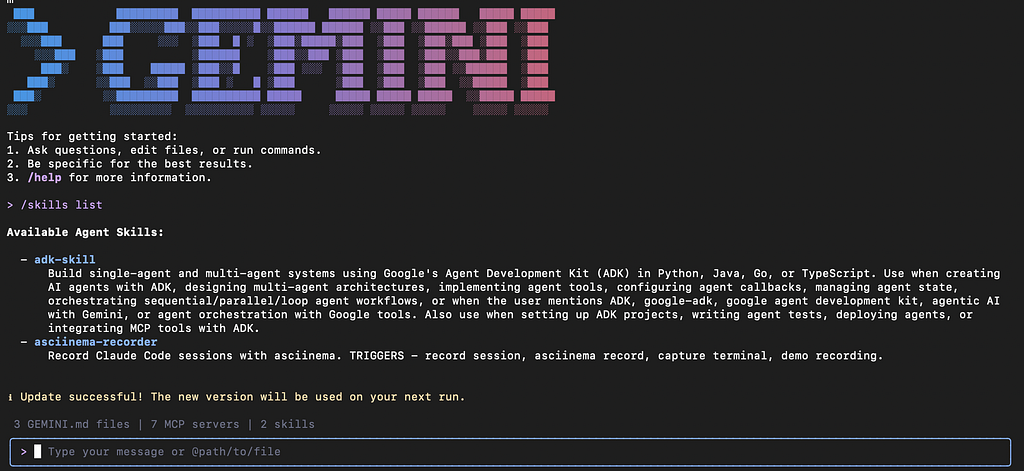
Codex / Cursor / Windsurf / OpenCode — same idea, just copy the adk-skill/ folder into your agent's skills directory (.codex/skills/, .cursor/skills/, etc.). Full instructions in the README.
Once installed, the skill activates automatically whenever you mention ADK, multi-agent architectures, agent tools, testing, deployment, or any related topic.
What the Skill Actually Knows
The skill is structured as a main file (SKILL.md) with on-demand reference files for deeper topics:
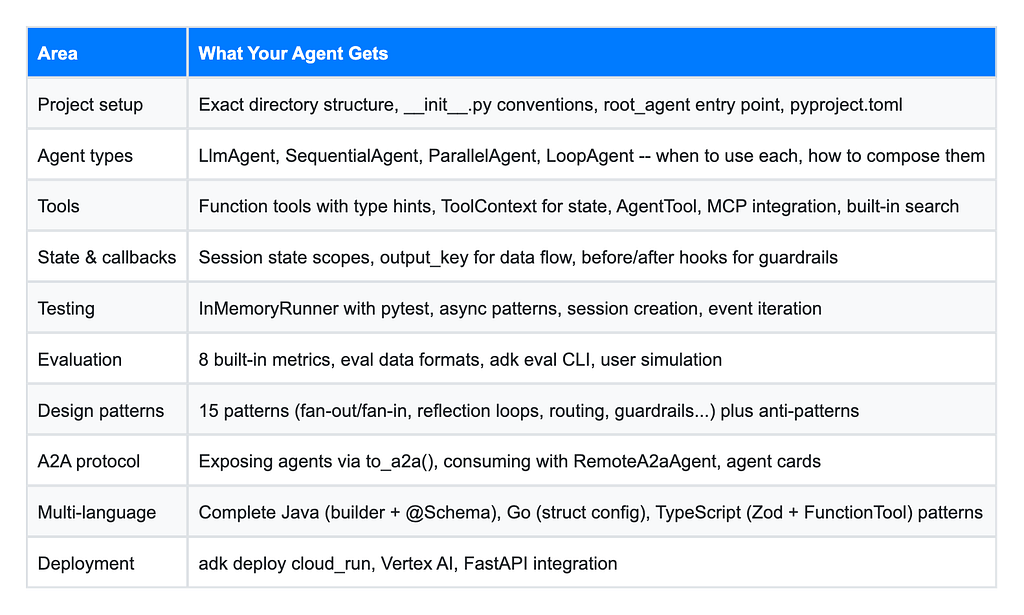
The skill also links to the latest official ADK documentation and ADK samples repository for anything beyond its scope.
The Real Question: Does It Actually Help?
Yes — and the numbers are stark.
I tested by giving the same 8 ADK prompts to an LLM with and without the skill, scoring each response on correctness, completeness, ADK-specific accuracy, and actionability (1–5 scale).
The headline number: +245% improvement
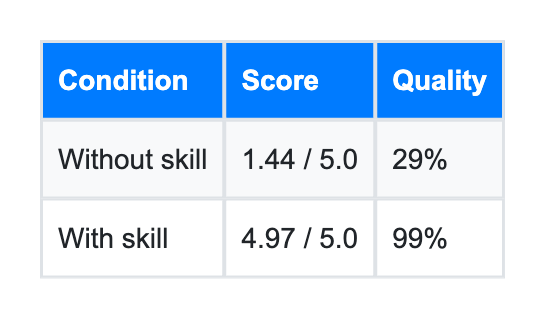
Let me break down what that looks like in practice.
Without the skill: “Build a multi-agent pipeline”
The LLM invents a .pipe() chaining API that doesn't exist, manually passes output between agents with function calls, misses SequentialAgent entirely, and produces code that won't run.
With the skill: same prompt
The agent uses SequentialAgent with sub_agents=[researcher, writer, editor], each agent writes to shared state via output_key, the downstream agent reads from state['research'] in its instruction, and the code runs on first try.
The gaps are widest where it matters most
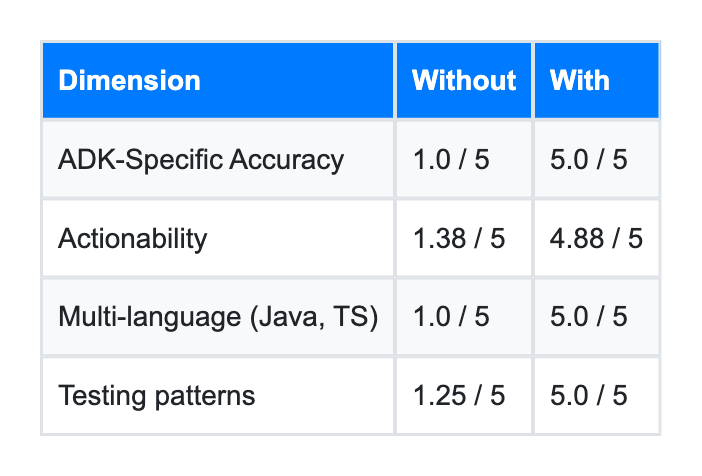
Without the skill, the LLM produces the wrong InMemoryRunner pattern, fabricates Java annotations, guesses TypeScript package names, and generates code that fails on import. With the skill, every example is copy-paste ready.
Design patterns made the biggest architectural difference
In a separate test focused on complex architecture (multi-source parallel research with validation, error handling, and user review), the design patterns reference transformed the output:
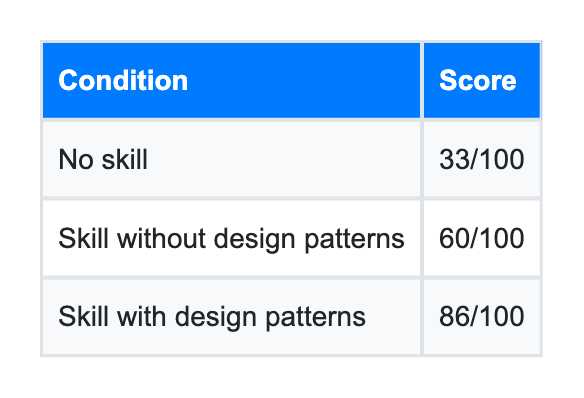
The biggest jumps: architecture correctness (4 -> 9), anti-pattern avoidance (2 -> 9), structured output (1 -> 9). Without design patterns, the agent produces a single “God Agent” monolith. With them, it builds properly composed multi-agent pipelines using fan-out/fan-in, layered fallback, model tiering, and structured data flow.
Try It, Break It, Improve It
The skill is open source under MIT license: github.com/miticojo/adk-skill
I’d love for you to install it and put it through its paces. Some things I’m particularly interested in feedback on:
- New patterns you need — Are there ADK workflows or patterns the skill doesn’t cover well? Open an issue.
- Language coverage — The Go SDK patterns are the thinnest. If you’re building ADK agents in Go, your contributions would be especially valuable.
- Edge cases — Try the weirdest ADK prompt you can think of and see if the skill helps. If it doesn’t, that’s a bug.
- Your own agents — If you build something cool with ADK + this skill, I’d love to hear about it.
Contributing is straightforward: the entire skill is markdown. No build system, no dependencies, no tests to run. Edit SKILL.md or the reference files, make sure SKILL.md stays under 500 lines, and open a PR.
Wrapping Up
LLMs are incredibly capable general-purpose tools, but they hit a wall with newer frameworks like ADK. Agent Skills bridge that gap by giving your coding agent authoritative, structured knowledge exactly when it needs it. The result: code that actually works, patterns that are actually correct, and a dramatically faster development experience.
The ADK Skill takes an LLM from 29% quality on ADK tasks to 99%. That’s the difference between spending your afternoon debugging fabricated APIs and shipping a working multi-agent system.
Give it a try: github.com/miticojo/adk-skill
Happy agent coding!
[Additional credits: this skill was built with Claude Code and Claude Opus 4.6]
I Built an Agent Skill for Google’s ADK — Here’s Why Your Coding Agent Needs One Too was originally published in Google Cloud – Community on Medium, where people are continuing the conversation by highlighting and responding to this story.
Source Credit: https://medium.com/google-cloud/i-built-an-agent-skill-for-googles-adk-here-s-why-your-coding-agent-needs-one-too-e5d3a56ef81b?source=rss—-e52cf94d98af—4
About the Author