📿 The Beads Memory System: Technical Architecture and Integration with Gemini CLI for Agentic Workflows
Audio Track(10m): https://www.youtube.com/watch?v=O_UrPKy3Xu8
The landscape of artificial intelligence in software engineering is undergoing a fundamental shift from simple code assistance to autonomous agentic workflows. However, a persistent challenge remains in the inherent “amnesia” of large language models, frequently described as the “50 First Dates” problem. Agents often lose critical context between discrete sessions, resulting in redundant work or a total loss of project direction. Beads, a lightweight and git-backed issue tracker designed by Steve Yegge, provides a persistent and structured memory layer that travels with the source code, effectively upgrading the cognitive capacity of coding agents. For technical leadership and engineering teams utilizing the Gemini CLI, Beads serves as the central nervous system for long-horizon planning and execution.
Technical Philosophy and the Problem of Agentic Amnesia
The primary motivation for the development of Beads stems from the limitations of current agentic workflows that rely heavily on unstructured markdown files for planning. While agents are proficient at generating initial six-phase plans, they struggle to maintain the “implicit stack” of their decision-making process once work begins. As sessions progress, agents encounter edge cases, sub-tasks, and bugs that were not part of the original spec. In traditional markdown-based workflows, these discoveries are often lost or create conflicting documents, leading to what is described as “agentic dementia”.
Beads addresses this by replacing verbose and ambiguous prose with a machine-readable dependency-aware graph. This shift from “parsing prose” to “querying structured data” reduces the cognitive load on the agent, allowing it to spend more tokens on implementation and less on orienting itself. The core philosophy is that an agent should never have to guess what is next; the system should provide a deterministic and unblocked queue of work.
Comparisons of Issue Tracking Paradigms
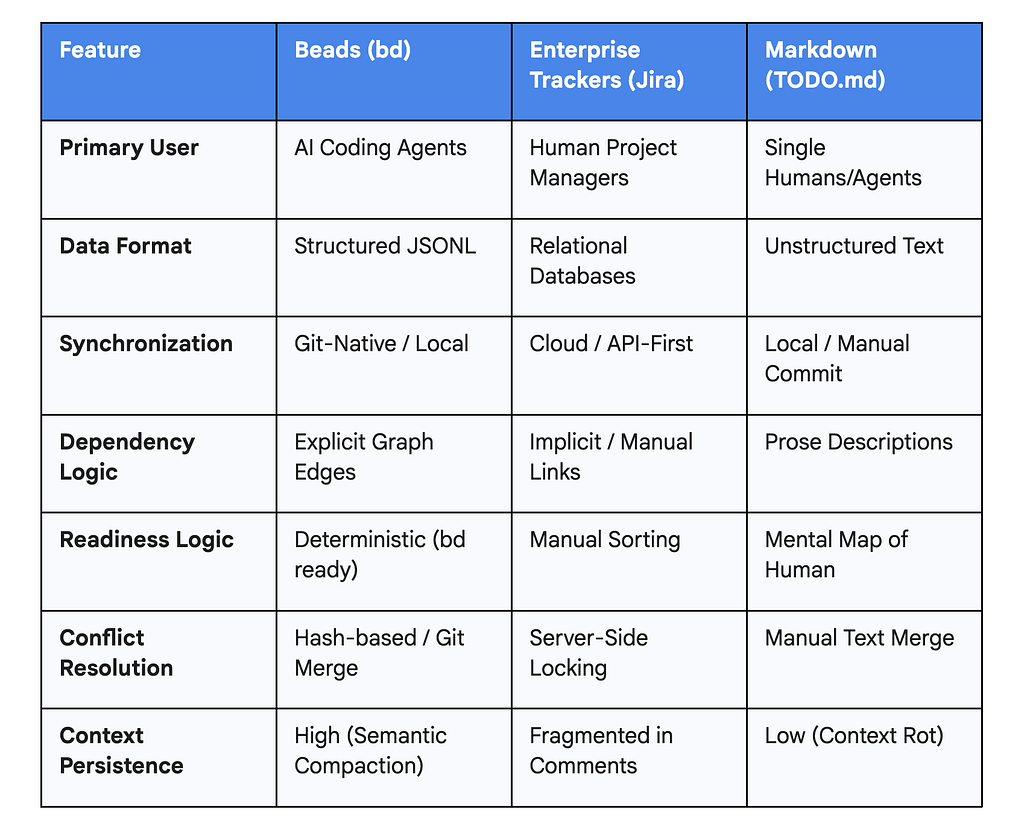
The following table highlights the distinctions between Beads and traditional human-centric trackers or markdown-based methods often used in early AI workflows.
The Architectural Blueprint: SQLite, JSONL, and Git
The architecture of Beads is a distributed and serverless system that balances performance with portability. It avoids the latency of centralized cloud services by utilizing the local filesystem and the existing git infrastructure of the project. The system employs a three-tier storage strategy to ensure data integrity across multi-agent and multi-branch environments.
Local Performance via SQLite
At the execution layer, Beads utilizes a SQLite database located at .beads/beads.db. This database acts as a high-speed queryable cache, enabling the bd CLI to calculate complex dependency traversals and filter tasks quickly. Because the SQLite binary is machine-specific, it is typically excluded from version control via .gitignore, serving strictly as a local performance optimization.

Portability and Source of Truth via JSONL
The primary source of truth for synchronization is the .beads/issues.jsonl file. Storing issue data in a line-delimited JSON format ensures that each task is a single entry, making it exceptionally safe for git-based merging. When an agent or human updates a task, the change is written to the SQLite database and then exported to the JSONL file. This format is both human-readable for debugging and machine-parseable for agents that may not have direct access to a database driver.
Synchronization and the Background Daemon
To manage the interaction between these layers, Beads runs a background daemon. This process uses Unix Socket RPC (or loopback TCP on Windows) to communicate with the CLI tool. The daemon provides several critical functions:
- Automatic Import/Export: It watches the filesystem for changes to the JSONL file and automatically hydrates the local SQLite database.
- Debounced Writes: To reduce disk I/O and git noise, the daemon batches updates and exports to JSONL with a 30-second debounce period.
- Concurrency Management: It handles file locking and coordinates access in environments where multiple agents may be attempting to write to the database simultaneously.
Installation and Initialization for Development Environments
Beads is a system-wide utility rather than a project-level dependency. It is installed once and utilized across all repositories on a developer’s machine.
Installation Protocols
The installation process varies slightly depending on the operating system but is generally streamlined via script or package manager:
- macOS and Linux (Homebrew): The command brew install beads is the recommended method.
- Cross-Platform (npm): For Node.js environments, npm install -g @beads/bd provides a global installation.
- Windows (PowerShell): Installation is achieved via a dedicated PowerShell script.
- Go-Native: Developers can use go install github.com/steveyegge/beads/cmd/bd@latest to compile the binary directly.
Project Bootstrapping
Once the binary is available, a project is initialized by running bd init in the root directory(Gemini CLI can do it for you). This command creates the necessary .beads metadata folder and prompts for the user's role—either maintainer or contributor.
Technical leads should be aware of the “Stealth Mode” feature. Running bd init –stealth allows a developer to use Beads for personal task tracking on a shared project without committing any .beads files to the repository. This is particularly useful for individual contributors on legacy codebases.
The Data Model: Hierarchy, Priority, and Graph Edges
Beads is built on a dependency-aware graph that dictates the execution order of software development tasks.
Issue Hierarchy and Naming Conventions
The system supports hierarchical task management through dot-delimited IDs, allowing for clear parent-child relationships:
- Epic (e.g., app-a1b2): A high-level feature or project milestone.
- Task (e.g., app-a1b2.1): A discrete piece of work required for the epic.
- Sub-task (e.g., app-a1b2.1.1): A granular technical step or fix.
The use of hash-based IDs prevents collisions when multiple agents work in parallel on different git branches.
Semantic Dependency Types
The relationships between issues are the “edges” of the graph. Beads utilizes four specific types:
- Blocks: A strict prerequisite where Task A must be closed before Task B is “ready”.
- Parent-Child: A hierarchical link where an epic blocks its children until initial planning is complete.
- Related: A context-only link providing relevant technical history.
- Discovered-from: A critical audit trail link. When an agent finds a bug while implementing a feature, it links the new issue to the current task, capturing the “provenance” of the work.
The Ready Engine and Prioritization
The bd ready command is the core mechanism for agent orientation. It programmatically filters the database to return only the tasks that are open and have zero open blockers. Tasks are further sorted by a 5-level priority scale (critical through backlog), eliminating the need for constant human triage.
Integration with Gemini CLI and MCP
For users of the Gemini CLI, the integration of Beads is essential for transforming the tool into a stateful coding partner.
MCP Server Implementation
The beads-mcp server acts as the interface between the Gemini CLI and the local bd tools. Developers can configure this by adding the Beads server to their Gemini CLI configuration (usually in ~/.gemini/settings.json). A standard configuration entry involves defining the transport mechanism—typically stdio—and pointing to the beads-mcp executable. Once connected, the Gemini agent can invoke Beads tools natively, such as calling beads__ready() to find unblocked work.
The Gemini Beads Extension
Alternatively, the gemini-beads extension can be installed to provide a tailored experience within the terminal. This extension wraps the bd binary and provides a GEMINI.md context file that instructs the agent on specific workflow requirements, such as how to claim tasks.
Context Injection via AGENTS.md
A key component of integration is briefing the agent on the tracking system. Adding a single line to an AGENTS.md or CLAUDE.md file—such as "Use 'bd' for task tracking"—is often the minimum requirement to activate planning capabilities. Advanced setups use bd prime to inject a state summary directly into the agent's initial context window.
Strategic Workflows: From Design to “Landing the Plane”
Effective use of Beads necessitates a disciplined workflow that separates planning from execution.
Phased Implementation Strategy
- Iterative Planning: Developer and agent collaborate on a high-level design (e.g., feature_spec.md).
- Filing Issues: The agent translates the design into Beads epics and issues.
- Dependency Alignment: Agent creates graph edges (e.g., migrations blocking functional updates).
- Focused Execution: Agent tackles one bd ready task at a time. Between tasks, the agent process is restarted with Beads serving as the "external RAM".
The “Landing the Plane” Hygiene Protocol
At the end of every session, the developer must instruct the agent to “land the plane”. This mandatory cleanup ensures the repository and task tracker remain synced:
- File Follow-ups: Create issues for work discovered but not addressed.
- Quality Gates: Run all project tests and linters.
- Update States: Close completed issues and add progress notes.
- Synchronize: Export the database to JSONL and stage changes.
- Push to Remote: Perform a git pull –rebase followed by a git push.
- Handoff: Generate a prompt for the next session to minimize orientation time.
Advanced Maintenance and System Diagnostics
As a project grows, technical leads must ensure the health of the Beads system using the bd doctor utility. This tool identifies broken git hooks, schema migrations, and circular dependencies.
Compaction and Semantic Memory Decay
When history accumulates, the bd compact command implements a graceful “memory decay.” Details of old closed tasks are summarized or removed from the active tracking file to improve agent speed, while the full history remains accessible in the git repository.
Multi-Agent Coordination and Concurrency
In “Agent Village” scenarios, Beads integrates with tools like beads-village to provide:
- Atomic Claiming: Using bd update –claim to prevent multiple agents from starting the same task.
- File Locking: Reserving specific files before beginning an edit.
- Messaging: Using special issue types for asynchronous agent communication.
Community Tooling and Extensibility
The Beads ecosystem includes several community-built interfaces:
- beads_viewer (Go): A high-performance terminal interface with tree navigation.
- bsv (Rust): A two-panel TUI for rapid triage.
- beads-kanban-ui: A web-based Kanban board.
- jira-beads-sync: Middleware for institutional project management synchronization.
Conclusion
The Beads memory system offers a robust, git-native solution for the persistent challenge of agentic amnesia. By utilizing a hybrid storage model of SQLite and JSONL, it provides a distributed framework for task management that aligns with modern version control. For teams using the Gemini CLI, this combination enables a new level of autonomous coding capability and project continuity.
📿 The Beads Memory System: Technical Architecture and Integration with Gemini CLI for Agentic… was originally published in Google Cloud – Community on Medium, where people are continuing the conversation by highlighting and responding to this story.
Source Credit: https://medium.com/google-cloud/the-beads-memory-system-technical-architecture-and-integration-with-gemini-cli-for-agentic-c2aa36430802?source=rss—-e52cf94d98af—4
About the Author