There you go — you’ve allowed your workload to scale to and from zero based on an external metric.
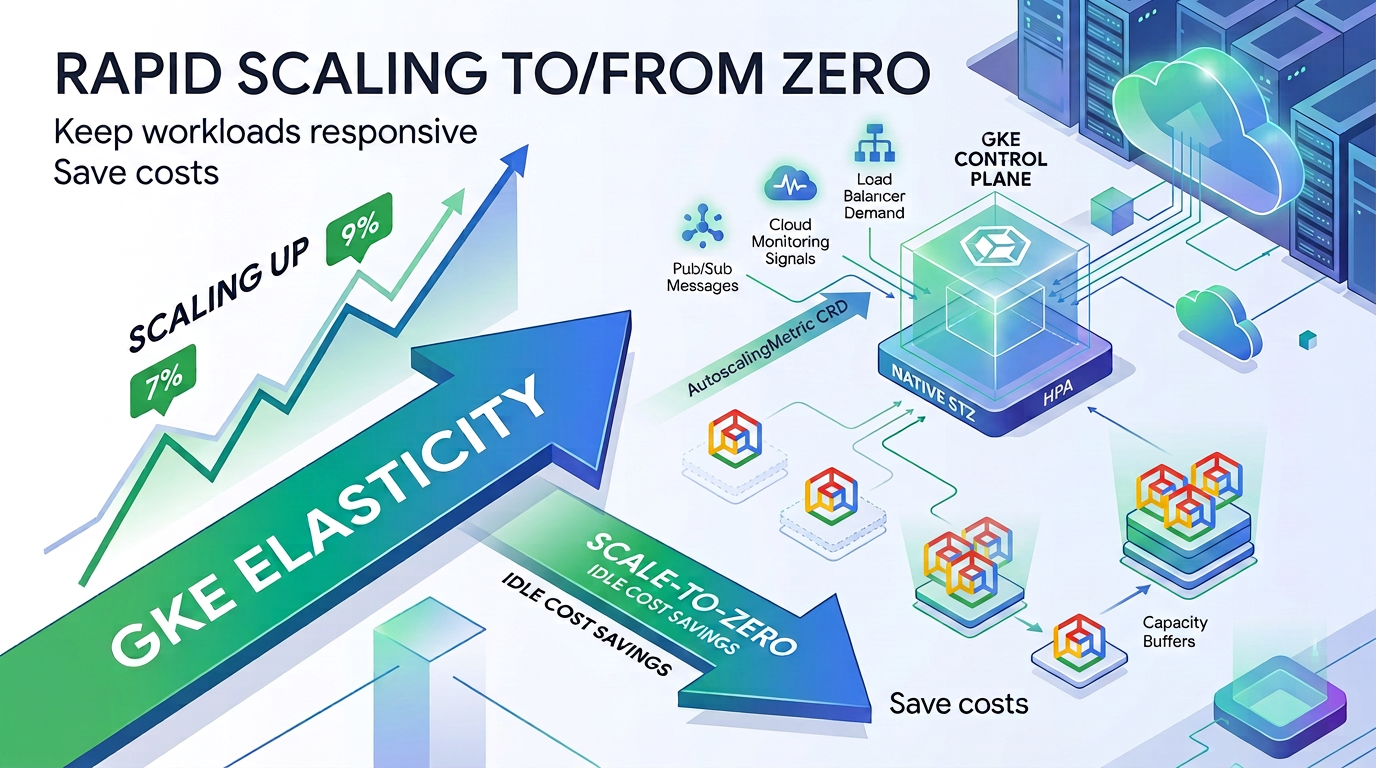
Scale-to-zero capabilities are made possible by support in GKE for external metrics from Cloud Monitoring. By extending the AutoscalingMetric custom resource, you can now query metrics from Google Managed Service for Prometheus, without complex, third-party adapters. This reduces latency, simplifies security, and serves as a key foundation for configuring native scale-to-zero workloads. To learn more about this integration, read our companion blog post on native support for external metrics in GKE.
Managing startup latency with capacity buffers
The biggest challenge with scaling from zero is the so-called cold start — the time it takes for GKE to provision a node and for the container to pull it and start it. This is where GKE capacity buffers come in.
Capacity buffers act as pooled warm capacity. By maintaining a small amount of warm compute resources that can be shared by multiple workloads that can all scale to zero, GKE ensures that when your HPA jumps from 0 to 1, the pod has resources that it can claim immediately. This eliminates the 60-90 second wait for a new GKE node to spin up, reducing startup latency from minutes to an instant, all while maintaining zero cost for the workload.
Capacity buffers come in two flavors: active and standby. A small active buffer can serve hundreds of workloads that are scaled to zero; instead of each of the workloads maintaining a replica, the active buffer acts as wildcard capacity that serves the whole cluster. A larger standby buffer, which costs a fraction of an active buffer, quickly refills the active buffer for any sustained load encountered by the cluster. By using them together, you get both instant scaling and can maintain low costs.
What’s ahead
We continue to expand our roadmap for GKE elasticity. For example, imagine you want your development environments to scale to zero at 8:00 PM and scale back up at 7:00 AM. Be on the lookout for methods to exert finer-grained control over recurring scaling, so you can proactively define your scale-to-zero windows.
Get started with scaling-to-zero today
The days of paying for idle resources are numbered. By enabling GKE’s native scale-to-zero capabilities for event-driven and sporadic workloads, you can slash costs without sacrificing startup performance. To get started with scale-to-zero, follow these steps:
-
Identify a workload with fluctuating demand that has periods of idleness.
-
Configure your AutoscalingMetric, and set your minReplicas to zero.
-
Add capacity buffers to your cluster or workload to keep response times snappy.
For more, check out the documentation on Scaling GKE workloads to and from zero using HPA.
Source Credit: https://cloud.google.com/blog/products/containers-kubernetes/gke-adds-native-scale-to-zero-capabilities/
About the Author