Your business doesn’t have a sales problem.
It has an operations bottleneck that is quietly choking growth.
When a small business hits a plateau, leadership often assumes they need more marketing, more leads, or more sales reps 🗣️
Yet when we audit the business, the pipeline is already full.
The real failure is that internal operations cannot keep up with momentum.
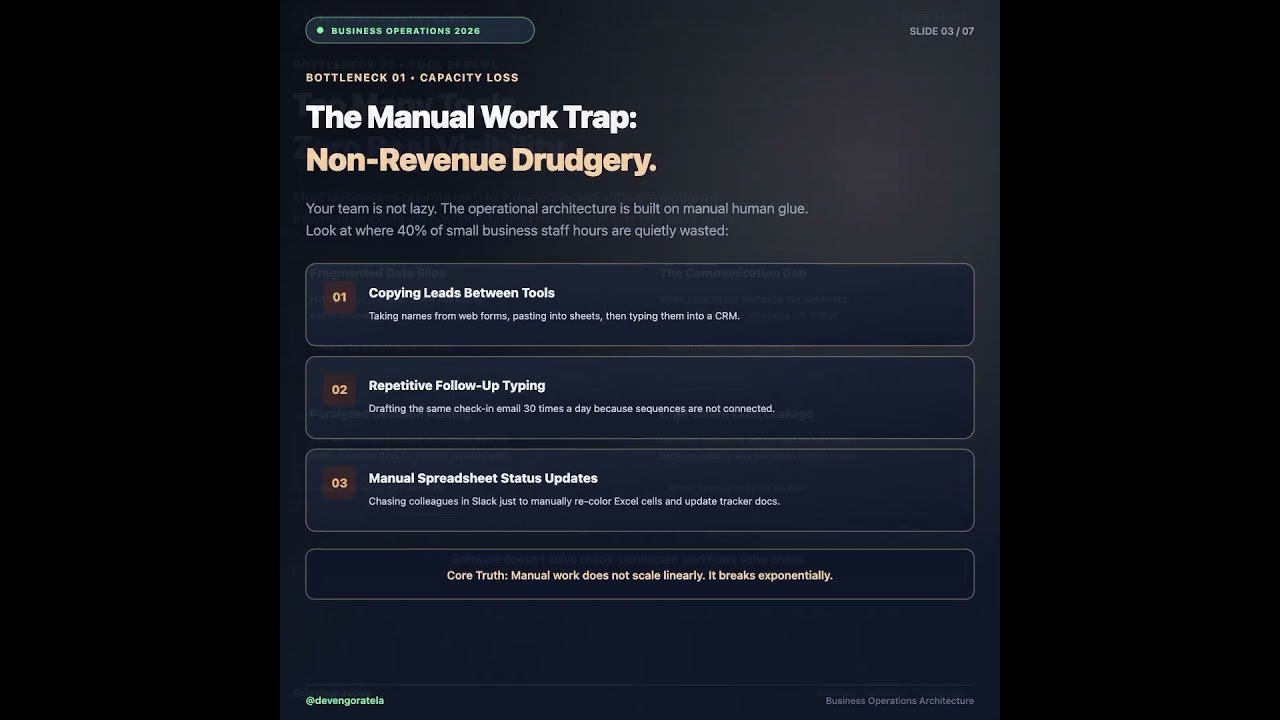
Inside this carousel is a breakdown of the 3 recurring operational bottlenecks killing small business growth in 2026:
1️⃣ The Manual Work Trap: Highly paid teams wasting 15+ hours a week copying lead data across tools, updating spreadsheets, and re-typing identical emails. Manual work does not scale linearly—it breaks exponentially.
2️⃣ Tool Sprawl Without Clarity: Most companies run on 5 to 7 disconnected SaaS apps. Data exists everywhere, but visibility exists nowhere. When tools don’t communicate cleanly, context gets lost and deals slip through the cracks.
3️⃣ The Speed Gap: Customer expectations have permanently shifted. High-intent buyers expect a reply in minutes, not days. If a small team takes 24 hours to manually triage an inquiry, the prospect has already booked with a competitor.
The shift for 2026 is simple:
Stop trying to scale manual headcount.
Start engineering connected operational architecture 🏗️
When you connect your intake webhooks, unify your data layer, and implement automated triage, your team is freed to focus exclusively on strategy, sales, and client outcomes.
What’s the #1 operational bottleneck you see causing businesses to lose momentum right now? Is it lead management, internal productivity, or client retention? Drop your thoughts below 💬
—
♻️ Repost this carousel to help other founders and leaders fix their operational bottlenecks.
➕ Follow Deven Goratela for practical breakdowns on business automation, systems thinking, and operational architecture.
#BusinessGrowth #Operations #Automation #Productivity #SystemsThinking #BusinessStrategy
Video Source
About the Author