Google unveiled further Antigravity updates at I/O this week. From what I’ve seen, most coverage frames Antigravity as a faster, smarter coding assistant, a natural successor to Gemini CLI (more on that shortly). While that’s certainly true, I feel it misses the more compelling story.
We’re now moving from AI assisted development, where a human still authors every line, to AI agentic development, where an agent plans the work, writes the code, calls tools, and commits. While the human in the loop still reviews, they no longer write the code themselves.
This distinction is crucial for enterprise architects because every governance model for software development code review, IP ownership, secrets management, audit trails, compliance assumes human authorship. None of those frameworks were designed with an autonomous agent in mind.
If an AI agent can now plan, write, and commit code autonomously within your enterprise environment, how do we redesign our development governance to treat the agent as a full participant in the SDLC, rather than just another tool?
What Antigravity Actually Is
Antigravity is not simply a better coding assistant. It is an agent first development platform with three key components: a desktop application (now 2.0, as announced at I/O) with a multi-agent orchestration UI, Antigravity CLI rebuilt in Go that will replace Gemini CLI, and an SDK for building custom agents ¹ . All three share the same execution harness, so improvements apply across all of them. An agent that can plan multi step tasks, invoke tools, spawn subagents, and execute across a full workspace is a meaningfully different proposition from a mere code suggestion engine. For engineering teams who get the governance right, this represents a significant unlock.
Google has set a deadline for transitioning from Gemini CLI to Antigravity CLI, with a firm date of June 18, 2026, for Google free tier, AI Pro and Ultra subscription users ². For enterprises still running Gemini CLI, however, that deadline appears to be on hold for now, with Google committing to keep Gemini CLI accessible via paid Gemini and Gemini Enterprise Agent Platform API keys for the foreseeable future.
Nonetheless, engineering teams are already beginning this transition, which means the governance conversation is already lagging behind the adoption curve.
The desktop application offers some distinct advantages. Unlike the CLI, it provides a visual agent manager and background task scheduling, capabilities that significantly lower the barrier to starting an agentic session. This is incredibly useful. It also means agentic execution can reach a much broader set of users, including those who might never have engaged with the CLI.
The Antigravity SDK is what makes this architecturally significant. It allows organisations to build agents on the same execution harness, integrated with Google Cloud projects ³. This is the surface where production workloads will eventually run, and it is the one that demands the most governance clarity before it is enabled. Crucially, it is also the one with the most potential once that clarity exists.
Google has built platform level security into Antigravity: terminal sandboxing, credential masking, hardened Git policies, and a permission system that controls what the agent can do. However, none of that is a substitute for comprehensive enterprise governance. Sandboxing limits accidental leakage within a session. It does not define who owns agent-generated code, where inference runs for regulated workloads, or how agent actions are audited across the organisation.
The Enterprise Governance Problem
Enterprise software governance was designed for humans. Every control assumes that a person made a decision: a developer wrote the code, a reviewer approved it, a team owns the change. Engineering teams are beginning to migrate to Antigravity, regardless of whether that conversation has happened. When an agent is doing the writing, many of those traditional controls simply do not apply. They were built for a world where every decision had a named human behind it.
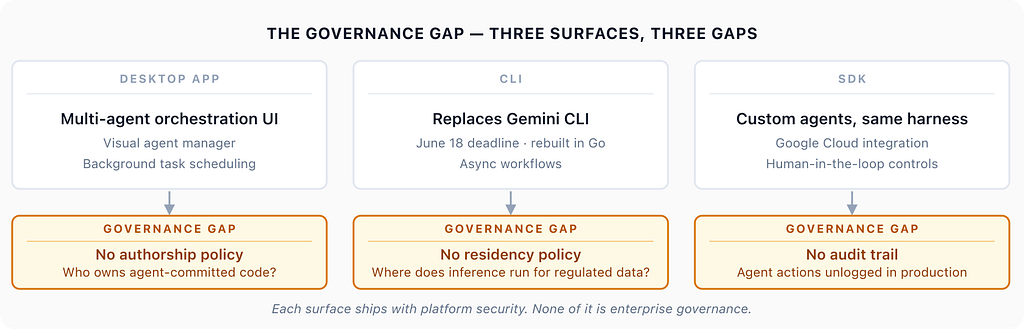
Figure 1: Antigravity ships three surfaces. Each surface has a different governance gap enterprises need to close.
The most immediate concern is IP and secrets. An agent reads the full repository context to do its job, and enterprise codebases contain far more than just application code: credentials, internal API contracts, architecture decisions, and proprietary business logic. Feeding such sensitive data into an external inference endpoint requires a robust data handling policy that most organisations simply do not yet possess. This is not a gap that sits quietly; it is the question a procurement team or a legal review will ask on day one, and it is considerably more comfortable to answer before the agents are running than after.
Directly connected is the authorship problem. An agent that generates code which passes review and ships to production creates a chain of accountability that nobody has yet worked out how to close. Compliance teams will not ignore this; the audit will certainly find it.
Less visible but equally consequential is data residency. When an agent reasons over enterprise code, that reasoning happens somewhere. Antigravity routes inference through Google’s infrastructure ⁴. For regulated industries, where that processing occurs is a governance requirement, not a preference, and it needs to be defined before agents are enabled. In practice, most organisations discover this requirement during the first audit rather than before it.
The Agentic SDLC Framework
The governance framework exists to enable Antigravity adoption safely, not to slow it down. Teams that define it before rollout are in a position to expand their use of the platform quickly and with confidence. In my view, this framework has four key components:
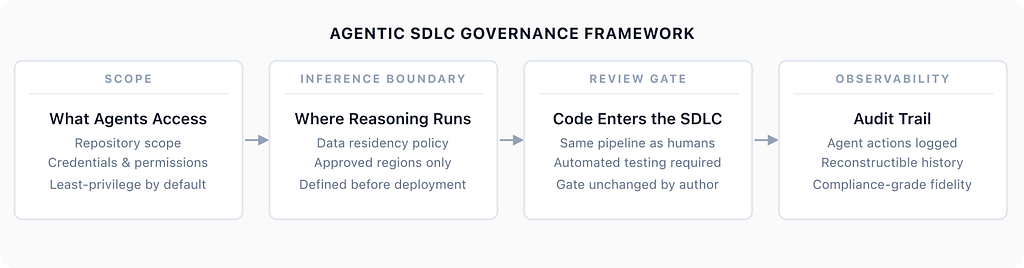
Figure 2: The agentic SDLC governance framework: scope, inference boundary, review gate, and observability.
The first decision is scope: what the agent can access. This covers repository permissions, credential access, and cloud resource scope. The principle of least privilege applies to agents just as it does to service accounts; an agent working on one service has no business reading the full codebase.
Directly connected to scope is the inference boundary, which determines where the reasoning actually happens. Which workloads are cleared to route inference through external infrastructure? What is the policy for repositories with regulated data? These answers need to exist before any agent session starts. They are incredibly difficult to define retrospectively once a pipeline is running.
The review gate determines how agent-generated code enters the SDLC. Crucially, the gate should not change simply because the author is not human. Agent-generated code should go through the exact same rigorous review and testing pipeline as human-authored code. Its job is to verify that the standard is met, full stop; it is not to flag the authorship.
Underpinning all of this is observability: a log of every agent action with enough fidelity to reconstruct what the agent did, why it did it, and what it touched. This is not optional in compliance environments. It is also the most useful signal for understanding where agent autonomy is working effectively and where it is not, and that signal is only available if the logging is in place from the very start. Most teams discover this when they need it for an audit and realise they haven’t got it.
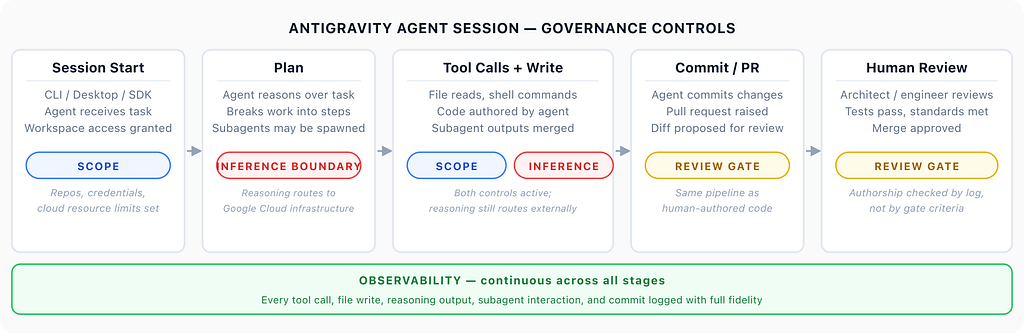
Figure 3: Where each governance control sits in an Antigravity agent session, from workspace access through to human review.
Scope and the inference boundary are pre session decisions: by the time an agent starts, both must already be in effect. The review gate and observability need to be wired into the pipeline before agents reach production. Antigravity’s built in sandboxing and credential masking operate at the session level and do not substitute for these four crucial controls.
What Architects Should Do Now
- Decouple the migration from agent enablement. The June 18, 2026 deadline requires moving engineering teams from Gemini CLI to Antigravity CLI for Google AI Pro and Ultra and free tier users, although enterprises have a little while longer to migrate. It does not, however, mandate enabling autonomous agent execution. Use that window to define scope per surface, establish inference boundaries per workload, and wire in the audit trail before the capability is widely enabled.
- Pilot in a greenfield service, not the core platform. The CLI, desktop app, and SDK each have different access patterns and risk profiles. A scope policy designed for CLI use will not map cleanly to a custom SDK agent running in production, and the desktop app may well reach engineering workstations before IT has any policy for it. The only way to uncover governance gaps before they incur significant cost is to run real engineering teams in a strictly constrained environment.
- Define the governance framework before the platform matures. Authorship policy, data residency, scope constraints, and observability all need to be in place before agents reach production. Policy written after agents are running is a retrofit, not thoughtful architecture.
The migration is already underway. Those who define the framework first will not move more slowly; they will move more safely, and ultimately, considerably faster.
References
[¹]: Google Developers Blog. *Build with Google Antigravity — Our New Agentic Development Platform*. https://developers.googleblog.com/build-with-google-antigravity-our-new-agentic-development-platform/
[²]: Google Developers Blog. *Transitioning Gemini CLI to Antigravity CLI*. https://developers.googleblog.com/an-important-update-transitioning-gemini-cli-to-antigravity-cli/
[³]: Google Cloud Blog. *Choosing Antigravity or Gemini CLI*. https://cloud.google.com/blog/topics/developers-practitioners/choosing-antigravity-or-gemini-cli
[⁴]: Google. *I/O 2026 Developer Highlights: Antigravity, Gemini API, AI Studio*. https://blog.google/innovation-and-ai/technology/developers-tools/google-io-2026-developer-highlights/
Originally published at https://danhenderson.cloud on May 23, 2026.
From Assistant to Agent: What Antigravity Means for Enterprise Development Governance was originally published in Google Cloud – Community on Medium, where people are continuing the conversation by highlighting and responding to this story.
Source Credit: https://medium.com/google-cloud/from-assistant-to-agent-what-antigravity-means-for-enterprise-development-governance-8e5361d54bd4?source=rss—-e52cf94d98af—4
About the Author