The initial wow factor of generative AI has passed. Most organizations have moved beyond the “look what this can do” phase and are now staring down a much more daunting, multi-faceted challenge: How do we scale this, ensure widespread adoption, and actually realize business value?
True scaling isn’t just a technical release; it is a collaborative achievement. A highly capable platform with zero adoption is a sunk cost; alternatively, high adoption of a low-impact tool yields zero business return. Successful scaling requires a tight loop where technology enablement, user adoption, and value realization feed into one another.
To achieve this, organizations must shift their approach and build a unique, highly collaborative modular engine.
Disclaimer: I work at Google in the cloud team. Opinions are my own and not the views of my current employer.
1. The Multiskilled Foundational Team
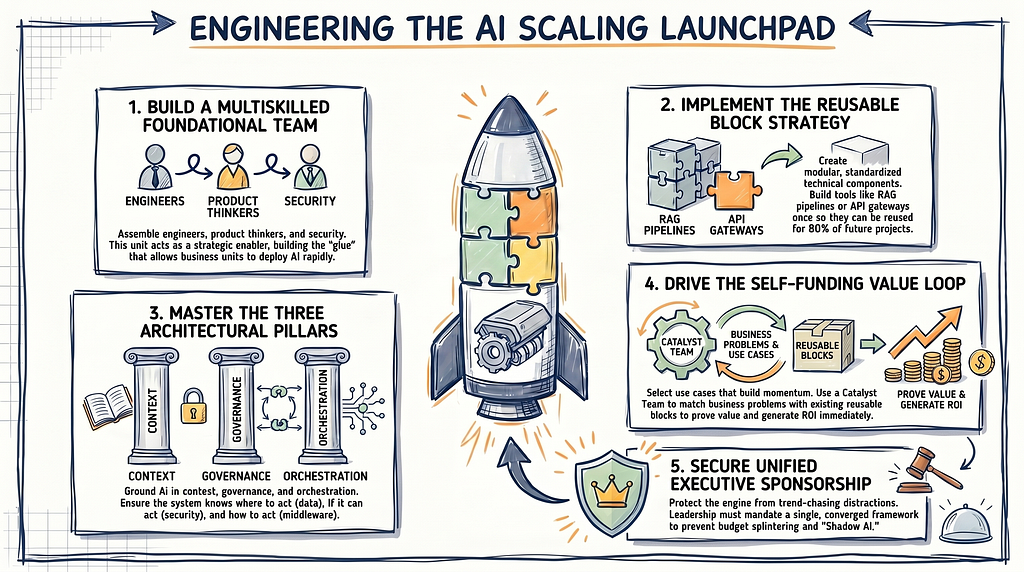
Scaling fails when AI is treated as an isolated specialty silo. To drive both adoption and value, you need a Foundational Team that acts as the strategic enabler of the organization. This isn’t a group of data scientists sitting in a corner; it is a multiskilled unit comprising:
- Platform Engineers: To build the glue and integration layers.
- AI Engineers: To leverage AI coding and custom engineering where off-the-shelf products fall short.
- Product Thinkers: To ensure that what is built is highly intuitive, easily adoptable, and reusable.
- Security & Governance Experts: To bake compliance into the framework from day one, removing adoption friction later.
Crucially, this team does not own the business problems — the business units and specialty teams do. Instead, the foundational team focuses on making them happen by selecting high-potential use cases, proving value rapidly, and then immediately moving to the next. They operate with a high-velocity, delivery-focused mindset, treating early projects as proofs of capability that build organizational momentum.
2. Aligning Other Platform Teams
The foundational engine cannot operate in a vacuum. To maintain high velocity, other infrastructure and platform teams (such as Cloud, Data, and IT) must recognize the strategic importance of this effort.
If the AI team has to wait months for database access, cloud provisioning, or security reviews, value realization grinds to a halt. These neighboring platform teams must transition from passive gatekeepers to proactive enablers. Their mission should be to anticipate the foundational team’s needs and actively work to preemptively eliminate operational bottlenecks and bureaucratic friction before they stall progress.
3. Solving the Budget Paradox
The biggest hurdle to scaling is often financial. Finding budget for exploratory AI is notoriously difficult. However, there is a path to self-funding: The Reusable Block Strategy.
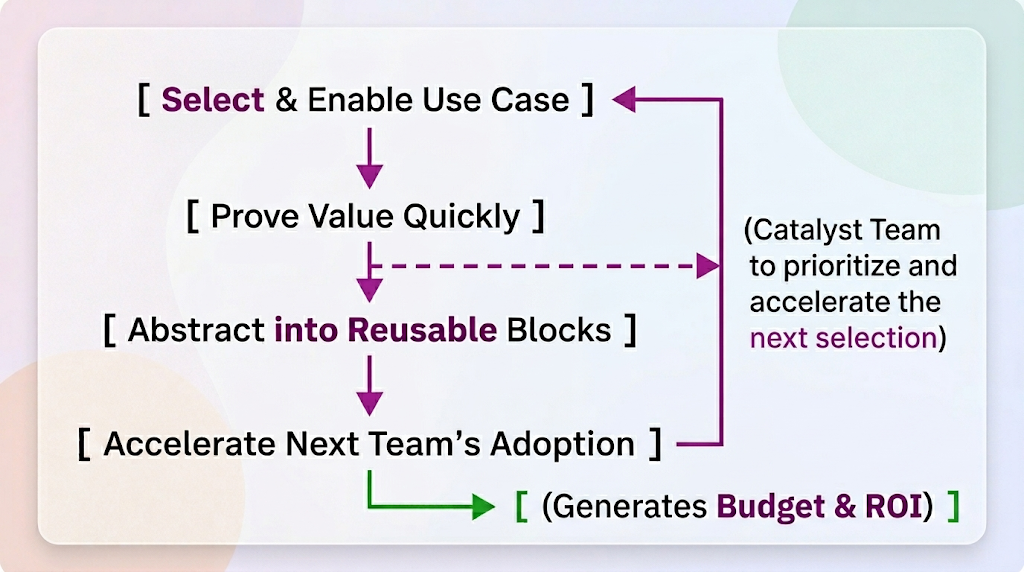
If the foundational team has the operational freedom to enable specific use cases by building modular, reusable capabilities (e.g., a standardized retrieval-augmented generation (RAG) pipeline, a secure API gateway, or a common data ingestion layer), they unlock a compounding value loop.
Some of this adoption will happen organically as other departments discover these tools and realize they can solve their own problems at a fraction of the cost. However, the real acceleration occurs when you introduce a proactive matchmaking capability — often represented by a Catalyst Team.
Instead of waiting for busy business units to discover these technical blocks on their own, the Catalyst Team acts as the strategic bridge. They actively engage with business departments to help them recognize how existing blocks can be quickly applied to solve their specific operational challenges.
Crucially, this catalyst mindset must be hardwired directly into the selection and prioritization process for new initiatives. When deciding which use cases to fund and build next, the team should prioritize projects that can be delivered rapidly by plugging into 70–80% of what has already been built. This transforms project selection from a chase after the shiniest new trend into a disciplined strategy that maximizes existing leverage, radically lowers delivery costs, and proves value almost immediately.
This approach requires a disciplined culture. Unrestricted autonomy must yield to a shared technical vision. To build a platform that others actually want to adopt — and that can be leveraged to accelerate selection — the team must prioritize standardized, highly compatible glue over fragmented, bespoke engineering.
4. The Three Pillars of Execution
A common pitfall is treating AI scaling purely as a model-selection challenge (e.g., debating Gemini versus Claude). But model intelligence is just raw processing power. If you’re just bolting new capabilities and rules onto your agent every single week, you aren’t scaling.
To build a system that delivers actual value, the foundational engine must focus on three architectural pillars surrounding the model:
- Data Context and Semantics (Knowing where to act): AI cannot work in a vacuum. It requires highly accurate, semantically rich context from your organizational data to ground its reasoning, prevent hallucinations, and operate within the correct business domains
- AI Control and Governance (Knowing if it can act): Scaling adoption relies entirely on trust. By implementing centralized guardrails, policy engines, and security frameworks, you define the hard boundaries of what the AI is permitted to do and access.
- Decoupling and Orchestration (Knowing how to get things done): The AI must be cleanly decoupled from downstream systems yet highly orchestrated. This API-driven middle layer serves as a robust middleware harness. This is where you implement critical platform capabilities such as session-based memory, semantic caching (to slash API latency and costs), prompt management, token rate-limiting, and comprehensive observability. By isolating these harness capabilities from the underlying model, you not only make downstream integrations robust, but you also eliminate model lock-in. This enables you to swap or upgrade the core foundation model overnight as newer, cheaper, or more powerful models emerge, without rewriting a single line of application logic.
By architecting these three capabilities, you move past basic chatbot and agent interfaces to a system where the AI knows exactly where to act, if it is allowed to act, and how to get things done.
5. Proactive Innovation and the Wow Factor
When employees build Shadow IT or deploy unsanctioned Shadow AI tools, it is rarely done with malicious intent. Generally, business teams are simply looking for immediate help, assistance, and execution. If the official organizational channels are too slow or overburdened in bureaucracy, employees will bypass them because the execution must follow the business need.
Having a robust technical foundation — built on clean data connections, governed control layers, and decoupled orchestration — fundamentally changes this dynamic. It empowers the foundational team to shift from a reactive, ticket-taking queue to a proactive engine of innovation.
However, unlocking this proactive power requires a complete shift in how the team thinks. It is not about asking users what solution they want, rather what challenge they want to tackle.
While users understand their problems intimately, they cannot imagine how modern AI can actually solve them. If you ask a business team drowning in document analysis what they want, they will ask for a slightly faster keyword search tool or a basic spreadsheet macro. They cannot conceptualize how an agentic orchestrator or semantic retrieval can transform their entire workflow. Instead of asking what they want, study how they work, uncover their friction points, and design the solution they didn’t know was possible.
This is not tech for tech’s sake. The underlying rule is user-centricity: when you solve for the user’s friction points first, organic adoption and measurable ROI follow naturally.
As you design these solutions, do not be afraid to think big. Aim for transformational change rather than small, incremental tweaks. Even if the path forward must be delivered in phased, manageable steps, the destination should be ambitious. By mapping out a grand vision but delivering it in rapid, bite-sized phases, you create a steady stream of wow factors that capture stakeholder imagination, build momentum, and prove that the foundational team is their fastest, most capable ally.
6. Converging on a Governed Framework
By design, this iterative, block-based approach leads to a natural organizational convergence. What starts as a few shared tools and architectural pillars eventually matures into a governed framework and platform.
- Early stage: Focuses on speed, experimentation, and rapid value realization.
- Mature stage: Focuses on driving widespread adoption, optimizing API costs, and establishing standardized governance.
As more teams onboard, the platform becomes a gravitational pull for the organization — the easiest, safest, and most efficient place to build AI. Governance is no longer a restriction; it becomes an accelerator for adoption, because developers know that anything built on the platform is automatically compliant and secure.
7. Buy vs. Build vs. Integrate
A common mistake is assuming every AI capability requires purchasing a new enterprise product. In the age of AI-assisted software development, the foundational engine should focus on:
- Integrating existing best-of-breed tools.
- Engineering the custom glue (specifically the orchestration and data-context layers) that makes those tools work for the specific organizational context.
- Building proprietary components only where a product doesn’t exist or is too restrictive.
With AI coding tools, the cost of writing, testing, and maintaining custom integration code has decreased dramatically. This allows the foundational team to be highly surgical in their technical choices, avoiding expensive vendor lock-in while maintaining the agility needed to deliver value quickly.
8. Executive Sponsorship
None of this works without a stable base. While vision and strategy set the trajectory, active Executive Sponsorship provides the political and financial direction required for long-term execution.
The organization must count on a consistent, unified direction. If leadership reacts to every new AI trend by launching fragmented side initiatives or tolerating shadow-IT projects, the organization’s focus and budget will splinter.
Crucially, a stable base is not the enemy of innovation. Rather, it serves as the necessary safety net for exploration. When the core architecture is stable and unified, the team actually gains the freedom to safely research, experiment with, and integrate emerging AI trends. Because previous technical investments are securely anchored, new developments can be tested and incorporated without putting existing value at risk.
Executive sponsors must trust this balanced process, protect the foundational team from reactionary distractions, and mandate that this engine remains the central point of organizational convergence.
Conclusion
Scaling AI is a marathon of integration, adoption, and value realization. By focusing on a multiskilled team that builds reusable blocks — and aligning neighboring platform teams to clear their path — you transform AI from a series of expensive, isolated experiments into a powerful, self-sustaining capability.
The goal isn’t just to use AI — it’s to build the engine that makes delivering business value through AI effortless.
Engineering the Launchpad: Why solid foundations are your secret weapon for scaling AI was originally published in Google Cloud – Community on Medium, where people are continuing the conversation by highlighting and responding to this story.
Source Credit: https://medium.com/google-cloud/engineering-the-launchpad-why-solid-foundations-are-your-secret-weapon-for-scaling-ai-93c7cc4f146f?source=rss—-e52cf94d98af—4
About the Author