How Google Agents CLI Solves the Biggest Enterprise AI Challenge
A few months ago, the biggest question in enterprise AI was:
“How do we build an AI agent?”
Today, that question has changed.
Organizations can build agents. Open-source frameworks are abundant. Every week brings another demo showing an AI agent approving expenses, generating reports, or orchestrating cloud infrastructure.
The real challenge begins after the demo succeeds.
The question enterprise leaders, platform engineers, security teams, and SREs are now asking is:
“How do we trust an AI agent in production?”
This is where many AI projects stall.
An agent that can read information is relatively easy to build. An agent that can take actions against production systems, interact with enterprise applications, trigger workflows, and make decisions safely is a completely different challenge.
The problem is not intelligence.
The problem is governance.
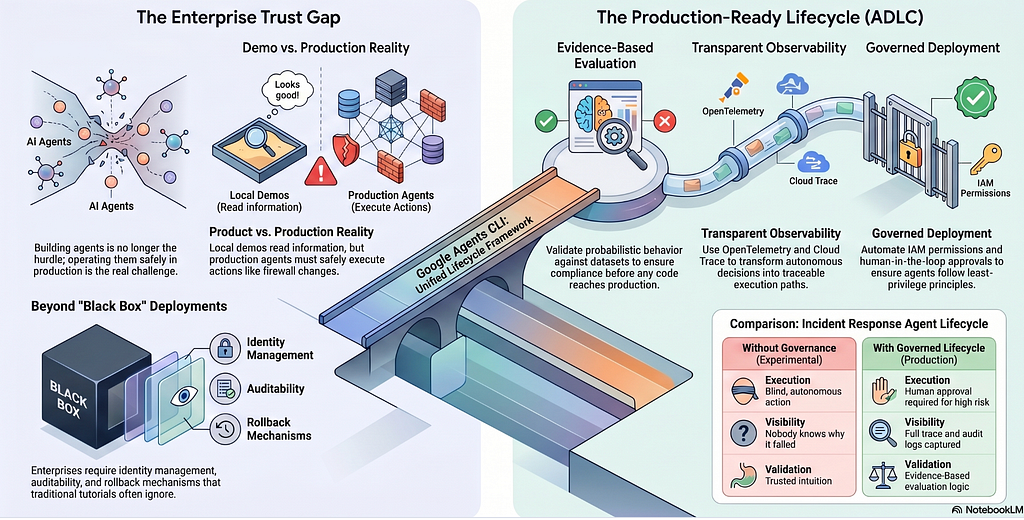
The Enterprise Trust Gap
Consider a simple incident-response agent.
A proof-of-concept version can:
- Read alerts
- Query logs
- Analyze metrics
- Suggest remediation steps
Now imagine giving that same agent permissions to:
- Restart services
- Roll back deployments
- Modify firewall rules
- Open and close incidents
- Execute automation runbooks
Suddenly the questions change:
- Why did the agent make that decision?
- What information did it use?
- Can we audit its actions?
- How do we test it before production?
- Can we limit its permissions?
- What happens when it fails?
These are the questions preventing many organizations from moving agents beyond experimentation.
The industry is rapidly discovering that building agents is not the bottleneck anymore.
Operating them safely is.
Why Traditional Agent Tutorials Fall Short
Most tutorials stop after:
python main.py
or
adk run
The agent works.
Everyone celebrates.
Then reality arrives.
Production environments require:
- Identity management
- Access control
- Evaluation
- Deployment pipelines
- Observability
- Auditability
- Rollback mechanisms
- Governance controls
Without these capabilities, organizations are essentially deploying black boxes into critical workflows.
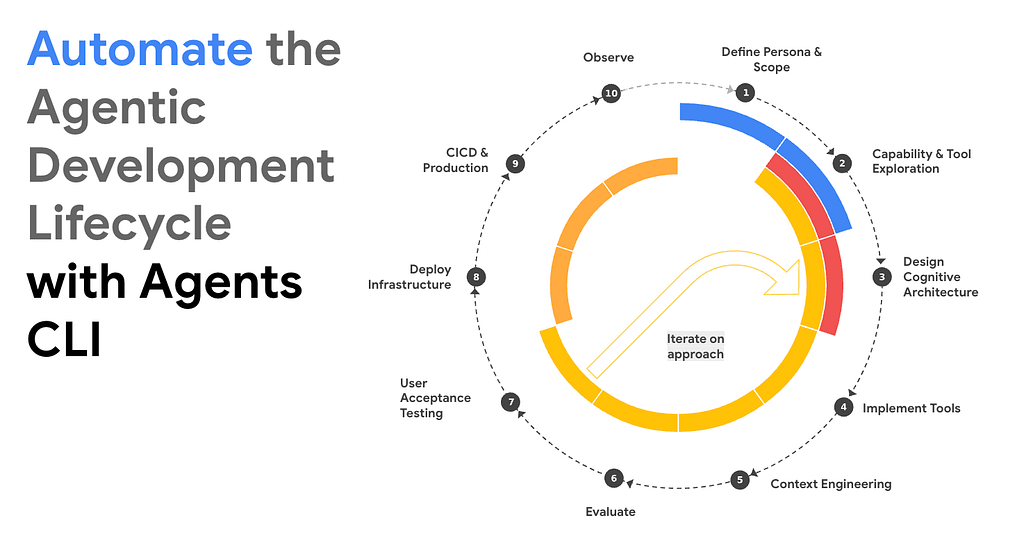
This is precisely the problem Google Agents CLI was designed to address. Rather than focusing only on agent creation, Agents CLI provides tooling across the entire Agent Development Lifecycle (ADLC).
Enter Google Agents CLI
Google Agents CLI is more than a command-line tool.
https://medium.com/media/c4bab214eea0afb0e86789bb74cd71b7/href
It is a lifecycle management framework that helps developers move from local experimentation to governed production deployment.
At a high level, Agents CLI provides capabilities for:
- Agent scaffolding
- Workflow design
- Evaluation
- Deployment
- Observability
- Publishing
Instead of stitching together multiple disconnected tools, developers can use a unified workflow from development through production.
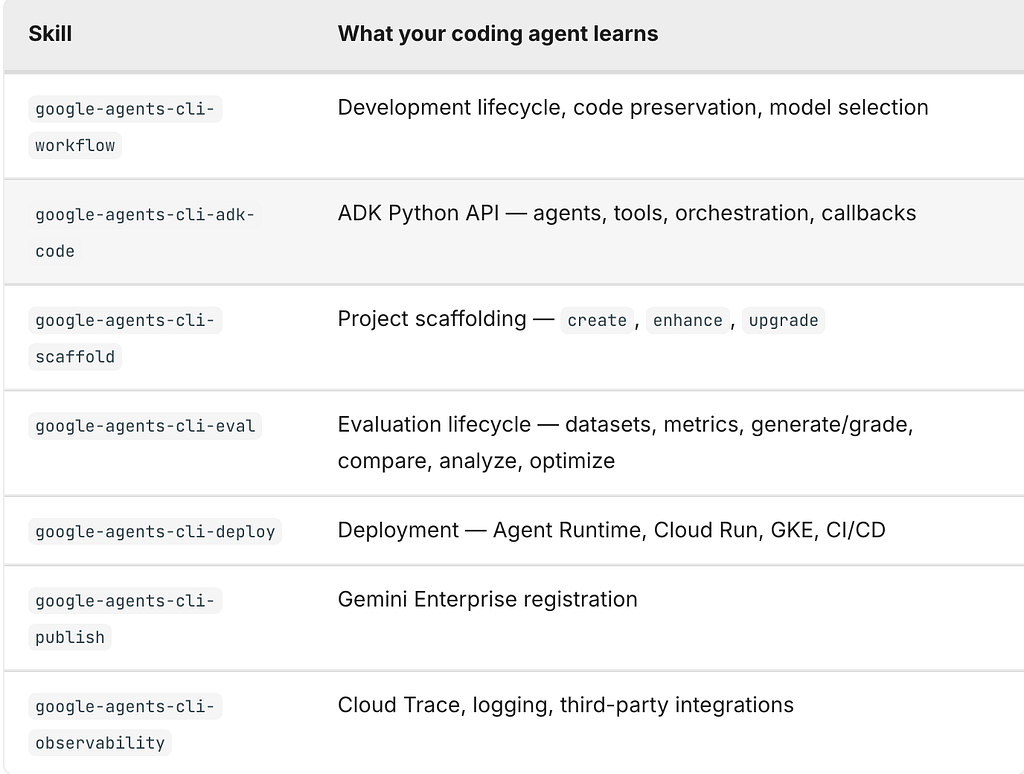
Installation is straightforward:
uvx google-agents-cli setup
Once installed, the CLI injects domain-specific skills into coding assistants such as Gemini CLI, Claude Code, Codex, and others, reducing the context burden of navigating the Google Cloud agent ecosystem.
But the real value appears when we examine how it addresses trust.
Pillar 1: Evaluation Before Deployment
One of the most dangerous assumptions in AI is:
“It worked once; therefore it works.”
Agents behave probabilistically.
A successful test run is not evidence of production readiness.
Google Agents CLI includes evaluation workflows that allow teams to validate behavior against expected outcomes before deployment. The platform supports evaluation datasets and automated testing workflows to ensure agent responses align with intended behavior.
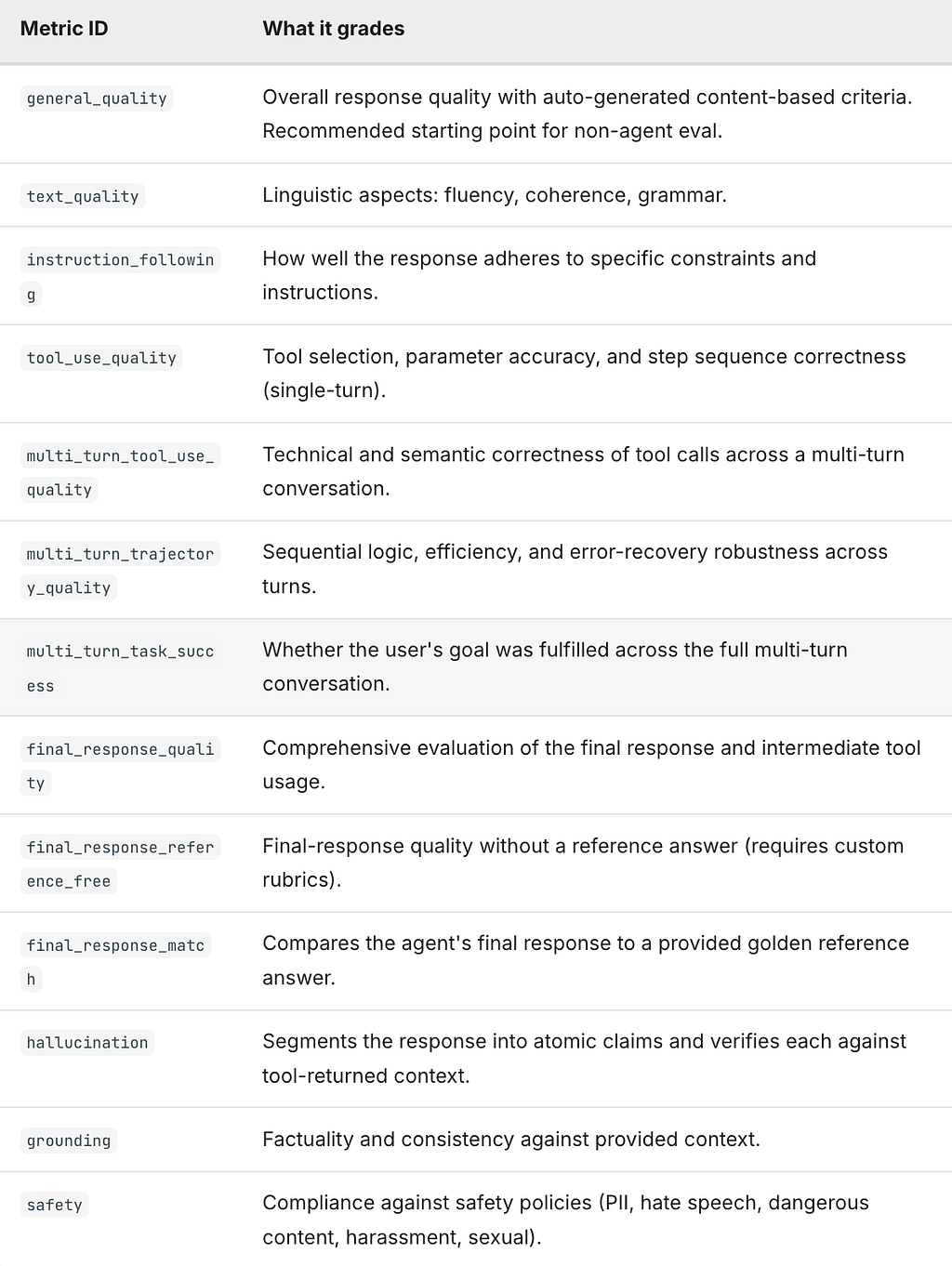
Think about an incident-management agent.
Before production, you might evaluate:
- Correct incident classification
- Escalation decisions
- Root-cause recommendations
- Tool invocation behavior
- Compliance requirements
Instead of trusting intuition, you gain measurable evidence.
This is a significant step toward operational trust.
Pillar 2: Observability Instead of Blind Execution
One of the biggest concerns with autonomous systems is visibility.
When an agent makes a decision, teams need answers.
- What happened?
- Why did it happen?
- What tools were called?
- How much did it cost?
Agents CLI projects include OpenTelemetry instrumentation and integration with Cloud Trace, allowing teams to inspect agent execution paths and distributed traces. This provides visibility into workflows, tool usage, latency, and execution behavior.
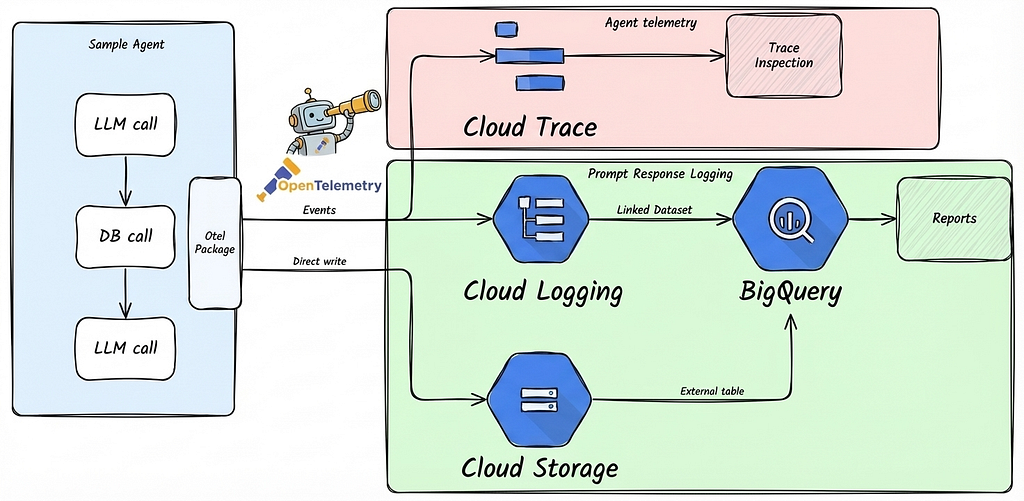
This transforms agents from black boxes into observable systems.
Instead of:
“The agent failed.”
You can determine:
“The agent called Tool X, received invalid data, retried twice, and escalated appropriately.”
That level of visibility is essential for enterprise adoption.
Pillar 3: Controlled Production Deployment
Many organizations discover a painful gap between local development and production deployment.
The agent works locally.
Production requires:
- Infrastructure
- Containers
- Registries
- Runtime environments
- IAM permissions
- CI/CD integration
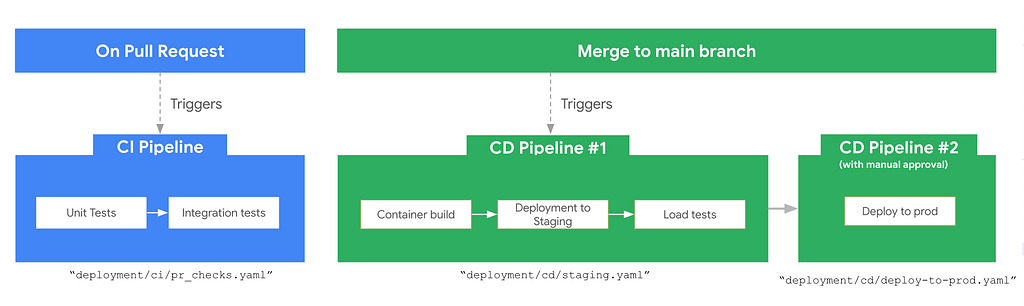
Google Agents CLI automates much of this process.
Deployment workflows handle building containers, provisioning infrastructure, publishing artifacts, and deploying agents into managed environments. The platform also supports Agent Runtime deployments with Infrastructure-as-Code and CI/CD integration.
This dramatically reduces operational complexity.
Developers can focus on agent behavior rather than deployment mechanics.
Pillar 4: Governance Through Structure
Trust requires constraints.
A production-grade agent should never have unrestricted access.
Instead, organizations need:
- Least-privilege permissions
- Service identities
- Human approval workflows
- Escalation paths
- Auditable execution
While governance remains an architectural responsibility, Agents CLI provides the operational framework required to implement these controls consistently throughout the lifecycle. The platform encourages repeatable deployment patterns rather than ad-hoc scripts and manual configuration.
This is a major shift from experimental AI toward enterprise AI.
A Real-World Example: Incident Response Agent
Imagine building an autonomous incident triage agent.
Without governance:
- Alert received
- Agent investigates
- Agent executes action
- Nobody knows why
With a governed lifecycle:
- Alert received
- Agent gathers logs
- Agent correlates metrics
- Evaluation logic validates confidence
- Agent proposes remediation
- Human approval required above risk threshold
- Execution recorded
- Trace captured
- Audit retained
The difference is not intelligence.
The difference is trust.
Why This Matters
The next generation of enterprise software will not be applications.
It will be agents.
But agents will only succeed if organizations can trust them.
Trust comes from:
- Evaluation
- Observability
- Governance
- Repeatability
- Operational excellence
Google Agents CLI recognizes this reality by treating agent development as a complete lifecycle rather than a coding exercise.
And that may be the most important shift happening in AI today. The future is not about building more agents. The future is about building agents we can trust.
References:
- GitHub – google/agents-cli: The CLI and skills that turn any coding assistant into an expert at creating, evaluating, and deploying AI agents on Google Cloud.
- Getting Started – agents-cli
- Evaluation Guide – agents-cli
- Development Guide – agents-cli
- The Lifecycle – agents-cli
- Agent Development Kit (ADK)
- Agents CLI in Agent Platform: create to production in one CLI
- Google’s agents-cli: The Complete Guide to Building AI Agents on Google Cloud
- Google Agents CLI Explained in 5 Minutes
- Building AI Agents in 30 Minutes from Prototype to Production
About Me
I’m an Enterprise Cloud & AI Architect with 13+ years of experience in the IT industry, helping organizations design and scale enterprise-grade cloud, AI, and automation solutions.
My current work focuses on building enterprise-scale AIOps platforms, accelerating customers’ AI-first transformation journeys, driving FinOps adoption, and developing production-ready Generative AI applications that create measurable business impact.
I’m deeply passionate about bridging architecture, platform engineering, and AI innovation to solve real-world enterprise challenges at scale.
If you have questions around Cloud Architecture, AIOps, Generative AI, or FinOps, feel free to connect with me on LinkedIn or X (Twitter) @jitu028 — my DMs are always open, and I’m happy to help.
For personalized 1:1 mentoring, architecture guidance, career discussions, or enterprise solution consulting, you can also schedule a session with me on Topmate: https://www.topmate.io/jitu028
Your AI Agent Works. Can You Trust It in Production? was originally published in Google Cloud – Community on Medium, where people are continuing the conversation by highlighting and responding to this story.
Source Credit: https://medium.com/google-cloud/your-ai-agent-works-can-you-trust-it-in-production-81a6c80871d0?source=rss—-e52cf94d98af—4
About the Author