Google quietly shipped something interesting last week.
**Gemma 4 E4B** uses Per-Layer Embeddings (PLE) — every decoder layer gets its own embedding table. Result: 4.5B effective parameters that retain ~8B-class knowledge.
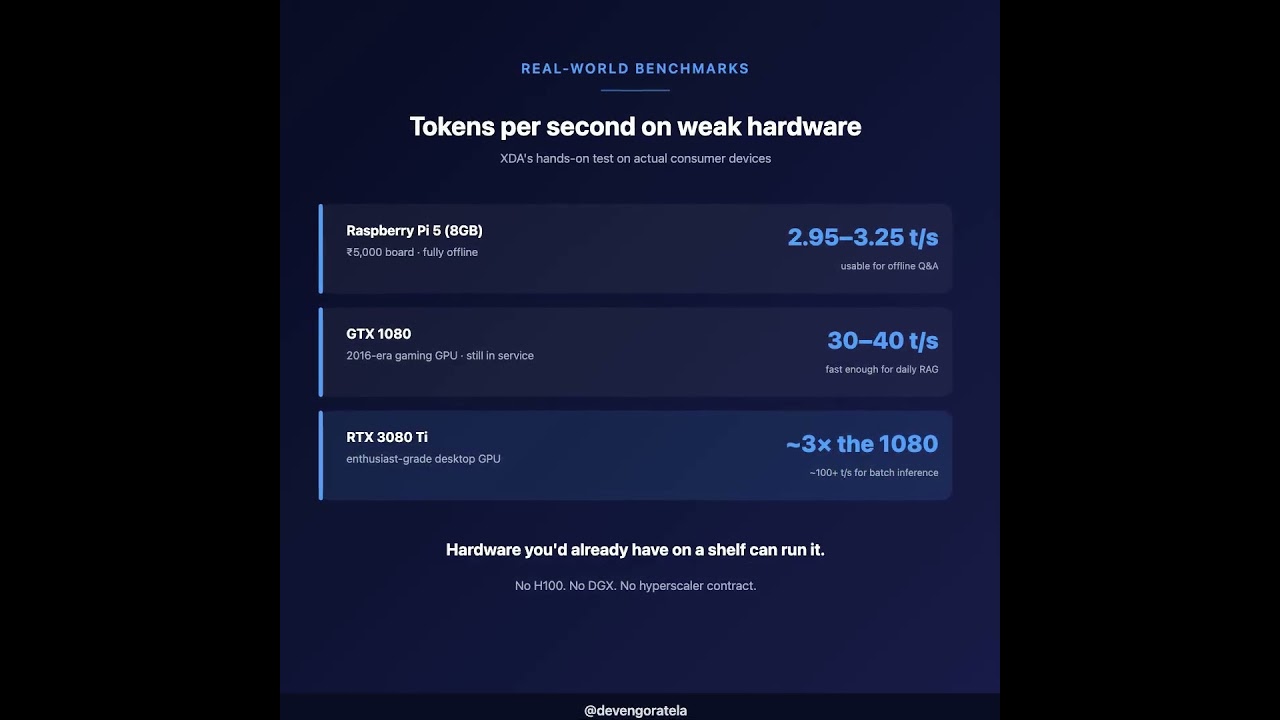
XDA’s hands-on test on actual weak hardware caught my attention. The numbers tell the real story:
🍓 Raspberry Pi 5 (8GB): 2.95–3.25 tokens/sec — usable for offline Q&A
🎮 GTX 1080: 30–40 t/s — fast enough for daily RAG
🖥️ RTX 3080 Ti: nearly 3× the 1080
What it can do today: PDF summarization, image and audio understanding, RAG over personal notes (tested with **Open Notebook** and **Blinko**), Docker MCP commands, tag generation, code troubleshooting.
What it can’t: deploy new Docker containers reliably, write valid Ansible Playbooks, run complex Home Assistant chains, or replace 35B MoE models on agentic reasoning.
The strategic takeaway for builders: the future of on-device AI isn’t “smaller models get dumber.” It’s “architecture gets smarter.” PLE proves you can compress knowledge without compressing capability.
For Indian mid-market companies thinking about AI infra: this is what a sub-₹5 lakh self-hosted stack looks like in 2026. No API bills. No data leaving your network. No waiting on a US provider’s rate limits.
Where do you see on-device LLMs creating the most ROI first — customer support, internal search, or field operations?
♻️ Repost this if someone on your team is still renting GPUs they could own.
➕ Follow Deven Goratela (https://www.linkedin.com/in/devengoratela/) for weekly playbooks on practical AI infrastructure and automation that compounds.
#OnDeviceAI #Gemma4 #LocalLLM #SelfHosted #AIInfrastructure
Video Source
About the Author