Secure and Govern Enterprise AI Agents at Scale
Think of Google Cloud’s Agent Gateway like a firewall for your agents.
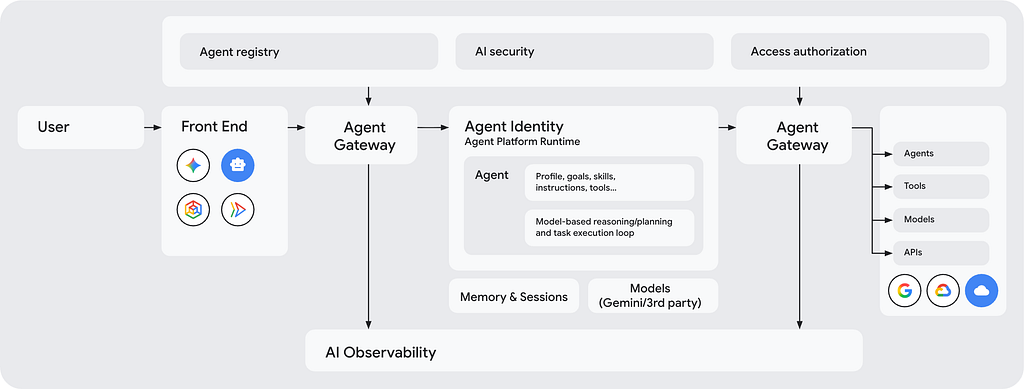
It’s a networking component in Google Cloud’s Agent Platform. It governs ingress and egress connections. Policies determine where traffic can go. Security Admins can enforce centralized governance without requiring developers to manage networking primitives.
The Agent Gateway integrates with other components in Google's Agent Platform:
- Agent Registry: A repository of approved agents, MCP servers, and endpoints.
- Agent Identity: Assigns a unique, trackable identity for every agent.
- Agent Runtime: A serverless compute runtime for your agents.
- Agent Platform Policies: Policies that control and govern agentic communication.
- Identity-Aware Proxy (IAP) & IAM: The enforcement layer that validates the agent’s identity against IAM permissions before allowing calls to specific tools.
- Model Armor: Sanitizes content and protects against prompt injections attacks or data leakage.
Agent Gateway Deployment Modes
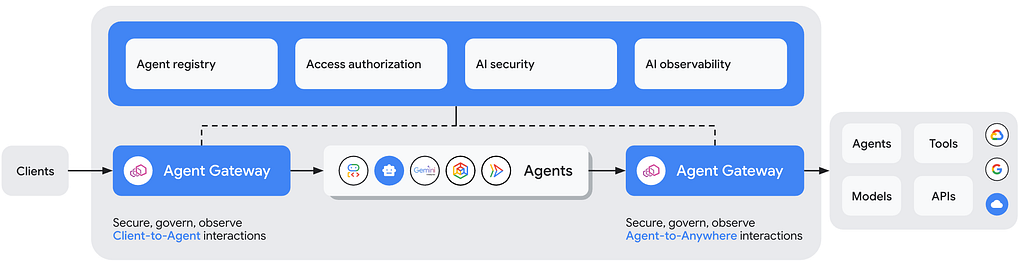
The Agent Gateway supports 2 deployment modes:
- Client-to-Agent: This mode secures ingress communication between clients, such as Gemini Enterprise, to agents running on Google Cloud.
- Agent-to-Anywhere: This mode secures egress communication between agents on Google Cloud to tools, models, APIs, and other agents running anywhere.
Agent Registry Centralizes Resource Discovery
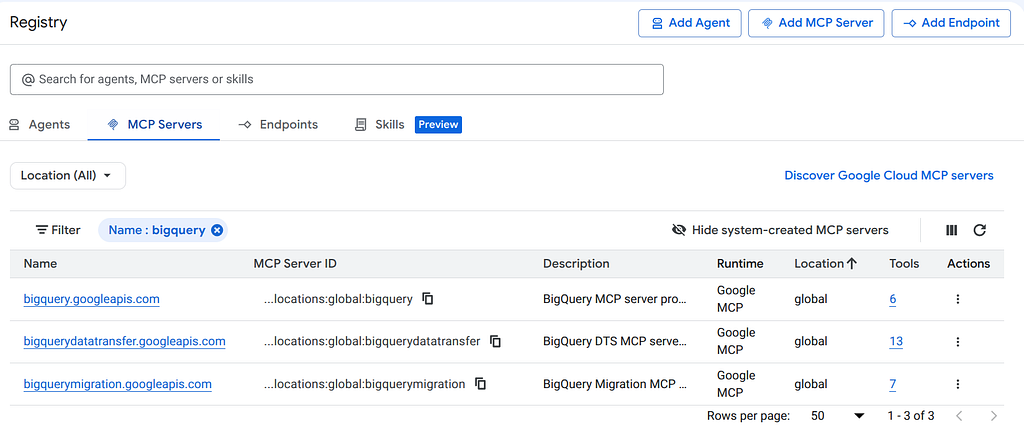
All your agents, MCP servers, and endpoints must be registered in Agent Registry.
It’s a catalog that stores your resources and allows the Agent Gateway to list, search, and discover them. The Agent Gateway will know who can talk with who by referring to the resources in the registry. It uses the registry data model as the governance framework to enforce egress access control.
Delegate Authorization with Service Extensions
What is an authorization extension?
An authorization Extension delegates the authorization decisions to an authorization engine. It intercepts and evaluates requests through an Agent Gateway and make a gRPC call to the authorization engine. The extension inspects the data based on an authorization policy. For example, the Identity-Aware Proxy (IAP) evaluation service is a type of authorization engine. It evaluates requests against IAM policies to determine whether the request is valid or not.
Permit Traffic with Authorization Policies
What is an authorization policy?
An authorization policy checks and sanitizes request through the Agent Gateway. A policy consists of a list of HTTP rules to match against the request. When evaluating a request, the policy specifies actions to be applied. At least one action is required and can be one of the following: ALLOW, DENY, or CUSTOM.
Summary
Google Cloud’s Agent Gateway acts as a specialized firewall and networking component for AI agents, governing ingress and egress traffic to secure agentic communication.
It allows security administrators to enforce centralized governance and access controls without requiring developers to manage underlying networking primitives. The gateway integrates tightly with the broader Agent Platform ecosystem, utilizing the Agent Registry for resource discovery, Identity-Aware Proxy (IAP) and IAM for identity validation, and Model Armor for content sanitization against prompt injection attacks.
Agent Gateway evaluates traffic against authorization policies to ensure secure, policy-driven interactions between agents, clients, and external resources.
Resources
- Agent Gateway Overview
- Codelab: Agent Gateway Egress from Agent Runtime to Google MCP
- Google Skills: Secure Agent Egress with Agent Gateway and Model Armor: Challenge Lab
Google Cloud: Agent Gateway Overview was originally published in Google Cloud – Community on Medium, where people are continuing the conversation by highlighting and responding to this story.
Source Credit: https://medium.com/google-cloud/google-cloud-agent-gateway-overview-e33eb9e02325?source=rss—-e52cf94d98af—4
About the Author


![ChatGPT vs Claude vs Gemini: 56 vs 46 Satisfaction [2026] – tech-insider.org](https://lh3.googleusercontent.com/J6_coFbogxhRI9iM864NL_liGXvsQp2AupsKei7z0cNNfDvGUmWUy20nuUhkREQyrpY4bEeIBuc=s0-w300-rw "ChatGPT vs Claude vs Gemini: 56 vs 46 Satisfaction [2026] – tech-insider.org")