There is a reflex every team adopting AI coding agents develops:
When the agent makes a mistake, add more context. Write a spec. Add 20 rules to `CLAUDE.md`. Tell it to read all relevant docs before starting. 📜
The assumption? More guidance = better output.
Not always. In fact, past a certain threshold, **more context makes AI agents worse**. 💣
Here is why your agent gets confused:
1️⃣ **The Conflation Cascade:**
When an agent pulls in 3–4 spec files at once, it starts treating a detail from Spec A as an absolute rule for Spec B. It over-anchors on half-read rules and hallucinates false constraints.
2️⃣ **Spec Drift:**
Specs balloon into 100+ lines of lawyerly RFC legalese. Code moves fast, but specs lag behind. The agent takes every clause as gospel—including outdated rules that actively break modern architecture!
3️⃣ **The Two Kinds of Truth:**
• **Executable Truth (How software IS):** Owned strictly by Code & Unit Tests.
• **Target Intent (How you WANT software to BE):** Owned by Goals & Architectural Boundaries.
Conflating these two truths causes 90% of agent failures.
💡 **How frontier teams fix context overload:**
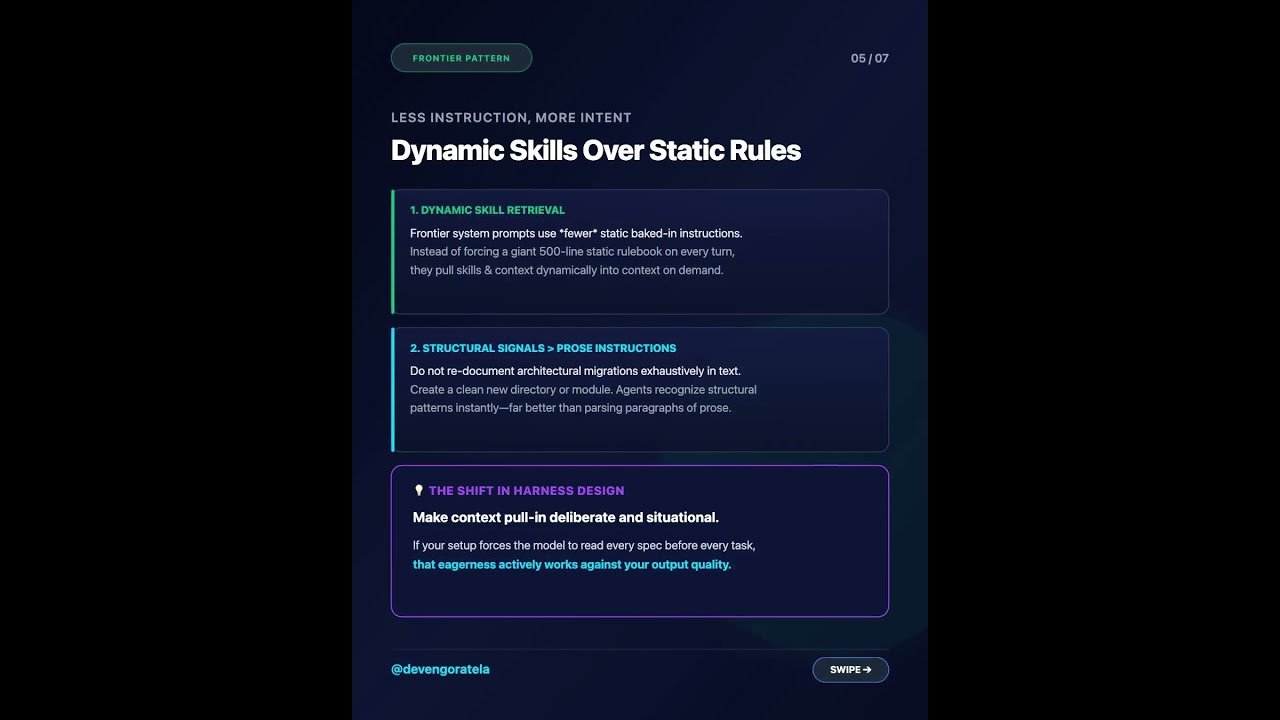
🔹 **Cut Standing Instructions:** Stop forcing the agent to read every spec before every task.
🔹 **Use Dynamic Skill Retrieval:** Pull context situationally into the window only on demand.
🔹 **Signal with Code Structure:** Use new folders & clean modules to signal patterns—agents parse structural signals faster than text docs.
🔹 **Reserve Specs for Hard Domains:** Limit specs to complex areas (billing, payment gateways).
The goal isn’t zero context. It’s the **RIGHT context**—pulled in on purpose, kept honest, and clearly separated. 🎯
💬 **How large is your project’s `CLAUDE.md` or instruction file?** Drop your setup in the comments!
💾 **SAVE this post** for your engineering team
🔄 **REPOST** to share with AI developers in your network
#AIEngineering #CodingAgents #SoftwareEngineering #TechLeadership #DeveloperExperience #PromptEngineering #SoftwareArchitecture #DevOps #AI
Video Source
About the Author