Most enterprise AI prototypes fail when they hit production.
Why? Because shipping autonomous LLMs without strict governance creates three critical failure modes:
1. **Unpredictable Outputs:** Hallucinations and schema drift breaking backend code.
2. **Zero Auditability:** Black-box decision loops that leave no audit trail for compliance.
3. **Unchecked Execution:** Autonomous side-effects mutating databases or triggering APIs without safeguards.
To solve this, I developed the **VAULT Framework** — a 5-pillar architectural governance model for enterprise AI:
🛡️ **V — Verify Output:** Validate model JSON responses against strict schemas before executing any backend actions. Never trust raw LLM text as parameter inputs.
🧩 **A — Augment Code:** Retain core business rules and calculations in proven deterministic code. Use AI for natural language parsing and intent routing, not math.
🎯 **U — Understand Intent:** Explicitly define problem intent, context boundaries, and failure fallback modes before prompt engineering.
🛑 **L — Loop Humans In:** Gate high-risk actions (financial transactions, data deletion, low-confidence outputs) behind interactive human approval checkpoints.
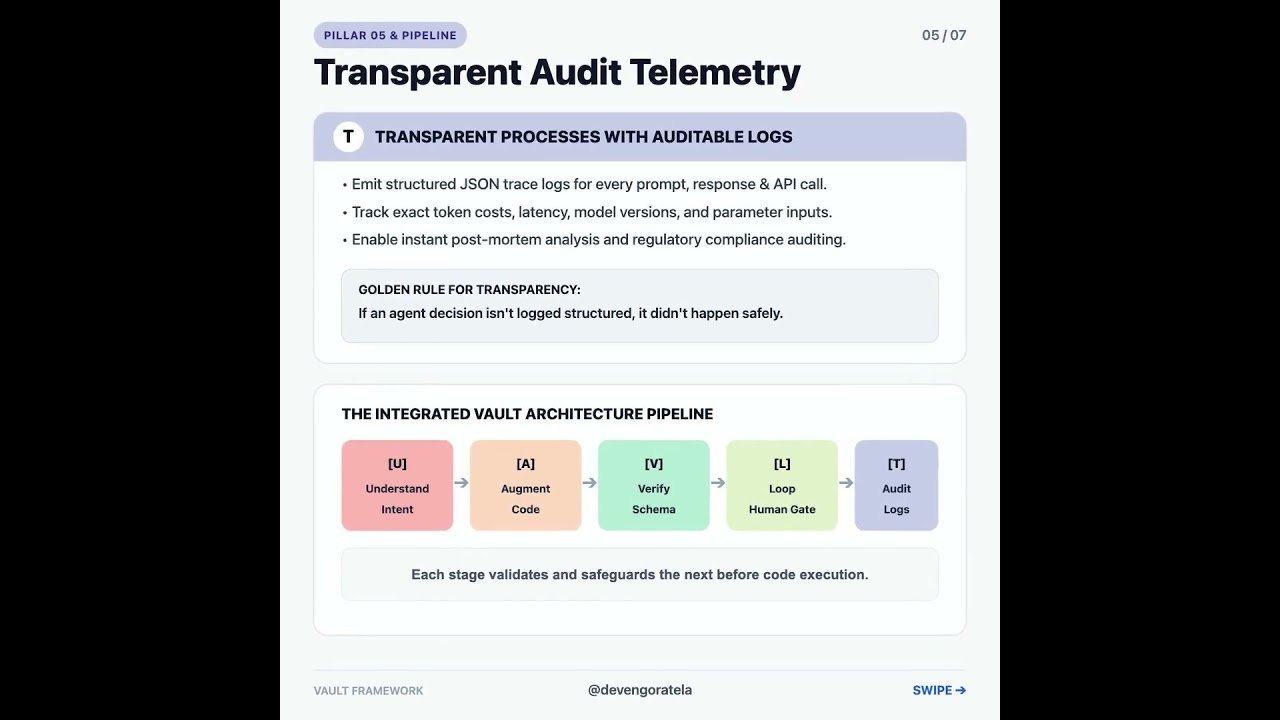
📜 **T — Transparent Logs:** Emit structured JSON trace logs for every prompt, tool call, latency metric, and decision step for instant post-mortems and compliance.
The gap between a fragile AI wrapper and an enterprise-grade system isn’t model size — it’s governance.
### Key Takeaways
– Deterministic code handles calculations; LLMs handle reasoning.
– Autonomy is earned progressively through verified safety metrics.
– If an agent decision isn’t logged in structured telemetry, it didn’t happen securely.
#EnterpriseAI #SoftwareEngineering #AIGovernance #SystemArchitecture #TechLeadership #AIProduction #LLM #Automation #AIValidation #DevOps #Developers #SoftwareArchitecture
Video Source
About the Author


![[Weekend Gaming] 77% of Game Companies Use Generative AI… "AI Skills" Top Hiring Priority Too – 아시아경제](https://lh3.googleusercontent.com/J6_coFbogxhRI9iM864NL_liGXvsQp2AupsKei7z0cNNfDvGUmWUy20nuUhkREQyrpY4bEeIBuc=s0-w300-rw "[Weekend Gaming] 77% of Game Companies Use Generative AI… \"AI Skills\" Top Hiring Priority Too – 아시아경제")