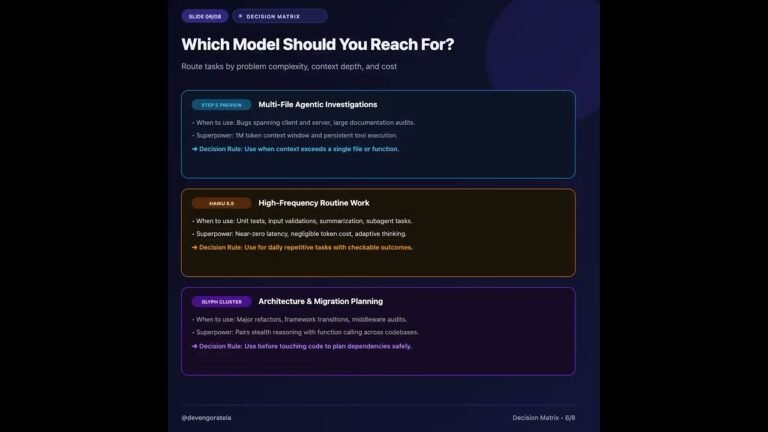
Most software engineers default to one flagship model for everything, wasting budget on routine plumbing and under-equipping deep repo investigations. Here are 3 specialized AI models you should be testing in your daily developer workflow.
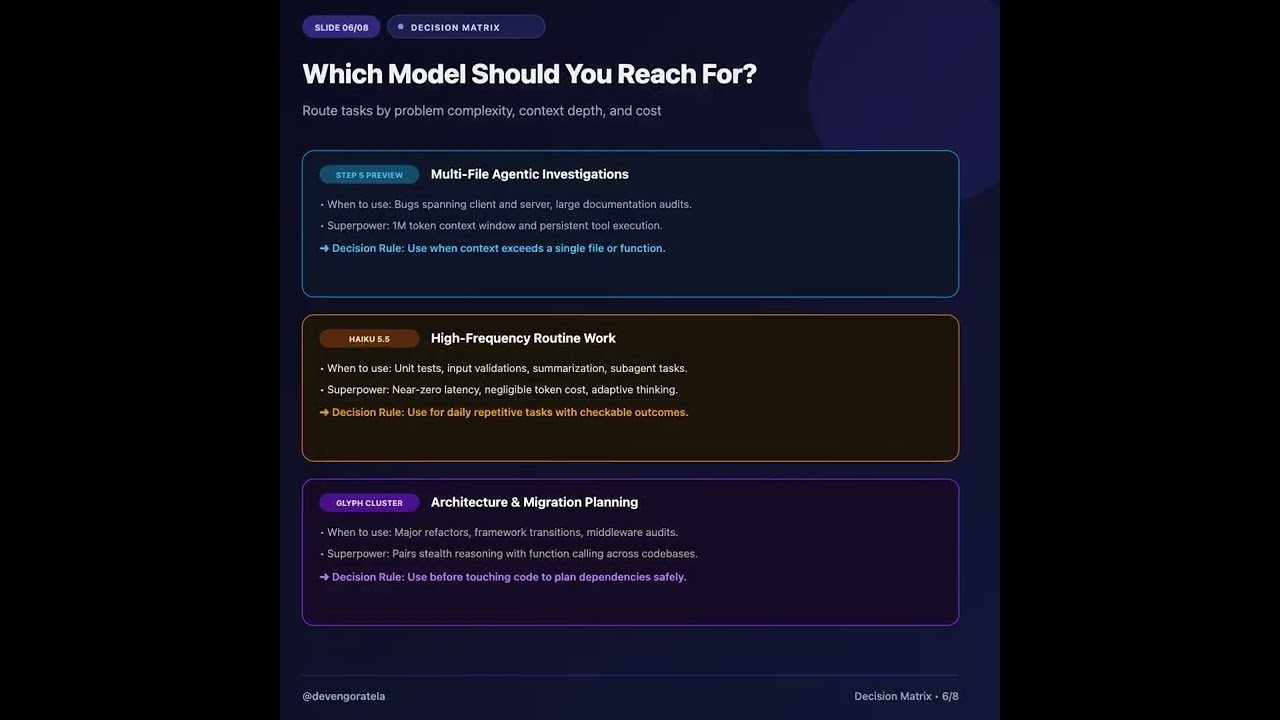
In this video, we break down why task-based model routing beats universal model usage. We examine Step 5 Preview from StepFun for multi-file agent investigations, Claude Haiku 5.5 from Anthropic for speed and economy, and Glyph Cluster from Vercel for deep architectural refactoring.
WHAT YOU WILL LEARN:
• The hidden cost of defaulting to a single frontier model
• The 3 cognitive tiers of software development tasks
• Deep repo tracing with Step 5 Preview’s 1M-token context window
• How Claude Haiku 5.5 cuts costs on unit tests and validation
• Architectural migrations with Vercel’s Glyph Cluster
• Practical benchmark prompts you can test in your own codebase
TIMESTAMPS:
00:00 – Introduction: The Default Model Trap
01:25 – Routine Tasks vs Deep Investigations
03:10 – Model 1: Step 5 Preview (StepFun) & 1M Context
05:40 – Multi-File Root Cause Tracing Prompt
07:30 – Model 2: Claude Haiku 5.5 (Speed & Economy)
09:45 – High-Frequency Unit Tests and Schema Validation
11:50 – Model 3: Glyph Cluster (Vercel) & Stealth Reasoning
13:30 – Planning Architectural Migrations Before Touching Code
15:15 – How to Architect Your Multi-Tier Model Router
RESOURCES & LINKS:
• Practical AI Community: https://skool.com
• Connect on LinkedIn: https://www.linkedin.com/in/devengoratela/
• Follow on Twitter/X: https://x.com/devengoratela
ABOUT DEVEN GORATELA:
Sharing practical AI workflows, automation architectures, and agentic engineering patterns that save real hours.
Subscribe for new AI tutorials and automation blueprints every week.
#aimodels #developertools #claudehaiku #anthropicclaude #vercelglyph
Video Source
About the Author