Most people think AI is just about automating isolated tasks.
The real shift is much bigger: AI is reshaping organizational architecture.
For over a century, organizations have been constructed around job titles 🏢
Sales rep. Recruiter. Accountant. Marketing manager. Ops lead.
Each role is essentially an arbitrary bundle of disparate tasks.
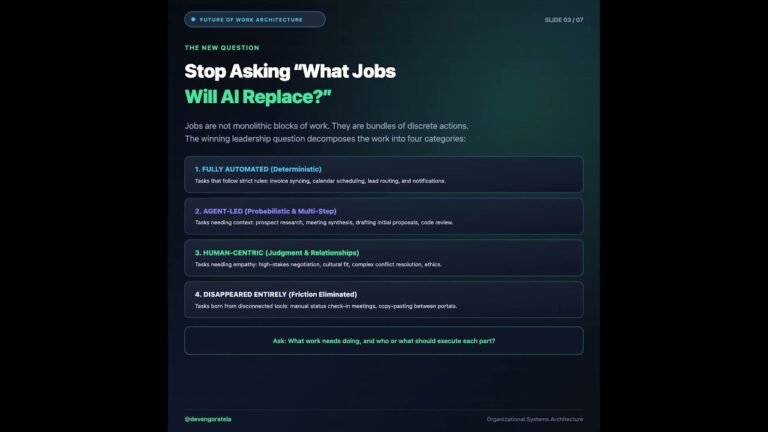
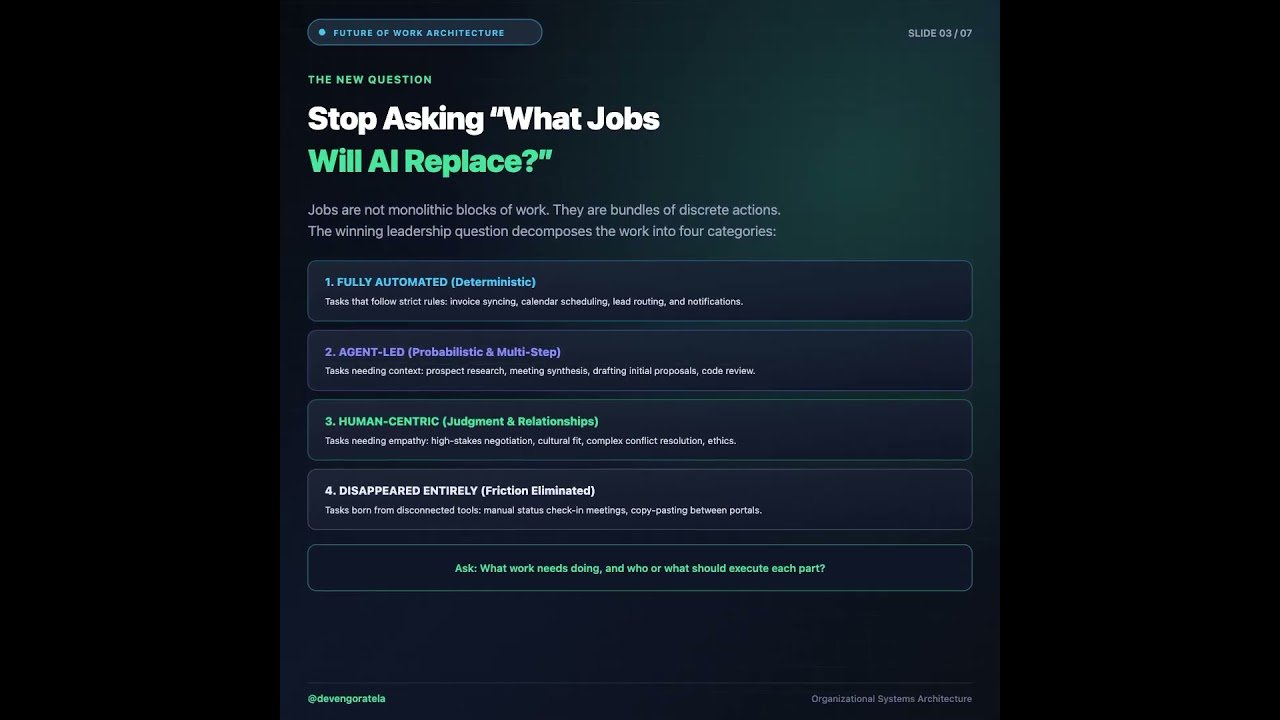
AI unpacks that entire bundle:
• Routine manual tasks get automated completely ⚡
• Cognitive prep and synthesis pass to autonomous AI agents 🤖
• Strategic judgment, empathy, and high-stakes negotiation remain human 🧠
• Low-value admin steps disappear altogether ✨
When work is unbundled this way, traditional org charts become secondary.
The underlying workflow architecture becomes primary.
Inside this 7-slide carousel:
1️⃣ The Misconception: Why task automation is only step one
2️⃣ The Legacy Model: How job titles bundled unrelated duties
3️⃣ The Great Unbundling: What happens when roles fracture into tasks
4️⃣ The New Division of Labor: Routing work between deterministic rules, agents, and humans
5️⃣ Real-World Example: How sales and recruiting evolve into hybrid operations
6️⃣ The Modern Builder’s Role: Moving from tool connector to enterprise architect
7️⃣ Strategic Question: The critical choice facing leadership today
If you build systems using n8n, Claude Code, or modern automation stacks, you aren’t just integrating APIs.
You are architecting the operating structure of next-generation companies 🚀
What do you think? In 5 years, will companies still organize around traditional titles, or around dynamic workflow networks? Drop your view below 💬
♻️ Repost this carousel to help leaders rethink team structure in the AI era.
➕ Follow Deven Goratela for practical insights on AI systems, operational workflows, and the future of work.
#AITransformation #FutureOfWork #OrganizationalDesign #WorkflowAutomation #AIArchitecture #Operations
Video Source
About the Author