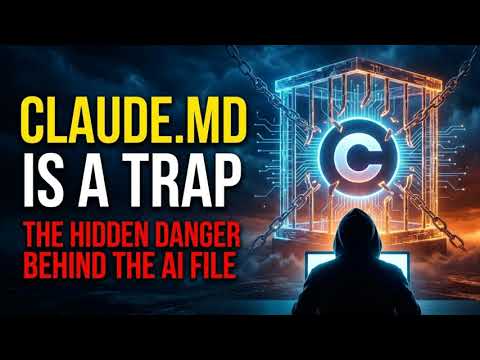
Are you falling into the “Claude.md Trap”?
The latest research from ETH Zurich reveals a shocking cost-performance divergence when using global context files like claude.md. While they might seem like a shortcut to better AI output, they could actually be making your AI agents “dumber” while increasing your inference costs by over 20%! [00:20]
In this video, we break down:
The “Payload Bloat” Mechanism: How persistent system prompts appended to every interaction create massive token overhead. [00:30]
Context Pollution: Why forcing an AI to balance local tasks against irrelevant global instructions leads to agent degradation and failed task execution. [00:40]
The Symptom Profile: Learn to spot the signs of a “polluted agent,” including token bloat, excessive tool calling, and redundant searches. [00:55]
The Architectural Exception: When is a claude.md file actually useful? We explore the “Sea of Documents” use case (like Obsidian vaults). [01:10]
The Minimalist AI Principle: How modern AI agents are now sophisticated enough to understand your codebase without constant “hand-holding.” [01:40]
Don’t let context pollution derail your development! Learn when to keep the claude.md file and when to drop it for a more efficient, cost-effective setup.
Timestamps:
0:00 – Intro: The Illusion of Global Context
0:20 – ETH Zurich Research: The 20% Cost Penalty
0:30 – Payload Bloat Diagram: The Invisible Overload
0:40 – Context Pollution: Why Agents Fail
0:55 – Symptoms of a Polluted AI Agent
1:10 – The Sea of Documents: When it Works
1:25 – Decision Matrix: Drop it vs. Keep it
1:40 – The Minimalist AI Principle
Relevant Hashtags
#ClaudeMD #AIAgents #ArtificialIntelligence #MachineLearning #AIPrompting #SoftwareDevelopment #CodingTips #TechStrategy #AIPerformance #MinimalistAI
Video Source
About the Author