There were numerous announcements at Google I/O. Here’s an important one you may have missed: Introducing Managed Agents in the Gemini API. For those familiar with ADK, you may be asking yourself how this new managed service differentiates itself.
I think it really comes down to the classic tradeoff between a fully managed cloud service vs. a build-it-yourself framework.
The newly-announced managed agents are, well, as the name implies — managed, so essentially “Agents-as-a-Service.” You give it instructions via simple Markdown files (AGENTS.md), make an API call, and Google handles the entire backend, including spinning up a secure sandbox for the agent to execute code.
ADK on the other hand, is an open-source, code-first software framework (something you can compare to LangGraph, CrewAI, or AutoGen), with a newly-released ADK 2.0 version and support for various languages, including Java, Typescript, Go, and Kotlin as of last week. ADK is a library to programmatically build the agent’s logic from scratch.
Here’s an attempt at comparing Managed Agents and ADK :
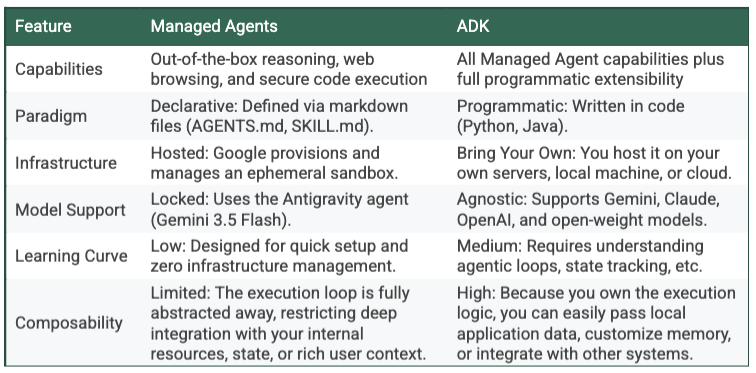
Managed Agents are currently primarily designed for single, specialized agents. In contrast, ADK is well-suited for complex multi-agent systems, with ADK 2.0 steering towards a Directed Acyclic Graph (DAG) architecture for sophisticated orchestration.
While Managed Agents offer a significantly flatter learning curve for rapid deployment, ADK’s programmatic paradigm offers potentially deeper sophistication and customization.
When should I stick to ADK?
Here are some cases that come to mind:
- Granular control over the agent loop: Managed Agents abstract the execution loop away, so if you need to customize how an agent handles memory or orchestrates multi-agents, ADK remains a solid choice.
- ADK integrates nicely with ecosystems like LangChain4j, allowing you to swap Gemini out for an Anthropic, OpenAI, or local Ollama model if your use case requires it.
- For organizations with stringent regulatory, sovereignty, or confidentiality requirements, ADK allows for both deployment within on-premises or cloud infrastructure, avoiding the multi-tenant nature of fully managed services.
If your goal is to quickly build an agent that can reason, browse the web, and execute code without worrying about server maintenance, give Managed Agents a try (and check out this Gemini Managed Agents: Developer Guide)!
If you are building a more sophisticated, multi-model application that requires you to own every line of the execution logic, ADK is your friend. Consider taking of the many available ADK Codelabs and exploring the recently announced Agent Platform which offers a number of managed services : Agent Registry, Agent Runtime, Memory Bank, etc.
Gemini Managed Agents or ADK? Autopilot or Cockpit? was originally published in Google Cloud – Community on Medium, where people are continuing the conversation by highlighting and responding to this story.
Source Credit: https://medium.com/google-cloud/gemini-managed-agents-or-adk-autopilot-or-cockpit-07355dd2310e?source=rss—-e52cf94d98af—4
About the Author