Background
Modern digital payment architectures in the ever evolving financial ecosystem require database performance, write scalability, and transactional consistency. As mobile wallets process heavy transaction volumes across unified payment channels — such as UPI, utility recharges, bill payments, and merchant checkouts — traditional single-instance databases fail under the weight of scaling bottlenecks, write hotspots, and replication lags.
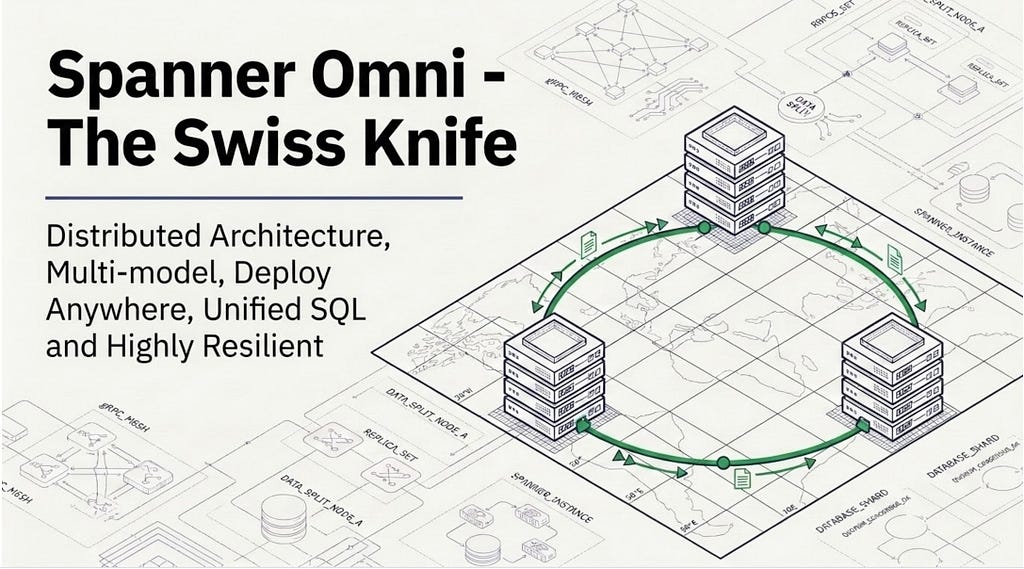
This article covers the architectural design and deployment topologies options of such Digital Payment App (let’s call it DemoPayApp) on Spanner Omni, Google’s enterprise-grade, distributed relational database engine that brings the power of Cloud Spanner to any environment — on-premises, hybrid, or multi-cloud. By combining strict relational ACID compliance with native multi-model capabilities (Columnar Engine, Property Graph, and Full-Text Search), DemoPayApp achieves real-time data convergence, high-throughput double-entry ledgering, and continuous service availability with complete database resilience under localized outages.
+-------------------------------------------------------------------------+
|                         DEMOPAYAPP CORE ENGINE                          |
+-------------------------------------------------------------------------+
|  [Relational Core]  <-->  [Property Graph] <-->  [Columnar Analytics]   |
|   ACID Transactions       Fraud Path GQL        Vectorized aggregations |
|   Schema Interleaving     Circular Money Flow   Real-time reporting     |
+-------------------------------------------------------------------------+
|                               SPANNER OMNI                              |
|                    Distributed Multi-Paxos Consensus                    |
+-------------------------------------------------------------------------+
1. Spanner — A Differentiated Geo-Distributed Database
At the core of DemoPayApp is a schema designed according to Spanner’s distributed relational principles. Unlike traditional single-instance databases that scale vertically and rely on Primary + Replica(s) based read scalability, Spanner partitions data horizontally across independent storage fragments called splits while maintaining strong global consistency and ACID transaction compliance.
Primary Key Strategy & Split Hotspot Avoidance
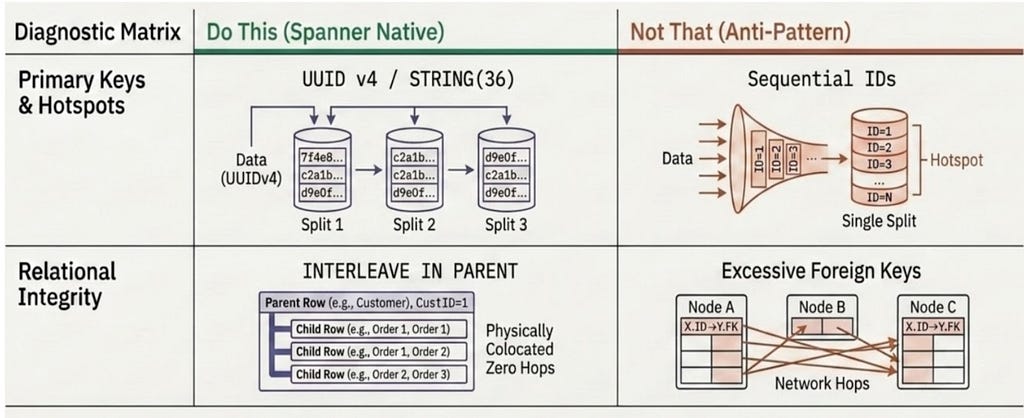
In distributed databases, monotonically increasing primary keys (such as AUTO_INCREMENT integers or sequential TIMESTAMP prefixes) represent a severe anti-pattern. Sequential inserts write into a single physical partition at the end of the keyspace, saturating a single node split while other nodes in the cluster remain idle [19].
To maximize parallel write IOPS across all nodes, DemoPayApp enforces an RFC 4122 UUID v4 string primary key strategy. The high entropy of UUID v4 prefixes ensures that data is uniformly hashed and distributed across all storage splits, eliminating ingestion hotspots.
Strategic Table Interleaving for Co-Located Locality
DemoPayApp employs table interleaving, a unique Spanner feature that establishes a physical parent-child relationship between tables in storage. Interleaving physically co-locates child rows inside the same storage split as the parent row. This design dramatically reduces network round trips during joins, since the co-located child rows are fetched in a single physical I/O operation.
For instance, DemoPayApp utilizes three primary interleaved hierarchies:
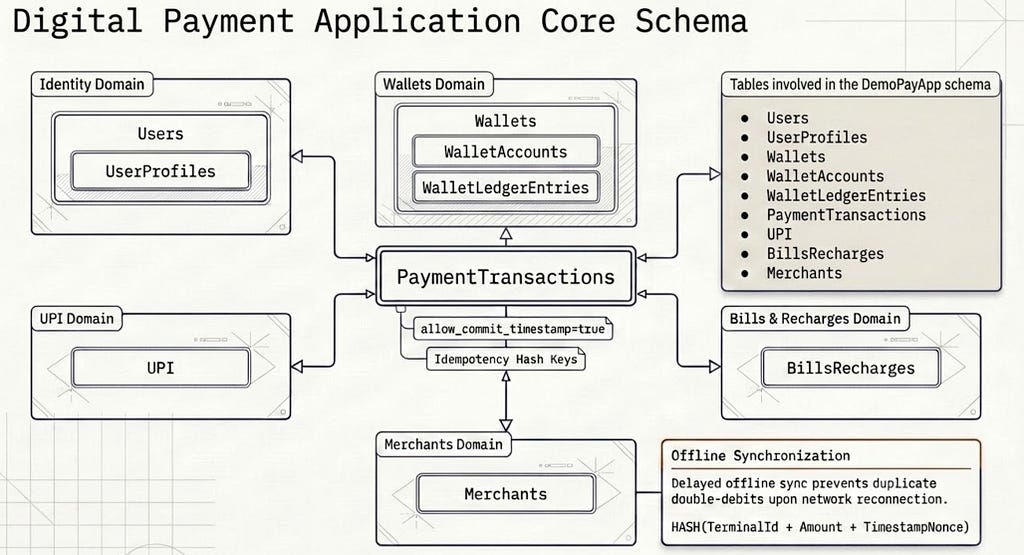
- UserProfiles interleaved inside Users: Since user profile updates and fetches are strictly tied to the individual customer, co-location ensures highly localized, rapid identity resolution.
- WalletAccounts, WalletTransactions, and WalletLedgerEntries interleaved in Wallets: High-frequency balance lookups, history fetches, and ledger modifications are handled locally on the same storage node.
- TransactionLifecycleEvents interleaved in PaymentTransactions: Co-locates all operational state audits and transitions alongside the parent transaction.
+-------------------------------------------------------+
|  Users (Parent Table split on UUIDv4 keys)            |
|  [UserId: usr-uuid-...]                               |
|   +-------------------------------------------------+ |
|   |  UserProfiles (Interleaved Child)               | |
|   |  [UserId: usr-uuid-...]                         | |
|   +-------------------------------------------------+ |
+-------------------------------------------------------+
Further Fine-Tuning: Financial Monetary Correctness
Representing monetary values using IEEE 754 floating-point numbers introduces binary rounding errors, which violate financial compliance. DemoPayApp mandates the use of fixed-point integer minor units (Paise) stored in INT64 (where ₹1.00 = 100 Paise). Storing balances and amounts as integers eliminates rounding vulnerabilities while supporting transactions of massive scales.
2. The Multi-Model Core of Spanner Omni
Modern payment systems require multiple data storage paradigms. User registration and payment ledgers demand strict relational structures; fraud detection requires graph representations of user-merchant transaction circles; and customer-merchant discovery requires fast fuzzy searching.
Historically, companies resolved this by deploying a “polyglot persistence” architecture, synchronizing data across a relational database, a graph database, and a search engine. This approach introduces operational complexity, latency, and consistency issues.
+------------------------------------------------------------------------+
|                      POLYGLOT PERSISTENCE TRADEOFF                     |
| Relational DB  ====== Sync ETL (Lag) ======> Graph DB (Fraud)          |
| Relational DB  ====== Sync ETL (Lag) ======> Search Engine (FTS)       |
| * Issues: Write amplification, sync lag, data mismatch, high TCO       |
+------------------------------------------------------------------------+
|                      SPANNER MULTI-MODEL SOLUTION                      |
|                      +--------------------------+                      |
|                      |       Spanner Omni       |                      |
|                      |  +--------------------+  |                      |
|                      |  |     Relational     |  |                      |
|                      |  +--------------------+  |                      |
|                      |  |  GQL Graph  |  FTS |  |                      |
|                      |  +--------------------+  |                      |
|                      |  |   Columnar Engine  |  |                      |
|                      |  +--------------------+  |                      |
|                      +--------------------------+                      |
| * Benefits: Zero-lag, single engine consistency, native execution      |
+------------------------------------------------------------------------+
Spanner Omni resolves this by natively integrating Relational, Property Graph (GQL), Columnar (HTAP), and Full-Text Search (FTS) into a single engine. This allows DemoPayApp to query relational tables, walk financial transaction graphs, execute vectorized aggregations, and perform fuzzy name search in a single SQL statement.
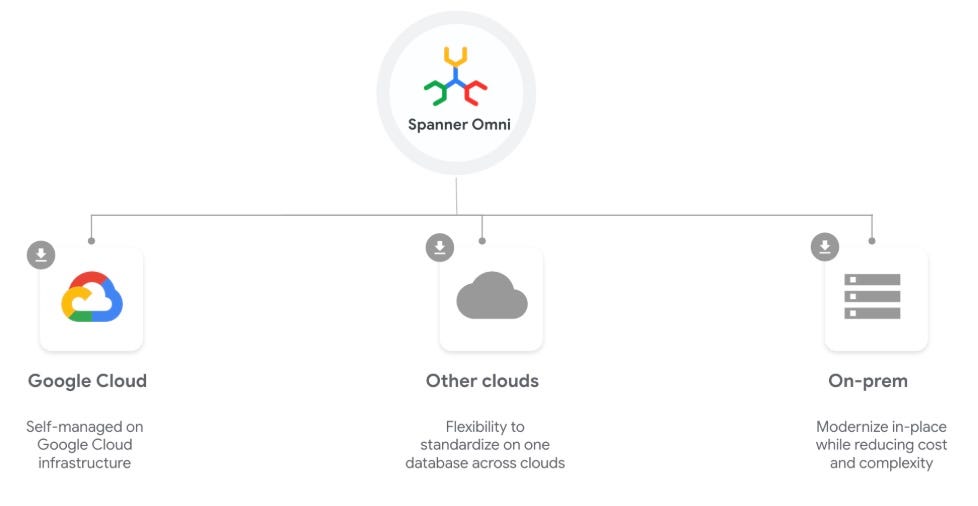
3. Spanner Omni: “Run It Anywhere at Any Scale”
Spanner Omni decouples Spanner’s core engine from Google Cloud infrastructure, allowing developers to run the exact same database engine on any VM, bare-metal hardware, Containers, or edge nodes.
4. Deep-Dive into Deployment Topologies
DemoPayApp can be designed to support distinct physical deployment topologies depending on business and/or regulatory requirements and infrastructure setups:
A. Deployment Architectures
- Cloud-Native Topology: Runs across standard managed cloud environments (e.g., virtual machine instances) using local virtual networks.
- On-Premises Hybrid Topology: Integrates on-premises private data centers with public cloud infrastructure. Zonal memberships are extended across dedicated virtual tunnels (e.g., direct network connections), allowing on-prem nodes to act as synchronous replicas alongside cloud instances.
- Multi-Cloud Topology: Runs across different hyperscalers to allow running the same setup on multiple hyperscalers, distributing root read-write replicas across diverse availability zones and cloud networks.
B. High Availability Multi-Paxos Replica Topologies
Spanner Omni supports multiple replica configurations to balance fault tolerance, latency, and operational complexity. These are designed based on three primary layouts:
1. Zonal Topologies
- Replicas: Typically uses a minimum of 3 read-write replicas.
- How it Works: All replicas and their corresponding compute nodes are placed within a single zone or logical datacenter segment.
- Operational Flow: This topology is ideal for localized development or non-critical staging. All writes and reads are executed within the same physical building. If that zone experiences a utility or hardware failure, the deployment will experience an outage until the zone recovers.
2. Regional Topologies
Regional topologies split replicas across multiple distinct availability zones within the same geographic boundary.
- Replicas: Minimum of 3 read-write replicas distributed across separate zones.
- How it Works: The compute nodes are spread across different availability zones (e.g., zone-a, zone-b, and zone-c) within a single logical region.
- Operational Flow: This is the baseline configuration for standard production workloads. Writes are sent to the elected Paxos leader, which replicates the transaction to the other two zones. Once a majority (2 out of 3 replicas) acknowledges the write, the transaction commits. If any single zone fails completely, the remaining two zones maintain a majority quorum, allowing DemoPayApp to continue serving read and write traffic with zero downtime or data loss.
3. Multi-Regional Topologies
Multi-regional topologies expand the cluster across geographically separated boundaries.
- Replicas: Typically uses a minimum of 5 replicas (such as 4 read-write replicas and 1 witness replica) distributed across at least 3 distinct regions or sites.
- How it Works: Replicas are distributed geographically to survive entire site outages. A standard configuration places 2 read-write replicas in the primary site, 2 read-write replicas in the secondary site, and 1 witness replica in a third, isolated site.
- Operational Flow: The witness replica does not store user data tables; it only participates in Paxos voting. When a write is initiated, the leader coordinates a vote across all sites. Since a majority requires 3 out of 5 votes, the transaction can commit using local replicas plus the witness, or replicas from the alternate site. If any single site fails completely (taking down 2 replicas), the surviving 3 replicas across the other sites maintain quorum, ensuring continuous read-write operations.
C. Deployment Choices in Spanner Omni
Spanner Omni offers flexible deployment choices across various infrastructure runtimes and architectures to satisfy diverse operational needs. It can be deployed on standard Virtual Machines (VMs), bare-metal hardware, or inside Linux containers for direct resource control, as well as on Kubernetes clusters (such as GKE or EKS) using official Helm charts for automated orchestration and self-healing.
Depending on redundancy goals, these runtimes can be configured into multiple topologies: from single-server setups for local prototyping, to multi-zone and multi-cluster (multi-regional) stretched deployments. This enables organizations to run the database in pure public cloud environments, on-premises data centers, or in hybrid and multi-cloud architectures to balance performance with strict data residency and disaster recovery mandates.
5. Columnar Engine with Its Benefits
DemoPayApp is a hybrid transactional and analytical (HTAP) application. While processing online UPI payments (OLTP), the system must simultaneously compile operational dashboards, transaction aggregates, and settlement metrics (OLAP).
Traditionally, this required copying transactions via ETL to an analytical warehouse, introducing synchronization lag. Spanner Omni solves this through its Columnar Analytics Engine.
Vectorized OLAP Acceleration and Layout Optimization
By creating a layout-optimized, covering index (IDX_PaymentTxns_DomainStatus) storing the Amount and CreatedAt attributes, Spanner Omni stores these index records in a high-density, columnar format on disk. The Columnar Engine uses Single Instruction Multiple Data (SIMD) processor vectorization to query this index, allowing the database to scan datasets in parallel without read/write locking conflicts.
-- Create Columnar Layout Index for Domain and Status Analytics
CREATE INDEX IDX_PaymentTxns_DomainStatus
ON PaymentTransactions(PaymentDomain, Status)
STORING (Amount, CreatedAt);
Analytics Execution & Performance Verification
The following analytics query calculates total transaction volumes and average ticket sizes across payment categories:
SELECT
    PaymentDomain,
    COUNT(*) AS TransactionVolume,
    SUM(Amount) AS TotalPaise,
    ROUND(AVG(Amount)/100.0, 2) AS AvgTransactionINR
FROM PaymentTransactions @{FORCE_INDEX=IDX_PaymentTxns_DomainStatus}
WHERE Status = 'SUCCESS'
GROUP BY PaymentDomain
ORDER BY TotalPaise DESC;
Analytical Benefits:
- Storage Footprint: High-speed, contiguous columnar layout scans optimize analytical aggregation efficiency.
- Resource Isolation: Analytical scans pull from layout-optimized index structures, leaving the primary write-path splits completely unblocked and free of contention.
- Vectorized Parallelism: Uses SIMD hardware instructions to perform real-time math over database columns, dramatically accelerating reports.
6. Property Graph Engine & Money Flow Use-Cases
Identifying complex money circulation loops and structured money laundering paths is difficult with traditional SQL relational structures, requiring expensive multi-table joins that degrade database performance.
DemoPayApp utilizes the native Spanner Property Graph Engine to address this. This engine overlays graph semantics directly onto relational tables, enabling developers to query data using standard ISO GQL (Graph Query Language) pattern matching.
Schema Definition: DemoPayAppGraph
The graph defines nodes for Users and Merchants, linked by directed edges representing payment channels (PAID_MERCHANT):
-- 1. Add foreign key linking column to edge table
ALTER TABLE MerchantPaymentAcceptances ADD COLUMN InitiatorUserId STRING(36);

-- 2. Define Property Graph Schema
CREATE PROPERTY GRAPH DemoPayAppGraph
NODE TABLES (
  Users
    KEY (UserId)
    LABEL User PROPERTIES (UserId, FullName, PrimaryEmail, PhoneNumber, AccountStatus),
  Merchants
    KEY (MerchantId)
    LABEL Merchant PROPERTIES (MerchantId, LegalName, TradingName, MCC, IsActive)
)
EDGE TABLES (
  MerchantPaymentAcceptances AS MerchantPayments
    KEY (AcceptanceId)
    SOURCE KEY (InitiatorUserId) REFERENCES Users(UserId)
    DESTINATION KEY (MerchantId) REFERENCES Merchants(MerchantId)
    LABEL PAID_MERCHANT PROPERTIES (AcceptanceId, TransactionId, PaymentChannel)
);
       +------------------+
       |   (u:User)       |  <-- Source Node (e.g., John Doe)
       +------------------+
                |
                |      [PAID_MERCHANT] (Directed Edge)
                v
       +------------------+
       |  (m:Merchant)    |  <-- Destination Node (e.g., Merchant-Alpha)
       +------------------+
Graph Use-Case: High-Speed Fraud Tracking
Using GQL, fraud teams match complex transaction paths across the network instantly:
GRAPH DemoPayAppGraph
MATCH (u:User)-[p:PAID_MERCHANT]->(m:Merchant)
RETURN u.FullName AS CustomerName, m.TradingName AS MerchantName, p.PaymentChannel, p.TransactionId
LIMIT 5;
This GQL query bypasses standard relational joining systems, traversing internal node-edge pointer maps directly on the storage split to achieve highly predictable, path-traversal analysis.
7. Full-Text Search (FTS) and Hybrid Search
Finding specific merchants or users across millions of accounts requires flexible, tolerant text matching. Standard SQL LIKE ‘%Doe%’ matches force costly full-table scans that consume processing resources.
DemoPayApp solves this by enabling Spanner’s Full-Text Search (FTS) Tokenizer Engine.
+-------------------------------------------------------------+
|                     FTS INVERTED INDEX FLOW                 |
|                                                             |
|   "John Doe"    ---> [TOKENIZE_FULLTEXT] ---> ["John",      |
|                                                 "Doe"]      |
|                                                     |       |
|                                                     v       |
|                     Search Index: IDX_Users_FTS <---+       |
|            (Points directly to physical row positions)      |
+-------------------------------------------------------------+
Schema Enhancements & Indexing
FTS uses hidden TOKENLIST columns that are asynchronously tokenized using TOKENIZE_FULLTEXT() and mapped via inverted search indexes:
-- 1. Add Token Columns
ALTER TABLE Users ADD COLUMN FullName_Tokens TOKENLIST AS (TOKENIZE_FULLTEXT(FullName)) HIDDEN;
ALTER TABLE Merchants ADD COLUMN TradingName_Tokens TOKENLIST AS (TOKENIZE_FULLTEXT(TradingName)) HIDDEN;
ALTER TABLE PaymentTransactions ADD COLUMN FailureReason_Tokens TOKENLIST AS (TOKENIZE_FULLTEXT(FailureReason)) HIDDEN;

-- 2. Create Inverted Search Indexes
CREATE SEARCH INDEX IDX_Users_FTS ON Users(FullName_Tokens) STORING (PrimaryEmail, PhoneNumber);
CREATE SEARCH INDEX IDX_Merchants_FTS ON Merchants(TradingName_Tokens) STORING (LegalName, MCC);
CREATE SEARCH INDEX IDX_PaymentTxns_FTS ON PaymentTransactions(FailureReason_Tokens) STORING (Amount, PaymentDomain, Status);
Fuzzy and Boolean Search Queries
To find customers with variations of names using boolean logic:
SELECT UserId, FullName, PrimaryEmail, PhoneNumber
FROM Users @{FORCE_INDEX=IDX_Users_FTS}
WHERE SEARCH(FullName_Tokens, 'John OR Doe')
LIMIT 5;
8. Unified Multi-Model Execution: The Power of Spanner Omni
The true power of native multi-model architecture is realized when DemoPayApp combines Graph, Full-Text Search, Columnar Analytics, and Interleaved Relational Joins into a single query block.
This query allows a compliance officer to search for customers matching “John Doe” (FTS), map their payments to specific merchants (GQL), filter for successful transactions (Columnar layout index), and pull customer profile metadata (Interleaved Relational Join).
SELECT
    u.FullName AS CustomerName,
    m.TradingName AS MerchantName,
    g.PaymentChannel,
    p.PaymentDomain,
    p.Amount AS PaiseAmount,
    ROUND(p.Amount / 100.0, 2) AS AmountINR,
    up.City,
    up.State,
    p.CreatedAt
FROM GRAPH_TABLE(
    DemoPayAppGraph
    MATCH (u:User)-[p:PAID_MERCHANT]->(m:Merchant)
    COLUMNS (
        u.UserId AS CustomerId,
        m.MerchantId AS MerchantId,
        p.AcceptanceId AS AcceptanceId,
        p.TransactionId AS TransactionId,
        p.PaymentChannel AS PaymentChannel
    )
) AS g
JOIN Users @{FORCE_INDEX=IDX_Users_FTS} u ON g.CustomerId = u.UserId
JOIN Merchants @{FORCE_INDEX=IDX_Merchants_FTS} m ON g.MerchantId = m.MerchantId
JOIN PaymentTransactions @{FORCE_INDEX=IDX_PaymentTxns_DomainStatus} p ON g.TransactionId = p.TransactionId
LEFT JOIN UserProfiles up ON g.CustomerId = up.UserId
WHERE SEARCH(u.FullName_Tokens, 'John OR Doe')
  AND SEARCH(m.TradingName_Tokens, 'Merchant-Alpha OR Merchant-Beta')
  AND p.Status = 'SUCCESS'
ORDER BY p.Amount DESC
LIMIT 10;
Conclusion
Using Spanner Omni, the organizations eliminate the trade-offs of traditional relational, graph, and search systems. The combined deployment of strict relational table interleaving, Multi-Paxos consensus topology layouts, Columnar aggregations, and GQL property graphs equips any Digital Payment Application with a resilient data platform capable of running anywhere at planet-scale.
NOTE: Spanner Omni as on the date of publishing this article (24Jul2026) is a preview offering subject to the “Pre-GA Offerings Terms”. Hence, always refer to the Spanner Omni official documentation for the latest status.
References
- Spanner Omni overview
- Spanner Omni key terms
- Spanner Omni system requirements
- Create a deployment on VMs
- Spanner schema design best practices
- Spanner columnar engine overview
- Spanner graph overview
- Spanner Full-text Search
Architecting Next-Gen Digital Payment App to run Anywhere using Spanner Omni was originally published in Google Cloud – Community on Medium, where people are continuing the conversation by highlighting and responding to this story.
Source Credit: https://medium.com/google-cloud/architecting-next-gen-digital-payment-app-to-run-anywhere-using-spanner-omni-a7935093dc68?source=rss—-e52cf94d98af—4
About the Author