The smarter the agent becomes, the worse a monolithic prompt performs. That sounds backward, but it is exactly what happens.
I keep seeing the same pattern.
Someone starts building an AI agent, and the first version feels simple enough. They write a large system prompt, define the role, add response style rules, include business constraints, maybe insert internal policies, a few formatting instructions, edge cases, and a growing list of “always do this” guidance. For a short time, it works.
Then the agent grows.
The moment it has to handle more than a few workflows, that giant prompt stops being convenient. It becomes expensive to send on every request. It becomes harder to maintain. It becomes easier to break. And eventually, each new requirement adds weight to a structure that was never designed to scale in the first place.
That is why I find ADK and Skills so interesting. The important idea is not just modularity for the sake of neatness. It is the move from putting everything into one prompt to building an agent that loads knowledge progressively. In other words, the agent starts with lightweight awareness of what capabilities exist, and only pulls in detailed instructions or reference material when a task actually requires them.
That shift sounds small, but it changes everything.
Why the giant prompt stops working
A monolithic prompt often feels efficient in the beginning because it keeps all the logic in one place. There is one file, one instruction block, one mental model. But once the agent becomes more useful, the downside becomes obvious.
Every new skill makes the prompt longer. Every exception makes the logic messier. Every update increases the risk of unintended side effects. Soon the agent is dragging around far more context than it needs for most tasks.
That creates three problems at once.
First, the cost goes up because unnecessary context is included again and again.
Second, reliability goes down because the model has to sift through too much unrelated information before it finds what matters.
Third, maintenance gets painful because changing one part of the agent means touching a central instruction block that now controls almost everything.
This is the point where I stop thinking in terms of “prompt writing” and start thinking in terms of “agent architecture.”
What changes when I use Skills
The core idea is simple.
Instead of forcing the agent to keep all of its knowledge in the base prompt, I break capabilities into separate Skills.
Each Skill has a clear name and description. That gives the agent a lightweight map of what it can do.
When the agent sees a task that matches one of those skills, it can load the instructions for that specific capability.
If the skill needs extra material, such as policies, examples, checklists, or internal guidance, those resources can be loaded only when necessary.
This is what makes the model feel less like a single overloaded assistant and more like a system with specialized modules.
I like to think of it this way: the agent should carry an index, not the entire library.
A cleaner mental model for agent design
Once I started looking at AI agents this way, the structure became much more intuitive.
The flow is no longer:
user request → giant prompt → hope the model finds the right rule
It becomes:
user request → agent sees available skills → agent selects the right skill → agent loads instructions → agent loads references only if needed → response
That architecture is easier to grow because I can add a new capability without rewriting the whole brain of the system.
It is easier to debug because each skill has a defined responsibility.
And it is easier to reuse because a good skill can move from one agent to another with far less friction than a tangled prompt section copied out of a giant instruction file.
Example 1: a small inline Skill
When a workflow is narrow and stable, I like starting with an inline skill. It keeps the initial setup simple while still giving the agent specialized behavior.
Imagine I am building an agent for a support team that needs to classify incidents by severity.
from google.adk import Agent
from google.adk.skills import models
from google.adk.tools import skill_toolset

incident_skill = models.Skill(
    frontmatter=models.Frontmatter(
        name="incident-triage",
        description="Classifies support incidents by severity and suggests the next action."
    ),
    instructions="""
When the user describes an incident:

1. Classify severity as low, medium, high, or critical.
2. Explain why that severity fits.
3. Assess possible impact on revenue, data, service availability, and trust.
4. Suggest the next action for the support team.
5. Return the result in a clear and structured format.
"""
)

skills = skill_toolset.SkillToolset(skills=[incident_skill])

root_agent = Agent(
    name="support_ops_agent",
    model="your-model",
    description="Helps a support team review and respond to incidents.",
    instruction="You support operations workflows and use Skills when specialized reasoning is needed.",
    tools=[skills],
)
What matters here is not just the code. What matters is the design choice.
The agent does not need every operational detail in the main prompt from the beginning. It only needs to know that a skill called incident-triage exists and what it is for. When a user says something like, “Customers cannot log in after the latest update and payment failures are rising,” the agent can activate that skill and load the relevant instructions at the right moment.
That makes the system feel much more deliberate.
This example is useful because the task is highly specific. The skill description tells the agent exactly when to use it. The instruction block tells the agent exactly how to behave once the skill is activated. That separation is what makes the system easier to trust and easier to expand later.
When inline Skills stop being enough
Inline skills are great for narrow cases, but they become limiting when the amount of supporting knowledge grows.
As soon as a skill depends on reference material, internal rules, content standards, review criteria, or reusable guidance, I prefer moving it into its own folder structure. That gives the skill a more durable shape and makes it easier to maintain over time.
Let us say I want an agent that reviews a sales proposal before it is sent to a client.
A structure like this is much easier to manage:
skills/proposal-review/
├── SKILL.md
└── references/
    ├── tone-rules.md
    └── red-flags.md
The main SKILL.md file could look like this:
---
name: proposal-review
description: Reviews a sales proposal before it is sent to a client.
---

When the user provides a draft proposal:

1. Check whether the client value is clear and concrete.
2. Find vague claims and generic statements.
3. If tone needs review, load references/tone-rules.md.
4. If risky wording or questionable promises appear, load references/red-flags.md.
5. Return the result in three sections:
   - what already works,
   - what should be improved,
   - a stronger rewritten version of the key paragraph.
And the agent setup stays clean:
import pathlib
from google.adk import Agent
from google.adk.skills import load_skill_from_dir
from google.adk.tools import skill_toolset

proposal_skill = load_skill_from_dir(
    pathlib.Path(__file__).parent / "skills" / "proposal-review"
)

skills = skill_toolset.SkillToolset(skills=[proposal_skill])

root_agent = Agent(
    name="sales_editor_agent",
    model="your-model",
    description="Reviews proposals and improves business writing.",
    instruction="You help improve proposal quality and use Skills for specialized review.",
    tools=[skills],
)
This approach becomes powerful for a very practical reason: the main instructions stay focused, while the heavier material lives in supporting files.
That means I can update the tone guidance without touching the central behavior of the agent.
I can refine the list of risky claims without rewriting a giant prompt.
And I can move this skill into another agent later without copying fragments out of a large instruction block and hoping nothing breaks.
For me, this is where the architecture starts to feel mature.
Why this matters more in 2026
In 2026, building an AI agent is no longer just about making it sound smart in a demo. The real challenge is making it stable as it grows.
That means the agent needs structure.
It needs a clean way to add capabilities.
It needs a way to load knowledge without dragging the entire system into every request.
And it needs boundaries between responsibilities, because that is what makes change manageable.
This is why I think the conversation is shifting. The industry is moving away from the idea that a better agent is simply a longer prompt with more rules inside it. The stronger approach is to design the agent like a living system: small core, modular capabilities, and selective access to deeper knowledge only when needed.
The most underrated advantage: maintenance
People often focus on token savings first, and that is fair. Reducing unnecessary context matters.
But for me, the more important benefit is maintenance.
A giant prompt creates hidden coupling. Rules that should be separate sit next to each other and quietly interfere. A change for one workflow can affect another workflow without anyone noticing until the agent starts behaving strangely.
Skills reduce that risk because they force clearer boundaries.
A support skill can stay a support skill.
A document review skill can stay a document review skill.
A compliance skill can keep its own references and logic.
That separation makes the whole system easier to reason about, easier to test, and far easier to evolve.
What I would treat as best practice
I would start with a small set of focused skills rather than trying to design a universal agent on day one.
I would write each skill description as carefully as I would write the interface for an internal tool, because that description is what guides selection.
I would keep the core instructions concise and move detailed materials into references whenever possible.
And I would treat generated or auto-created skills with caution. If an agent starts helping create new skills, that can be powerful, but those skills should be reviewed, tested, and evaluated before they become part of a production workflow.
That is the difference between a system that grows intelligently and a system that quietly accumulates chaos.
My takeaway
The biggest mistake I see in agent design is assuming that a bigger prompt is the same thing as a better system.
It is not.
A monolithic prompt is often a useful starting point, but it is a weak foundation once the agent begins to scale. The moment I want maintainability, modular growth, cleaner reasoning, and better control over context, I need something more structured.
That is why ADK and Skills matter.
They push agent design away from “how do I cram more into the prompt” and toward “how do I build a system that can grow without collapsing under its own instructions.”
To me, that is one of the most important shifts in AI agent design in 2026.
🙏 If you found this article helpful, give it a 👏 and hit Follow — it helps more people discover it.
🌱 Good ideas tend to spread. I truly appreciate it when readers pass them along.
📬 I also write more focused content on JavaScript, React, Python, DevOps, and more — no noise, just useful insights. Take a look if you’re curious.
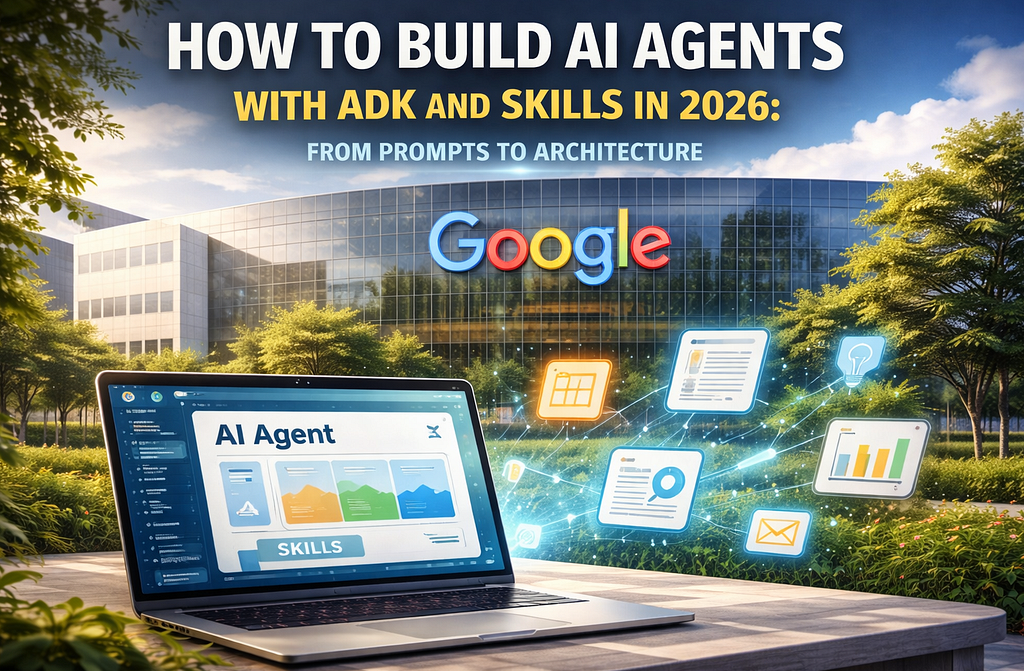
How to Build AI Agents with ADK and Skills in 2026: From Prompts to Architecture was originally published in Google Cloud – Community on Medium, where people are continuing the conversation by highlighting and responding to this story.
Source Credit: https://medium.com/google-cloud/how-to-build-ai-agents-with-adk-and-skills-in-2026-from-prompts-to-architecture-2b7c5ff7003c?source=rss—-e52cf94d98af—4
About the Author