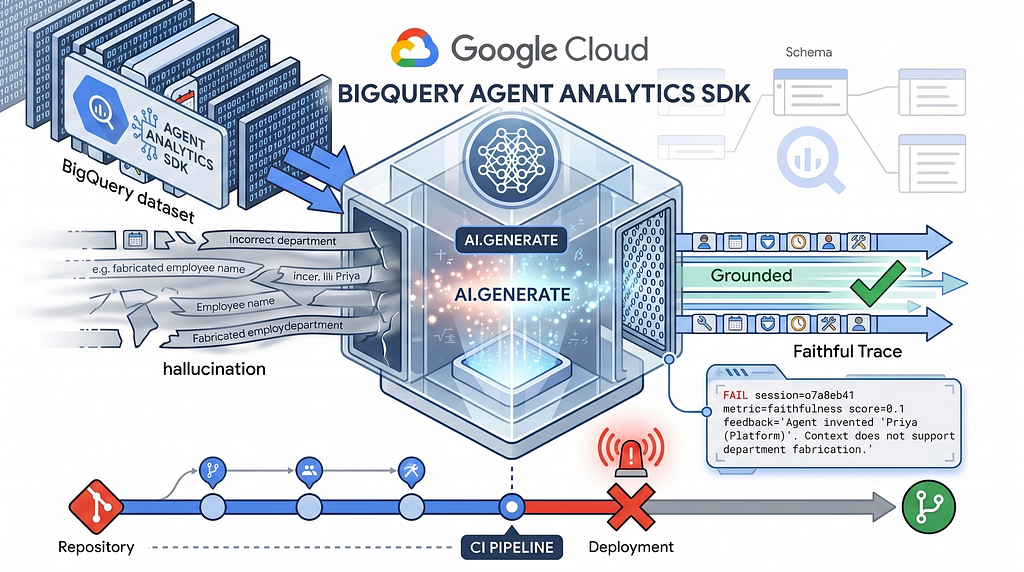
BigQuery Agent Analytics Series 3: Use BigQuery Agent Analytics, AI.GENERATE, and yesterday’s production traces to gate CI on hallucination, correctness, and sentiment.
1. Hook
Imagine your agent’s CI is fully green. Latency budget: passed. Token budget: passed. Tool errors: zero. Turn count: under cap. You merge. The next morning a user reports the agent confidently told them their meeting was booked with “Jordan Lee (Design)” — except Jordan Lee is in Platform, and the meeting never made it onto the calendar.
The deterministic gate from post #2 in this series caught nothing. It couldn’t. “The agent invented a detail” is not a budget you can put a number on.
That’s the gap. This post fills it with one workflow step.
By the end, you’ll have:
- A semantic CI gate that runs AI.GENERATE over yesterday's production traces and fails the PR when the agent is making things up.
- A FAIL line on stderr that names the session and quotes the model’s own justification — not a vibe score.
- The same –exit-code shape post #2 already trained your CI on; one extra workflow step.
- Live-verified against current BigQuery — no broken table-valued SQL, no missing connection_id.
2. The problem in one paragraph
Post #2’s deterministic gates catch things you can put a number on. Some regressions hide under those numbers. Confident wrong answers. Refusals. Off-tone responses. Schema-shaped hallucinations — the agent asserts a team or a date that wasn’t in any tool output, and the surrounding response is plausible enough that latency is fine, tokens are fine, no tool errors fire. You can’t scale “did a human read it” to fleet traffic. You also can’t trust a vibe score from a hand-rolled judge prompt. The SDK ships three pre-built judges (correctness, hallucination, sentiment) backed by frozen prompt templates and a typed score INT64, justification STRING output schema, runnable over thousands of sessions in a single AI.GENERATE SQL job — or via a transparent Gemini API fallback when AI.GENERATE isn't available in your environment.
3. The SDK is already AI-in-warehouse
One CLI invocation, same exit-code shape post #2 trained your CI on:
bq-agent-sdk evaluate \
  --project-id="$PROJECT_ID" \
  --dataset-id="$DATASET_ID" \
  --evaluator=llm-judge \
  --criterion=hallucination \
  --threshold=0.7 \
  --last=24h \
  --agent-id=calendar_assistant \
  --exit-code
Three things to know:
- AI.GENERATE issues the model call from BigQuery SQL. The judge runs as a single BigQuery job — no app-side export, no custom judge service in the middle. (Inference itself is Vertex AI-backed; see section 6 for how the BQ side and the AI Platform side bill separately.) When AI.GENERATE isn't available (no project access, wrong region, missing permissions), the SDK falls back to direct Gemini API calls via google-genai. report.details["execution_mode"] says which path actually ran (ai_generate, ml_generate_text, or api_fallback) so your CI logs are auditable.
- –exit-code is the same gate post #2 used. Exit 0 means every session passed the threshold; exit 1 means at least one failed; exit 2 means configuration error. Your existing GitHub Actions / Cloud Build wiring honors it.
- Failure output explains itself when the judge gives a parseable score. When the gate fails, scored FAIL lines carry the session id, the metric, the score, and a bounded feedback="…" snippet drawn from the judge's justification — the model telling you exactly what it caught. Sessions where AI.GENERATE didn't return a parseable score still show up as FAIL session=… (no per-metric detail available) and still count as failures (more on those in section 4).
4. The demo — semantic gate catches what budgets can’t
Real run, captured today against the same Calendar-Assistant demo from posts #1 and #2. The agent’s prompt was tweaked to be more “decisive” — confirm bookings, propose times, fill in plausible team names. The deterministic budgets from post #2 wouldn’t have caught this regression: the agent’s responses are within latency, token, and turn budgets, and there are no tool errors. In the run below the deterministic steps appear greyed out because the semantic gate runs first and ends the job on its first failure; for this PR the kind of regression the budgets check for never came up.
Here’s what AI.GENERATE returns when you ask it whether the agent's claims are supported by the trace:
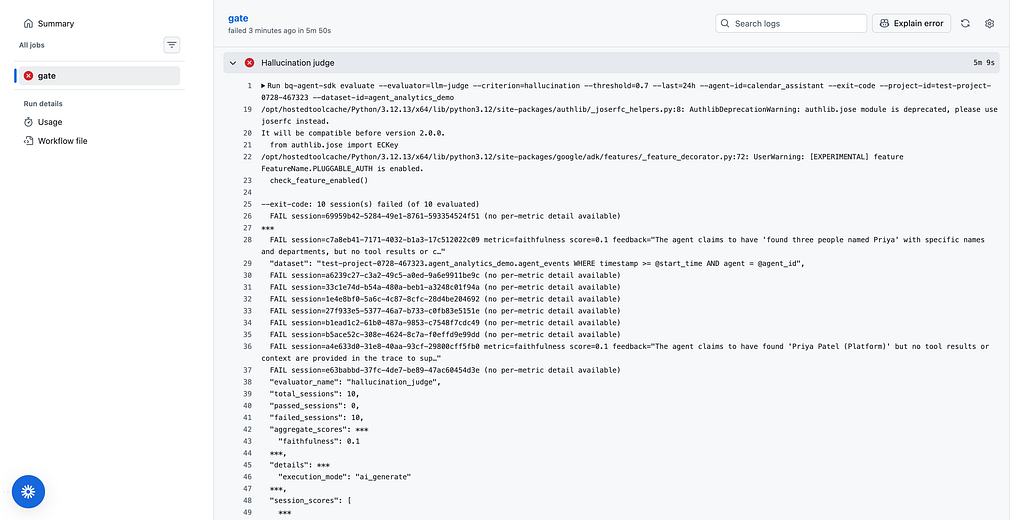
--exit-code: 10 session(s) failed (of 10 evaluated)
  FAIL session=69959b42 (no per-metric detail available)
  FAIL session=c7a8eb41 metric=faithfulness score=0.1
        feedback="The agent claims to have 'found three people named
                  Priya' with specific names and departments, but no
                  tool results or c…"
  FAIL session=a6239c27 (no per-metric detail available)
  FAIL session=33c1e74d (no per-metric detail available)
  FAIL session=1e4e8bf0 (no per-metric detail available)
  FAIL session=27f933e5 (no per-metric detail available)
  FAIL session=b1ead1c2 (no per-metric detail available)
  FAIL session=b5ace52c (no per-metric detail available)
  FAIL session=a4e633d0 metric=faithfulness score=0.1
        feedback="The agent claims to have found 'Priya Patel
                  (Platform)' but no tool results or context are
                  provided in the trace to sup…"
  FAIL session=e63babbd (no per-metric detail available)
Three things worth pausing on:
- The judge cites the trace. “Priya Patel (Platform)”, “three people named Priya” — the agent confidently asserts specific names and departments. The tool output never said any of that. The judge spots it.
- Scored sessions come back at 0.1, well under the 0.7 threshold. The model isn’t split on these; it’s sharply confident the agent fabricated specifics. Tune your threshold above what your judge considers a passing answer.
- The other eight rows are (no per-metric detail available). Those are sessions where AI.GENERATE returned an empty score for that row — the regressed agent's responses didn't fit the judge's structured-output schema cleanly. Empty scores fail any non-zero threshold, so the gate still fires red on them. If a dashboard needs to tell empty-score failures apart from low-score failures, add –strict and the SDK stamps details["parse_error"]=True plus a report-level parse_errors counter. For pass/fail-only CI, –strict is a no-op.
If you only copy one thing from this post, copy that one workflow step. Add it to the gate from post #2 with –evaluator=llm-judge –criterion=hallucination –threshold=0.7 –exit-code and your next merge against unsupported claims goes red. [Gist](TBD: Gist URL for llm_judge_hallucination.sh — resolve before publish).
Latency you can measure. Hallucination you have to score.
5. Going deeper — stack judges, don’t pick one
The same workflow step extends to two more judges with frozen prompts:
- name: Hallucination judge
  run: bq-agent-sdk evaluate --evaluator=llm-judge
       --criterion=hallucination --threshold=0.7
       --last=24h --agent-id=calendar_assistant --exit-code
       --project-id=${{ vars.PROJECT_ID }}
       --dataset-id=${{ vars.DATASET_ID }}
- name: Correctness judge
  run: bq-agent-sdk evaluate --evaluator=llm-judge
       --criterion=correctness --threshold=0.7 ...
- name: Sentiment judge
  run: bq-agent-sdk evaluate --evaluator=llm-judge
       --criterion=sentiment --threshold=0.6 ...
Each gets its own threshold; each shows up as its own row in the CI log. To pick the right combination for your agent, run all three locally against a slice of recent traffic before wiring them into CI. Against a three-session slice of the same trace data this post’s CI run scored, run separately, the picture splits cleanly:
- Correctness scored the slice 0.9–1.0 (3/3 pass at threshold 0.7). The agent does what it’s asked given what its tools returned.
- Sentiment scored the slice 0.8–0.9 (3/3 pass at threshold 0.6). Helpful tone.
- Hallucination/faithfulness scored the slice 0.1–0.3 (0/3 pass). Same agent, same data — the grounding is what’s broken.
That’s why faithfulness is the sharper judge for this trace data, and why a booking agent should care about it more than tone. A support bot or a copywriting assistant might invert the priority.
A short compare/contrast vs. post #2’s categorical-eval: LLMAsJudge produces continuous scores (0.0–1.0), good for thresholded gates and tracking distributions over time. categorical-eval produces discrete one-of-N classifications, good for pass-rate gates over named categories. Use both in the same workflow when both shapes apply.
6. What the plugin labels show over time
The SDK labels every BigQuery query it issues. Three sdk_feature rows show up in INFORMATION_SCHEMA after a day of judge runs:
SELECT
  (SELECT value FROM UNNEST(labels) WHERE key = 'sdk_feature') AS sdk_feature,
  COUNT(*) AS runs,
  ROUND(SUM(total_bytes_processed) / POW(1024, 3), 3) AS gb_processed,
  ROUND(AVG(total_slot_ms), 0) AS avg_slot_ms
FROM `region-us`.INFORMATION_SCHEMA.JOBS_BY_PROJECT
WHERE creation_time >= TIMESTAMP_SUB(CURRENT_TIMESTAMP(), INTERVAL 24 HOUR)
  AND EXISTS (
    SELECT 1 FROM UNNEST(labels)
    WHERE key = 'sdk' AND value = 'bigquery-agent-analytics'
  )
GROUP BY sdk_feature
ORDER BY runs DESC;
Three things you’ll see when you run this against your own CI:
- eval-code — the deterministic gates from post #2. Cheap; small bytes, sub-second slot ms.
- eval-llm-judge — the new semantic gate. Larger slot ms (the model call dominates), still small bytes.
- trace-read — developers pulling individual failing sessions with client.get_session_trace(…).render() from post #1.
One gotcha: AI.GENERATE jobs do show up in INFORMATION_SCHEMA, but Vertex AI inference is billed separately on the AI Platform side. The pivot tells you what the BigQuery side costs; check the AI Platform billing report for the inference side.
7. Try it
- Enable the BigQuery Agent Analytics plugin (5-minute quickstart). If you have an ADK agent running, the plugin is a 5-minute wire-up and it starts populating agent_events immediately.
- Star the SDK repo if this made your next release safer
Two-step CTA:
- Add one step to your post-#2 workflow with –evaluator=llm-judge –criterion=hallucination –threshold=0.7 –exit-code (the same shape used in section 3 and section 4). Run it against your last 24 hours of traces; tune the threshold once you've seen the score distribution your agent actually produces. Add –strict later if you want a dashboard to tell empty-score failures apart from low-score ones — the gate exits red the same way either way.
- If you don’t have AI.GENERATE access in your project — wrong region, missing model permissions — install bigquery-agent-analytics[improvement] and the SDK uses the Gemini API fallback path automatically. Same scores, different mechanics.
Your CI shouldn’t only check what you wrote. It should check whether the agent stays grounded in what your tools said.
If you haven’t seen the deterministic gate yet, post #2 is Your Agent Events Table Is Also a Test Suite. Same SDK, complementary gate: post #2 turns rows into a budget gate; this post turns the same rows into a semantic gate.
Scalable LLM-as-Judge: Automating Agent Evaluation Directly in BigQuery was originally published in Google Cloud – Community on Medium, where people are continuing the conversation by highlighting and responding to this story.
Source Credit: https://medium.com/google-cloud/scalable-llm-as-judge-automating-agent-evaluation-directly-in-bigquery-302ca4acf19f?source=rss—-e52cf94d98af—4
About the Author