A Proposed Blueprint for Rebuilding Corporate Treasury on Google Cloud and Blockchain
Here’s a scenario that plays out thousands of times every business day.
A multinational corporation’s treasury team needs to move $10 million from its US headquarters to its Singapore subsidiary. Someone logs into a banking portal. A payment instruction is keyed in. A SWIFT message departs. It navigates through two correspondent banks, each extracting a fee, each adding latency. By the time funds clear — assuming no message formatting errors, no AML flags, no currency cut-off complications — it’s Thursday. The original instruction was sent Monday.
Three to five business days. Approximately $45 in fees per transaction. Zero visibility while the money is in transit.
Now imagine the same payment settled in 8 seconds, for five cents, with cryptographic proof of delivery, an automatic SAP journal entry, and a Travel Rule compliance record simultaneously written to an immutable audit ledger.
That’s not a thought experiment. That’s what a well-designed blockchain treasury platform running on Google Cloud delivers today.
This article is the full architecture blueprint for how to build it.
Why Now? The Compounding Cost of Doing Nothing
Corporate treasury has a dirty secret. While retail banking has been transformed — you can split a dinner bill in seconds on your phone — the systems that move billions between corporate entities look almost identical to how they looked in 1995. SWIFT MT messages. Correspondent bank chains. Nostro accounts pre-funded with trapped capital. Batch settlement runs. End-of-day bank statements that give CFOs a 24-hour lag on their own global cash position.
The numbers tell the story:
- A 50-subsidiary multinational runs 2,450 bilateral settlement transactions daily just to net obligations between its own entities
- Correspondent bank cross-border payments cost $25–50 each and represent the bank’s margin, not the customer’s value
- Corporate treasury teams spend 40% of their time on reconciliation — matching what the bank says happened to what their ERP says should have happened
- $120 trillion in cross-border transactions occurs annually, with friction costing an estimated $2 trillion in aggregate fees and trapped capital
Blockchain technology was invented to solve exactly these problems. The question that every CISO, CFO, and Chief Digital Officer is grappling with right now isn’t “should we explore blockchain treasury?” It’s “which architecture is actually production-grade, regulatory-compliant, and safe enough for us to run our real money through?”
This blueprint answers that question.
The Architecture: Seven Layers That Replace a Century of Banking Infrastructure
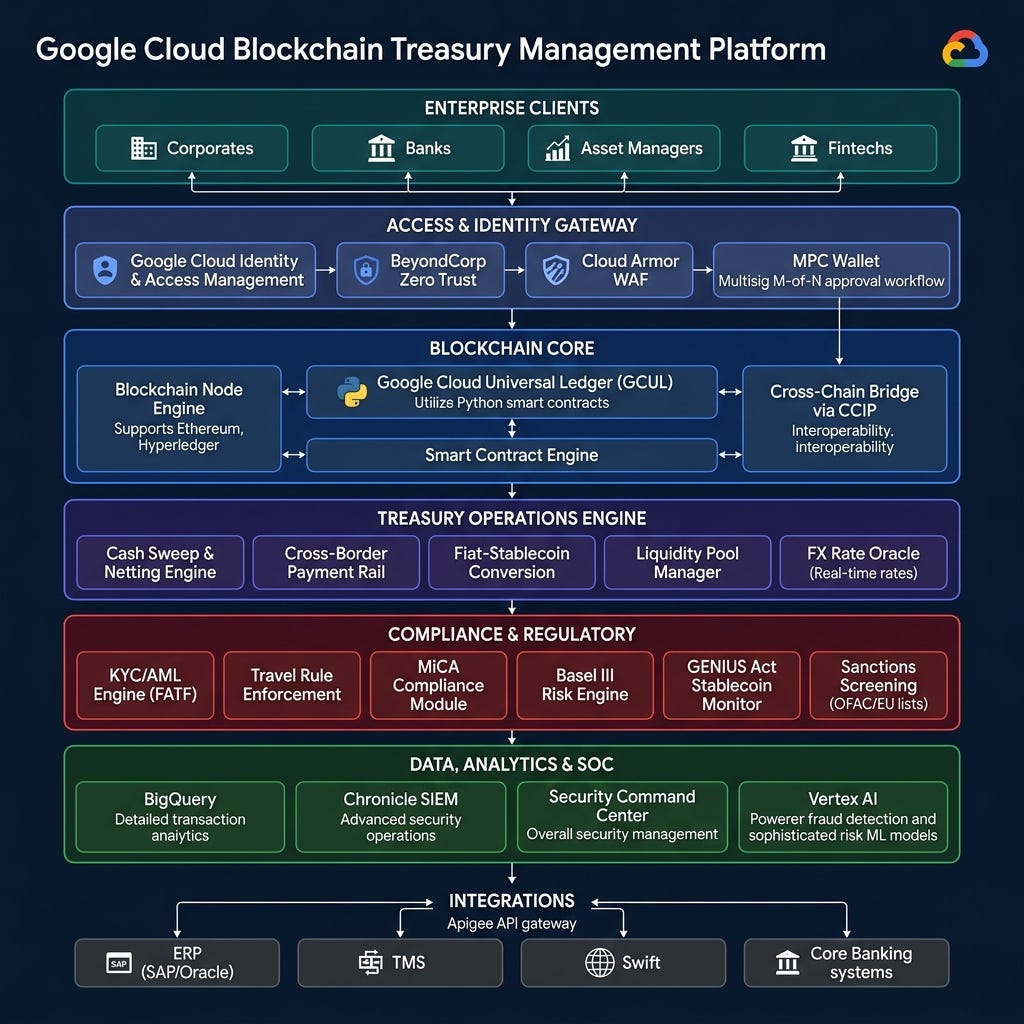
The platform is built across seven distinct layers, each with a specific responsibility, each mapped to specific Google Cloud services that are already in production and already carrying enterprise SLAs.
Google Cloud Blockchain Treasury Management Architecture
The complete 7-layer reference architecture — from enterprise clients to ERP integrations
Let me walk you through each one.
Layer 1: Enterprise Clients — Meeting Customers Where They Are
The first design principle of any enterprise platform is that you don’t rip out what’s working. A treasury team at a Fortune 500 company has SAP S/4HANA, Kyriba, and Bloomberg Terminal deeply embedded in their workflows. You don’t replace those. You connect to them.
Every entity — whether a multinational corporation connecting via its Oracle Fusion ERP, a commercial bank speaking ISO 20022 through its Temenos core banking system, an asset manager running ION Treasury, or a fintech using a native GraphQL SDK — arrives at the same front door: Google Cloud Apigee.
Apigee handles the impedance mismatch between the legacy world and the on-chain world. It speaks every protocol: REST, SOAP, gRPC, SFTP, ISO 20022, SWIFT MT/MX, FIX. It authenticates every caller with OAuth 2.0 and mutual TLS, rate-limits against abuse, and logs every request and response to Cloud Logging before a single instruction touches the blockchain. Think of it as the universal adapter for the global financial system.
Layer 2: The Vault Door — Security Before Anything Moves
If Layer 1 is the entrance, Layer 2 is the security gauntlet that every asset instruction has to pass before it gets anywhere near actual money.
This is the most security-critical layer in the entire stack, and it operates on a simple philosophy: no implicit trust, anywhere, ever.
Google Cloud IAM and BeyondCorp Enterprise enforce Zero Trust access. Every request — whether it comes from a treasury officer’s laptop or an automated ERP system — is evaluated in real time against four factors: who is the identity, what device are they using, what is their location, and what time is it? A CFO connecting from a new device at 3 AM from a country they’ve never accessed from before gets challenged, regardless of their credentials. This isn’t a VPN-era mindset. It’s context-aware security at the request level.
Cloud Armor sits in front of everything, running ML-powered DDoS detection and enforcing OWASP Top 10 protections, with pre-configured financial services rule sets. Geo-IP restrictions automatically block API calls from sanctioned jurisdictions — Russia, Iran, North Korea — at the network layer, before the request even reaches the application.
But the most architecturally interesting component in this layer is the MPC Wallet infrastructure.
In a blockchain system, the private key is the asset. Whoever controls the key controls the funds. There is no “forgot my password” recovery, no customer service helpline, no reversal. Key compromise equals permanent, irreversible loss.
The solution is Multi-Party Computation (MPC) running inside Google Confidential Space — hardware-based Trusted Execution Environments where computation happens inside an encrypted enclave that not even Google administrators can access. Private key material is split into shares distributed across multiple independent Cloud HSMs (FIPS 140–2 Level 3 validated hardware) located in geographically separate facilities. No single HSM ever holds a complete key. No single person or system can reconstruct it alone.
For high-value transactions, this combines with M-of-N multisignature approval. A payment above $5 million requires three of five designated approvers to independently sign with their MPC key shares. Cloud Workflows orchestrates this as an automated approval pipeline: the treasury team initiates, Pub/Sub sends push notifications to approvers’ mobile devices, and the transaction executes only when the cryptographic consensus threshold is met. It’s mathematically enforced governance that no internal fraud, no social engineering, and no single point of key compromise can bypass.
Layer 3: The Blockchain Core — Where Digital Assets Live
This is where the rubber meets the road.
The centerpiece is Google Cloud Universal Ledger (GCUL), announced in 2025 and now in active pilot with institutions including the CME Group. GCUL is Google’s own purpose-built, permissioned blockchain designed specifically for financial institutions — and it carries a characteristic that sets it apart from every other enterprise blockchain on the market.
Its smart contracts are written in Python.
This matters more than it sounds. Today, blockchain smart contracts are predominantly written in Solidity — a specialized language most financial engineers have never encountered. Asking a treasury team to deploy Solidity for their cash sweep rules is like asking your accounting team to develop their financial models in assembly language. GCUL eliminates this barrier entirely. The same Python skills that power a data science team or a quant’s risk model can write a production smart contract.
Here’s what a real cash sweep contract looks like on GCUL:
class CashSweepContract:
    def __init__(self, master_wallet, threshold_min, threshold_max):
        self.master = master_wallet
        self.min = threshold_min
        self.max = threshold_max

    def on_balance_change(self, subsidiary_wallet, new_balance):
        if new_balance > self.max:
            excess = new_balance - self.max
            self.transfer(subsidiary_wallet, self.master, excess)
            self.emit_event("SWEEP_UP", excess, timestamp=now())
        elif new_balance < self.min:
            deficit = self.min - new_balance
            self.transfer(self.master, subsidiary_wallet, deficit)
            self.emit_event("INJECT_DOWN", deficit, timestamp=now())
Every time a subsidiary wallet’s balance changes, this contract fires automatically. Excess funds above the maximum threshold sweep up to the master treasury wallet instantly. Balances that drop below the minimum receive an automatic injection. No manual intervention. No batch runs. No overnight float sitting idle. The CFO’s capital efficiency strategy is expressed as executable code.
GCUL also carries specific enterprise attributes that public blockchains cannot match: no gas fee volatility (predictable monthly pricing instead), a KYC-gated validator set that makes it compliant by design, Byzantine Fault Tolerant consensus achieving finality in under 2 seconds, and 10,000+ transactions per second throughput.
For clients that also need public chain interoperability — say, to access DeFi yield protocols on Ethereum or Avalanche — the Blockchain Node Engine provides managed, auto-patched node infrastructure, and Chainlink’s Cross-Chain Interoperability Protocol (CCIP) acts as the secure bridge between GCUL and 15+ public and private chains.
Layer 4: The Treasury Operations Engine — Business Logic at Blockchain Speed
The blockchain core holds and moves assets. The Treasury Operations Engine decides what to move, when, and to where.
Multilateral Netting is perhaps the best example of how blockchain transforms treasury economics. A 50-subsidiary multinational currently runs 50 × 49 = 2,450 bilateral netting calculations daily to determine the net obligations between every possible entity pair. Each calculation is slow, error-prone, and triggers its own settlement transaction.
On-chain, this collapses to a single atomic operation. A Cloud Run service, triggered by Pub/Sub, pulls all subsidiary positions from BigQuery in under 50 milliseconds, runs a Vertex AI optimization model to calculate the minimum settlement set across all entities, dispatches the optimal settlement instructions to GCUL smart contracts, and all positions update atomically. The settlement risk that existed between the old T+2 bilateral settlements? Eliminated entirely. The 2,450 transactions? Replaced by one.
The Cross-Border Payment Rail replaces the correspondent bank chain entirely. Payment instructions travel through Pub/Sub, hit GCUL smart contracts for execution, cross-chain via CCIP if the destination requires a different network, and convert to local currency via an on-chain FX oracle — updated every 100 milliseconds with rates from 31 independent data providers, aggregated using a volume-weighted median that’s mathematically resistant to manipulation.
For digital asset management, the platform supports the full spectrum of instruments that modern treasury needs: regulated stablecoins like USDC and EURCV for cross-border settlement bridging, tokenized bank deposits via Partior for interbank settlement, tokenized money market funds from Fidelity and BlackRock for yield-bearing idle cash, and wholesale CBDCs from MAS and the ECB in pilot. The Liquidity Pool Manager, powered by Vertex AI cash flow forecasting with 94% accuracy on 90-day horizons, allocates across these instruments automatically, deploying idle capital to yield-generating positions and recalling it just-in-time when payment obligations arise.
Layer 5: Compliance — The Layer That Cannot Be Optional
Let me be direct about something. Every other layer in this architecture makes the treasury team’s life more efficient. This layer makes the platform deployable in the real world of regulated finance.
Regulatory failure is not a recoverable event. EU MiCA violations carry fines of up to 5% of annual global turnover. AML failures result in license revocation and criminal liability for executives. OFAC sanctions violations trigger penalties that have exceeded $1 billion for individual institutions. A beautiful treasury architecture that can’t pass regulatory scrutiny is worthless.
This is why the compliance layer is not an afterthought bolted onto the outside. It is enforcement-first, programmatic, and pre-transactional.
KYC/AML runs through Document AI for identity verification during onboarding, Chainalysis and Elliptic for real-time wallet risk scoring against known illicit addresses, and Vertex AI behavioral models that detect unusual patterns — velocity spikes, structuring, counterparty graph anomalies — that rule-based systems miss entirely.
The FATF Travel Rule (Recommendation 16) requires that for every VASP-to-VASP transfer above $1,000, the originator’s identifying information travels with the transaction — collected before execution, transmitted to the beneficiary, and archived. The platform enforces this via Notabene integration, with all Travel Rule records written to Cloud Spanner, Google’s globally consistent database with 99.999% availability, specifically chosen because Travel Rule archives face regulatory subpoena without warning.
MiCA compliance — the EU’s Markets in Crypto-Assets regulation, now in full force — is enforced by smart contracts running directly on GCUL. Reserve verification runs via Chainlink Proof of Reserve in real time. Liquidity buffers are maintained automatically (≥30% in demand deposits as required). Transaction limits over €200 million per day are automatically blocked at the contract level. Periodic reports to ESMA flow automatically via Cloud Composer.
Basel III capital treatment for banks uses a risk weight engine that classifies assets according to the BCBS framework: tokenized traditional assets treated identically to their underlying, stablecoins under the market risk framework, and unbacked crypto at the punitive 1,250% risk weight with real-time exposure limit monitoring. Vertex AI runs stress tests simulating 30%, 60%, and 80% crypto market drawdowns, generating regulatory-ready reports.
OFAC and sanctions screening operates pre-transaction, not post-transaction. This distinction is critical. The platform doesn’t alert you after suspicious money has moved. It blocks the wire before it sends. Sanctions lists update every 15 minutes via Cloud Functions. Wallet addresses are scored against Chainalysis. Beneficiary names run through a Vertex AI NLP fuzzy-matching model that catches transliterations, misspellings, and the naming variations that hard-coded sanctions screeners routinely miss.
The full regulatory coverage spans 12 frameworks across every major jurisdiction: MiCA, GENIUS Act, FATF AML/CFT, Basel III, Bank Secrecy Act, PSD2, GDPR, DORA, SOX, PDPA/PDPL, and OFAC/EU/UN sanctions. This isn’t compliance consulting. It’s compliance as running code.
Layer 6: The 24/7 SOC — Security Operations That Never Sleep
You can build the most cryptographically secure treasury platform in the world. You will still face adversaries who probe it every minute of every day, looking for the human factors, the configuration errors, the zero-day vulnerabilities that math alone can’t defend against.
The response is a Security Operations Center built on Google Security Operations (Chronicle SIEM) — a platform designed to ingest and analyze security telemetry at petabyte scale. Every GCUL transaction log, every Cloud Armor WAF event, every IAM change, every KMS key access, every VPC flow record, every blockchain node event, and every MPC wallet access log streams into Chronicle in real time.
The detection is written in YARA-L, a rule language purpose-built for large-scale threat detection. A rule that detects a suspicious wallet drainage pattern — five or more large transfers from the same wallet within 10 minutes — looks like this:
rule rapid_wallet_drain {
  meta:
    severity = "CRITICAL"
    tactic = "Exfiltration"
  events:
    $e.metadata.event_type = "BLOCKCHAIN_TRANSFER"
    $e.target.wallet = $wallet
    $e.network.sent_bytes > 1000000
    #e > 5 over 10m
  condition:
    $e
}
When this fires, Chronicle SOAR launches an automated playbook: MPC wallet access is suspended, the compliance officer is notified, the on-call security analyst gets the full event context pre-enriched with threat intelligence, and the incident is escalated in seconds rather than the minutes or hours that manual SOC processes require.
Security Command Center Premium runs continuous compliance monitoring across SOC 2 Type II, ISO 27001, PCI DSS v4, CIS Benchmarks, and NIST CSF simultaneously. Every Google Cloud resource is automatically assessed. Misconfigurations are flagged before auditors find them. Compliance evidence is collected continuously, not scrambled together the week before an audit.
Vertex AI adds the intelligence layer on top of what rules-based systems can detect. Five models run in production:
- A Transaction Fraud Detector processing 847 on-chain and off-chain features, returning a risk score in under 50 milliseconds
- An AML Typology Classifier identifying money laundering pattern types from transaction graphs in under 200 milliseconds
- A Cash Flow Predictor generating 90-day forecasts from 36-month history plus macroeconomic signals
- A Liquidity Optimizer producing optimal capital allocation recommendations in under one second
- A Smart Contract Auditor scanning bytecode for vulnerabilities before deployment — because the most important time to detect a flaw in a financial smart contract is before real money runs through it
All models carry full governance: lineage tracking, bias detection, SHAP explainability for regulatory examination, and continuous performance monitoring with data drift alerts.
Layer 7: Integration — Connecting the New to the Old
The final layer ensures the platform doesn’t exist in isolation. Every on-chain transaction needs to flow back into the systems of record that run the business: the ERP, the TMS, the accounting system, the core banking platform.
Apigee serves as the universal connector here too, but in the outbound direction. When a GCUL smart contract executes, a Pub/Sub event fires and fans out simultaneously to five subscribers: the compliance engine for AML screening (under 100ms), the SAP booking service creating the journal entry, the treasury team notification service, the BigQuery streaming insert for analytics, and the audit log service for the immutable write. Every downstream system receives the event in real time, in parallel, with guaranteed delivery.
BigQuery provides the analytical foundation: every on-chain transaction at sub-100ms latency, queryable at petabyte scale, powering Looker Studio dashboards that give the CFO a real-time global cash position map, an intraday liquidity waterfall, settlement efficiency metrics, and FX exposure dashboards with live hedge effectiveness ratios.
Putting It All Together: A $10 Million Cross-Border Payment in 8 Seconds
Let me trace the original scenario through the full architecture.
A treasury officer initiates a $10 million payment from the US to Singapore via Kyriba. The instruction hits Apigee, is authenticated with OAuth 2.0 and mTLS, then runs OFAC screening in under 10 milliseconds and a Vertex AI AML behavioral check in under 50 milliseconds. Because the amount exceeds $5 million, Cloud Workflows triggers the 3-of-5 multisig approval workflow, pushing notifications to five designated approvers. Three approve, signing with their MPC key shares stored in geographically distributed Cloud HSMs.
GCUL smart contracts execute: USDC is minted or drawn from the Circle integration, CCIP bridges it to the Singapore entity wallet, and an on-chain FX oracle converts it to SGD, which the MAS FastPay rail credits to the destination bank account instantly.
Post-settlement: Travel Rule data transmits to the Singapore VASP via Notabene. SAP creates the journal entry automatically via Apigee. A SHA-256 hash of the entire transaction is written to the immutable audit ledger. Chronicle indexes every event in the sequence.
Total elapsed time: approximately 8 seconds. Total cost: approximately five cents. SWIFT equivalent: 3 to 5 business days, approximately $45.
The Infrastructure: Multi-Region, Active-Active, Five Nines
The platform runs active-active across three Google Cloud regions:
- us-central1 hosts the GCUL primary validator set, a GKE Autopilot cluster for the Treasury Operations Engine, the primary Cloud HSM pool, and Chronicle SIEM’s primary log ingestion
- europe-west4 runs GCUL replica validators, EU compliance microservices, GDPR-compliant Cloud Spanner with EU data residency, and the MiCA regulatory reporting engine
- asia-southeast1 hosts GCUL APAC validators, APAC treasury operations, and MAS-aligned data residency via regional Firestore
Recovery objectives: RTO of 30 seconds via automatic Traffic Director failover, RPO of zero through Cloud Spanner’s external consistency model — not “near-zero,” not “best effort” zero. No data loss.
Target availability: 99.999% — less than five minutes of downtime per year.
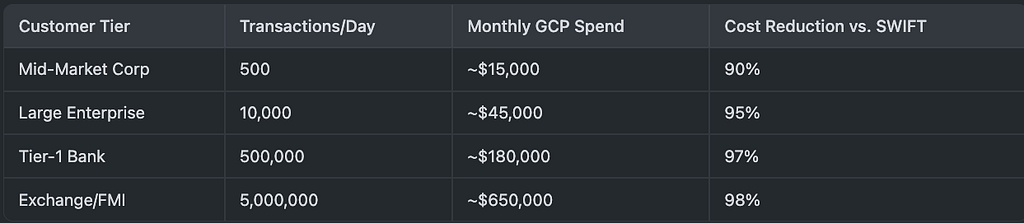
The Economics: What This Actually Costs
Implementation: Twelve Months to Production
The roadmap runs in four phases:
Phase 1 (Months 1–3): Foundation. GCUL network provisioning, IAM and BeyondCorp Zero Trust baseline, Cloud HSM and MPC wallet infrastructure, Apigee API gateway with initial ERP connector, Chronicle SIEM deployment and SOC runbooks.
Phase 2 (Months 3–6): Core Treasury. Smart contract deployment (sweep, netting, conditional payment), GCUL cross-border payment rail pilot across three currency corridors, fiat/USDC conversion, KYC/AML engine, sanctions screening.
Phase 3 (Months 6–9): Compliance. Travel Rule enforcement, MiCA module, Basel III risk engine, GENIUS Act monitoring, SOC 2 Type II audit preparation.
Phase 4 (Months 9–12): Intelligence. Custom Vertex AI model training on client transaction data, cash flow forecasting, liquidity optimizer, DeFi yield access, executive dashboards, full 24/7 SOC activation.
The Honest Risk Register
Every architecture built honestly acknowledges what can go wrong.
Smart contract vulnerabilities are real — a code error in a financial smart contract can be catastrophic. Mitigation: pre-deployment audits from firms like CertiK or Trail of Bits, plus the Vertex AI smart contract auditor running on bytecode before deployment.
Private key compromise, while protected by MPC and HSM, is a permanent-loss event. Mitigation: geographic distribution of key shares, air-gapped backup HSMs, and the M-of-N consensus that prevents any single party from unilaterally transacting.
Regulatory change is high-probability in this space — MiCA is already evolving, the GENIUS Act is new. Mitigation: modular compliance microservices where any single regulation’s logic can be updated without restarting the system. Compliance modules are deployed as independently versioned Cloud Run services.
GCUL network outage, while extremely low probability given the multi-region active-active design and 99.999% SLA, has a fallback: SWIFT gpi via the Apigee connector layer, which serves as the universal correspondent banking safety net.
Oracle price manipulation is mitigated by Chainlink’s 31-node decentralized oracle network with volume-weighted median aggregation and automatic circuit breakers that halt execution if price data becomes stale.
Why This Belongs on Google Cloud
Three things about Google’s infrastructure make this platform uniquely achievable here versus any other provider.
Google Cloud Universal Ledger is the only purpose-built, bank-grade, Python-programmable blockchain from a Tier-1 cloud provider. AWS shut down its managed blockchain service. Azure never built one. GCUL’s “credibly neutral” positioning — Google doesn’t run a competing bank or financial services business — means that Citibank, HSBC, BNP Paribas, and Goldman Sachs can all run on it without competitive conflict. This distinction is more commercially significant than any technical capability.
Chronicle SIEM ingests and analyzes 1 petabyte per day of security telemetry at a flat, predictable price. The blockchain-specific threat detection capabilities — wallet drainage patterns, smart contract exploit signatures, cross-chain bridge attacks — don’t exist in competing SIEM platforms that weren’t designed for this domain.
Vertex AI provides pre-trained models for financial crime and risk, plus the BigQuery data infrastructure to build custom models fine-tuned on each client’s own transaction history. Compliance stops being a cost center and starts being a competitive moat — the institution that catches fraud faster, generates fewer false positives, and produces cleaner audit trails has a measurable advantage in winning institutional business.
A Final Thought
The technologies described in this blueprint — blockchain, MPC cryptography, smart contracts, AI-powered compliance enforcement — are not research projects. They are production systems running today, carrying real institutional money, built by teams at Google, Circle, Chainlink, Chainalysis, Notabene, and dozens of fintech partners.
What hasn’t been built yet is the complete, integrated stack — the orchestration layer that connects all of these capabilities, wraps them in enterprise-grade compliance enforcement, and delivers them as a coherent platform that a multinational corporation or tier-one bank can actually deploy and audit.
That’s the gap. That’s the opportunity. That’s what this architecture proposes to fill.
Because the CFO who can see their global cash position in real time, move $10 million in 8 seconds for five cents, and hand their auditors an immutable cryptographic record of every transaction that ever occurred — that CFO has a structural competitive advantage over every peer still waiting for a SWIFT confirmation that arrives Thursday.
Views expressed are those of the author in their capacity as a principal architect and do not constitute Google’s official product roadmap or legal/financial advice. Google Cloud service capabilities are subject to change. Regulatory frameworks referenced reflect the environment as of April 2026.
The $10 Million Payment That Settled in 8 Seconds was originally published in Google Cloud – Community on Medium, where people are continuing the conversation by highlighting and responding to this story.
Source Credit: https://medium.com/google-cloud/the-10-million-payment-that-settled-in-8-seconds-82a64f5c1184?source=rss—-e52cf94d98af—4
About the Author