What impact are AI developer tools actually having on productivity? A new study of more than 100,000 GitHub developers reveals some interesting results. The good news: teams are shipping up to 30% more than before. We also see that the number of commits, earlier in the delivery pipeline, is up by 180%. That tells us there’s a big opportunity to raise the ceiling on shipping velocity.
The working paper, “Writing Code vs. Shipping Code: Productivity Effects Across Generations of AI Coding Tools” by Mert Demirer, Leon Musolff, and Liyuan Yang, measures output at five points across the software development lifecycle.
Across those stages, they analyzed three generations of AI coding capabilities: inline suggestions, synchronous agents, and asynchronous agents. Where we started was autocomplete. Now we have real-time agents like Google Antigravity and Claude Code that can be assigned a task and left to run.
The code-to-release funnel
What they observed is that the productivity benefits diminished as the work progressed through the pipeline:
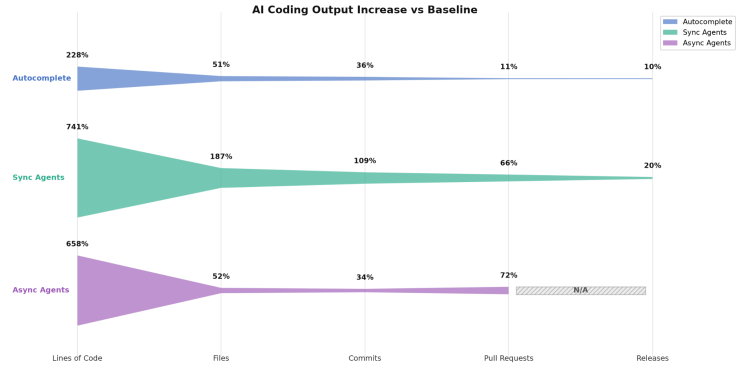
There are a couple important nuances to understand when looking at the chart. First, the paper acknowledges that coding agents are known to write more verbose code, which can inflate line counts and file counts without actually raising output. So, the researchers treat commits as their primary productivity measure precisely, because it’s unaffected by verbosity. From commits onward, the attenuation pattern is real.
Also, it might stick out that for async agents, there’s an increase in pull requests over baseline (71.8%) that’s higher than the gain on commits (33.6%). That doesn’t mean that agents are creating PRs without commits. Rather, it’s reflecting that async agents tend to produce fewer commits per PR than a typical human developer’s workflow.
The economic model of the developer pipeline
To model how productivity gains propagate from writing code to final output, the researchers use an economic production function called the Constant Elasticity of Substitution. The elasticity of substitution measures how easily you can swap one input for another.
An elasticity of infinity represents perfect substitutes, like swapping two interchangeable network cables. An elasticity of one represents a proportional trade-off, e.g. as in instances of the space-time tradeoff in computer science. An elasticity of zero represents perfect complements, a completely fixed-proportion recipe like needing both source code and a compiler. Under a perfect-complement relationship, doubling one input while keeping the other flat yields zero additional output.
The researchers calculate the elasticity of the SDLC at 0.25, firmly in the complement category. So, if you write 100% more code, you need almost, but not quite, 100% more review and release capacity to ship it.
The implication for developers and engineering leaders is clear. To capture the full gains of AI, teams must also apply AI and automation downstream. Automating the review and release stages allows shipping speed to keep pace with code generation.
Practical strategies to scale your release velocity
In practice, what can engineering teams do to keep pace with the output of AI coding tools?
- Use AI to assist with review: Since human review is the main constraint, AI tools can help with initial checks. Automated assistants can verify style consistency, flag logical errors, and summarize PR changes.
- Automate pull request verification: If developers are writing code faster, your continuous integration pipeline must keep pace. Run test suites, linting, and automated security scans on every commit so code is verified before human reviewers ever see it.
- Implement continuous deployment: Shipping faster requires removing manual hurdles at the release stage. Move toward continuous deployment where code is automatically deployed to production once it passes tests and reviews. Engineering teams can leverage AI agents and specialized tools to automate infrastructure deployment.
Generative AI has unlocked code-writing speed. To fully realize the benefits, teams need their whole SDLC to match that velocity. What bottlenecks is your team running into, and how are you addressing them? I’d love to hear from you on X, LinkedIn, or Bluesky.
How to turn a 180% commit boost into shipped software was originally published in Google Cloud – Community on Medium, where people are continuing the conversation by highlighting and responding to this story.
Source Credit: https://medium.com/google-cloud/how-to-turn-a-180-commit-boost-into-shipped-software-da9d57058994?source=rss—-e52cf94d98af—4
About the Author