Author : Kumar Ramamurthy
Comparing Weaviate and AlloyDB Vector (AlloyDB AI) is a classic architectural matchup: choosing a purpose-built, AI-native vector database versus an enterprise-grade relational database with specialized AI and vector extensions.
While both excel at high-performance vector operations and power Retrieval-Augmented Generation (RAG) workflows, they approach the problem from completely different philosophy points.
1. High-Level Overview
- Weaviate: An open-source, AI-native vector database designed from scratch for high-dimensional vector search. It stores data objects alongside their embeddings and treats vectors as first-class citizens. It includes unique built-in “modules” that can automatically handle your machine learning pipelines (like converting text to embeddings on ingestion).
- AlloyDB Vector: Google Cloud’s fully-managed, PostgreSQL-compatible relational database equipped with specialized AI acceleration (AlloyDB AI). It uses an enhanced version of the pgvector extension alongside Google’s proprietary ScaNN (Scalable Nearest Neighbors) algorithm to execute lightning-fast vector operations right inside your core transactional database.
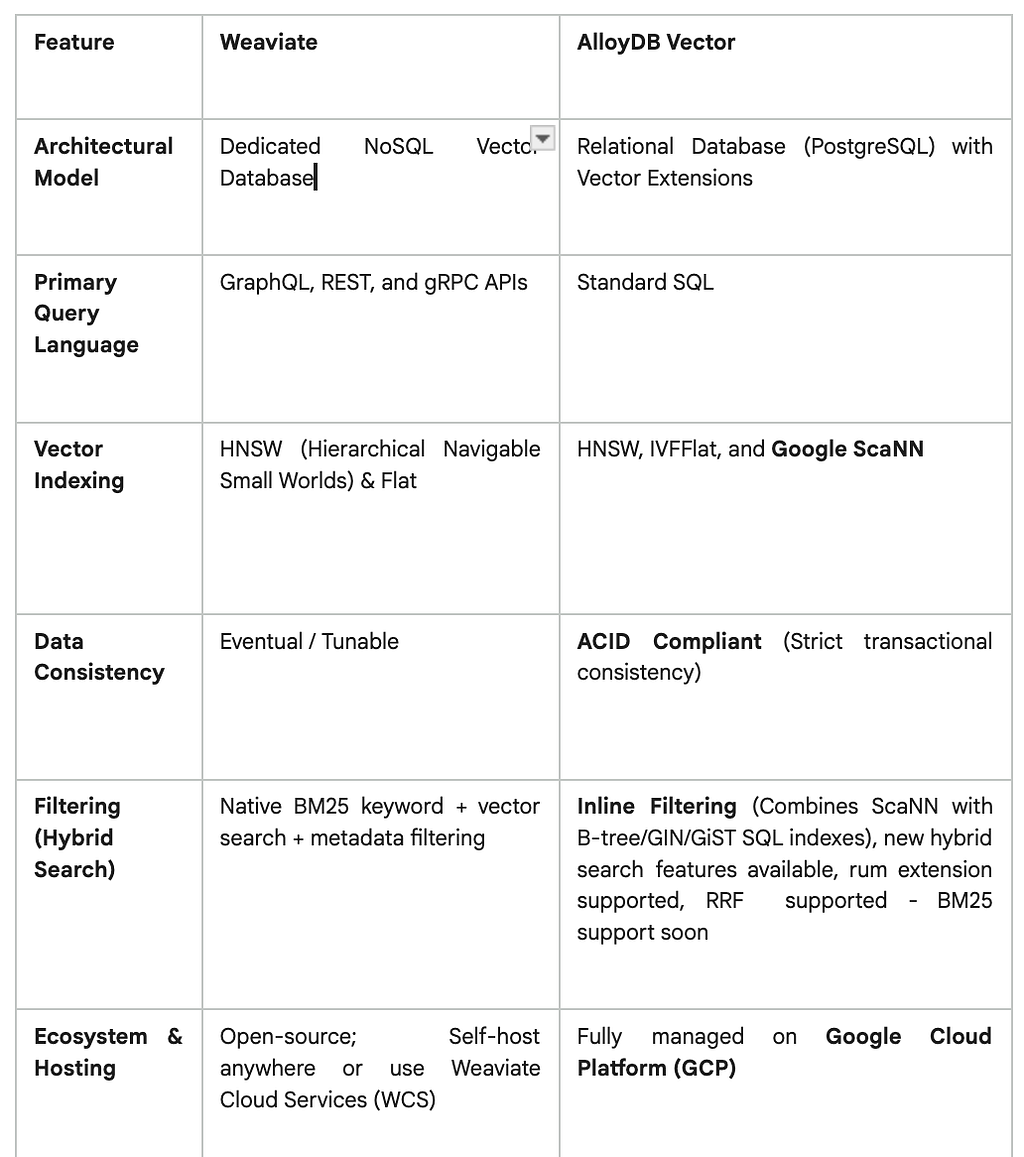
2. Core Differences & Feature Breakdown
3. Deep Dive: Key Technical Battlegrounds
A. Querying and Metadata Filtering
- AlloyDB shines with complex data relations. Because it is PostgreSQL at its core, you can execute a vector similarity search (<=>) and seamlessly join it across dozens of relational tables, applying intricate SQL WHERE clauses, aggregations, and window functions. Its Inline Filtering feature ensures that metadata filters are evaluated in tandem with the vector search, yielding massive performance gains.
- Weaviate shines with unstructured data and keyword search. Weaviate supports a highly optimized Hybrid Search that blends vector similarity with classic BM25 keyword search right out of the box. It handles unstructured data objects (JSON-like payloads) elegantly through native GraphQL or client SDKs.
B. Indexing Algorithms and Performance
- Weaviate utilizes a highly tuned implementation of HNSW. It is blazingly fast for high-concurrency, low-latency vector queries, but HNSW is notoriously memory-intensive, meaning your infrastructure costs scale with your vector count.
- AlloyDB changes the PostgreSQL vector game by implementing Google’s proprietary ScaNN index. Compared to standard open-source PostgreSQL HNSW, AlloyDB’s ScaNN index boasts up to 10x faster index creation and superior recall at scale. It offers fantastic query optimization via pre-, post-, and inline-filtering query plans.
C. AI Pipeline Integration
- Weaviate has “built-in” vectorization. You can configure a schema so that when you insert raw text, Weaviate automatically pings APIs (OpenAI, Cohere, Hugging Face, etc.) to generate and store the embedding for you.
- AlloyDB relies on Google Cloud integrations. Through the google_ml_integration extension, you can call Vertex AI text-embedding models directly via SQL queries. You can even set up “Virtual Columns” that automatically generate and persist embeddings using SQL functions, linking neatly with GCP’s generative AI ecosystem (like Gemini models).
4. Which One Should You Choose?
Choose Weaviate if:
- You want a dedicated AI-native tech stack: You are building an unstructured data pipeline (RAG, semantic search, multimodal apps with audio/video) and don’t want or need rigid SQL schemas.
- Multi-cloud or Open-Source is a priority: You need the flexibility to run your database anywhere — locally in Docker, on AWS/Azure Kubernetes, or via Weaviate’s managed cloud.
Choose AlloyDB Vector if:
- You want “One Database to Rule Them All”: You already have operational/transactional enterprise data and want your vectors to live in the same table, under the same ACID transactions as your structured business data. No messy sync pipelines.
- Your team knows SQL: You want to avoid learning a new query language or API setup, preferring to manage AI workloads via standard PostgreSQL tooling.
- You are heavily invested in Google Cloud: You want deep, native, low-latency integrations with GCP infrastructure, IAM security, and Vertex AI.
Weaviate vs AlloyDB Vector was originally published in Google Cloud – Community on Medium, where people are continuing the conversation by highlighting and responding to this story.
Source Credit: https://medium.com/google-cloud/weaviate-vs-alloydb-vector-53c9c5c798e6?source=rss—-e52cf94d98af—4
About the Author