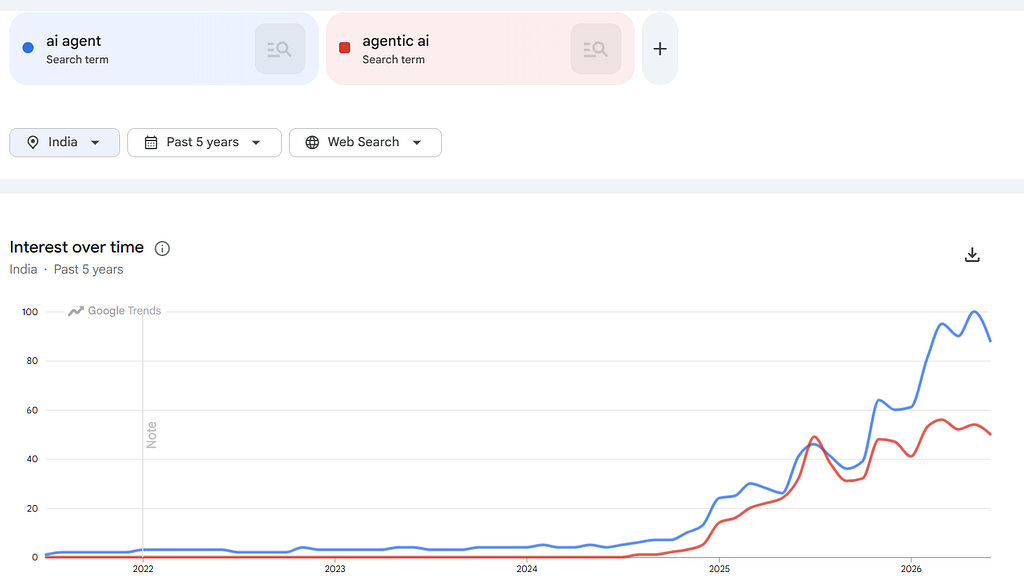
Is my solution Agentic? is the most common thought you get while planning a agentic solution. With increasing trends in Agentic AI modelling, organisations are converging towards Agentic AI workflows rather than generative AI solutions. As we move past simple generative models toward truly autonomous Agentic AI workflows, we need to clearly understand the difference between AI Agents and Agentic AI. With latest transformaion leading to confusion among both terms. The Global Google search trends shows the rising interest in “AI Agents” and “Agentic AI” . It also reflect how people are confused between an AI Agent and a Agentic AI solution. Though both word sounds similar but has subtle difference.
What are AI Agents?
Before exploring agentic AI, we must first understand AI agents and how they differ from standard Large Language Model (LLM) generative systems. While standard generative models are limited to creating content from predefined vector stores, AI agents actively extend LLM capabilities through autonomous decision-making and reasoning. They integrate a dynamic search space with external tools — such as API calls or custom code routines — to perform real-time data retrieval. Designed to execute specific tasks and achieve narrow goals, the most critical characteristic of an AI agent is its ability to self-reflect and self-correct without human intervention.
Checklist of an AI Agent:
Autonomous: Have reasoning power to select the right tool for completing a task.
Self reflection: It learns on its own using feedback loop.
Tools: It use multiple tools to complete its goal.
Narrow: goal oriented
What not is an AI agent!!
a) LLM models are not AI agents , they are only models
b)conversational assistants
c) Routine/procedure calls
d) Models that are dependant on human feedback and cannot self reflect
Now what is Agentic AI?
Agentic AI solutions enable the complete, end-to-end automation of a business workflow by orchestrating multiple AI agents. While a single agent focuses on a narrow, goal-oriented task, an Agentic AI solution coordinates these multiple discrete agents to manage complex, multi-step operations.
Agentic AI solutions can be both deterministic and non-deterministic in nature. Non-deterministic Agentic AI solutions have uncertainty in its output based on the selection of agents while a deterministic workflow has a predefined set to be followed by every agent. Highly regulated sectors — such as healthcare, insurance, and banking — rely on deterministic Agentic AI solutions to automate their end-to-end workflows. Because their execution paths are entirely predefined, deterministic workflows inherently deliver the unwavering reliability required by compliance officers. This structural predictability serves as the foundational cornerstone for trust, audit transparency, and regulatory compliance. By contrast, non-deterministic workflows adopt fluid, exploratory strategies that yield variable results, making them poorly suited for strict risk-managed environments.
References and recommended reads:
- What is agentic AI? Definition and differentiators
- Conductor: Deterministic orchestration for multi-agent AI workflows | Microsoft Open Source Blog
https://www.sciencedirect.com/science/article/pii/S1566253525006712
https://trends.google.com/trends/
Is my solution Agentic!! was originally published in Google Cloud – Community on Medium, where people are continuing the conversation by highlighting and responding to this story.
Source Credit: https://medium.com/google-cloud/is-my-solution-agentic-2076d557da9b?source=rss—-e52cf94d98af—4
About the Author