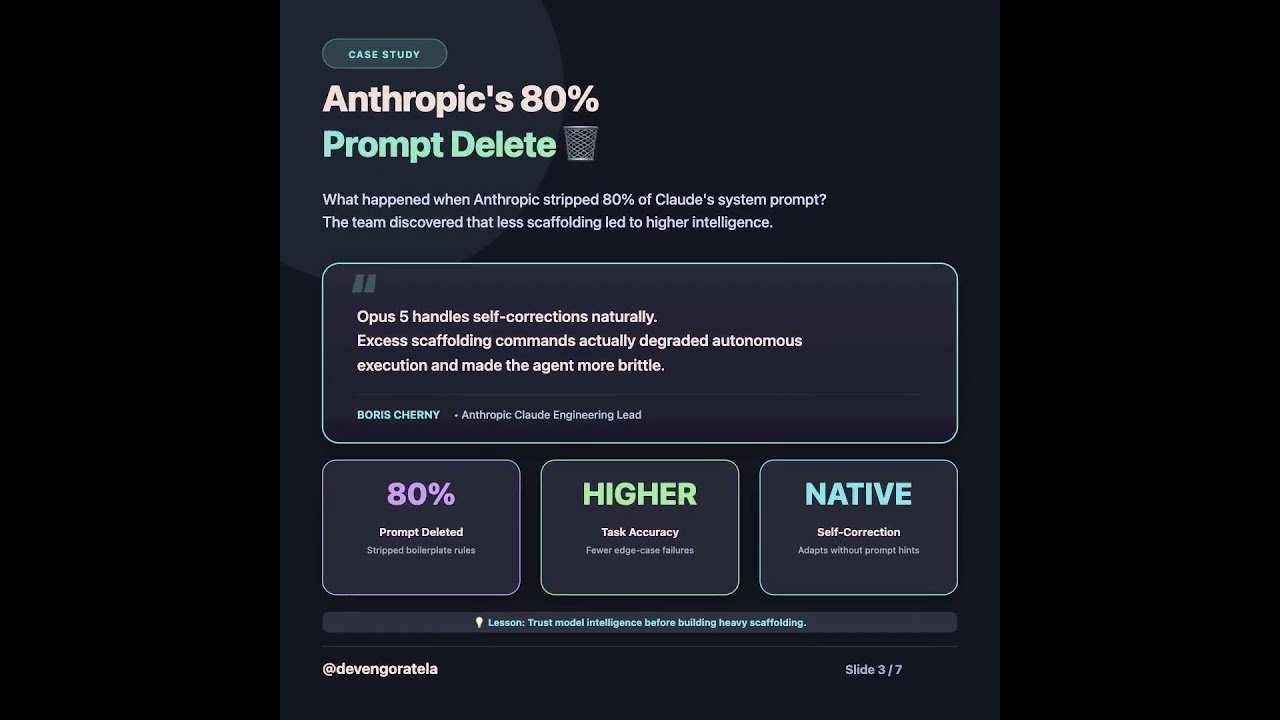
When Anthropic built Claude Opus 5, engineer Boris Cherny deleted 80% of Claude’s system prompt scaffolding.
The result? The model got noticeably **smarter**, more adaptive, and suffered far fewer edge-case failures.
### ❌ The Micromanagement Trap
When building AI agent pipelines, our natural instinct as software engineers is to script every move:
– 1,000+ line system prompts
– Complex step-by-step branching rules
– Heavy pre-execution scaffolding
But rigid scaffolding creates context bloat. It dilutes model attention and forces AI into brittle pathways that break the moment an unexpected input appears.
### 🔬 The Ablation Method
Instead of guessing what your model needs, make it prove the need through real runtime failure:
1️⃣ **Strip the Scaffolding**: Delete your CLAUDE.md, custom skills, and pre-execution hooks. Start clean.
2️⃣ **Run & Observe**: Execute tasks on a clean codebase. Log exact failure points and error tracebacks.
3️⃣ **Add Rules ONLY on Repeated Failure**: Introduce instructions strictly after a failure mode recurs 3+ times.
### 🎯 The 3 Pillars AI Models Actually Need
Replace 20 pages of prompt rules with these 3 essentials:
1. **Task 🎯** — Unambiguous goal & desired deliverable.
2. **Guardrails 🚧** — Non-negotiable boundaries & forbidden patterns.
3. **Exit Criteria 🏁** — Verifiable definition of DONE (passing tests, 0 linter errors).
### 🔍 The Secret Sauce: Continuous Self-Verification
When you give your AI model automated ways to audit and test its own work (verification loops), you don’t need 50 rules telling it *how* to code. The AI executes, tests, reads tracebacks, self-corrects, and finishes autonomously.
📌 **Save this post for your next AI pipeline build!**
💬 How much system prompt scaffolding are you running in your current AI agents? Let me know in the comments below!
#AIEngineering #ArtificialIntelligence #PromptEngineering #ClaudeCode #Anthropic #AIAgents #Automation #SoftwareEngineering #TechLeadership #DeveloperExperience
Video Source
About the Author