Most people use AI models completely wrong.
They burn hundreds of dollars prompting Claude Opus or GPT-4 just to classify an email or route a ticket.
When teams encounter fast, probability-based models like Jev, they try to chat with them like ChatGPT 💬
When they get raw probabilities instead of paragraphs, they assume the tool is broken.
In reality, pairing fast probabilistic decision-makers with heavy reasoning engines is the highest-leverage pattern in modern AI engineering 🚀
Inside this 8-slide carousel:
1️⃣ The Core Concept: Chatbot vs. Probability Engine (200x faster, 400x cheaper)
2️⃣ Shift 01: Replace one-time static rules with self-improving loops (accuracy jumps from 43% to 81%+)
3️⃣ Shift 02: Dynamic micro-loops for browser automation (12 turns vs 36 turns, 50% lower cost)
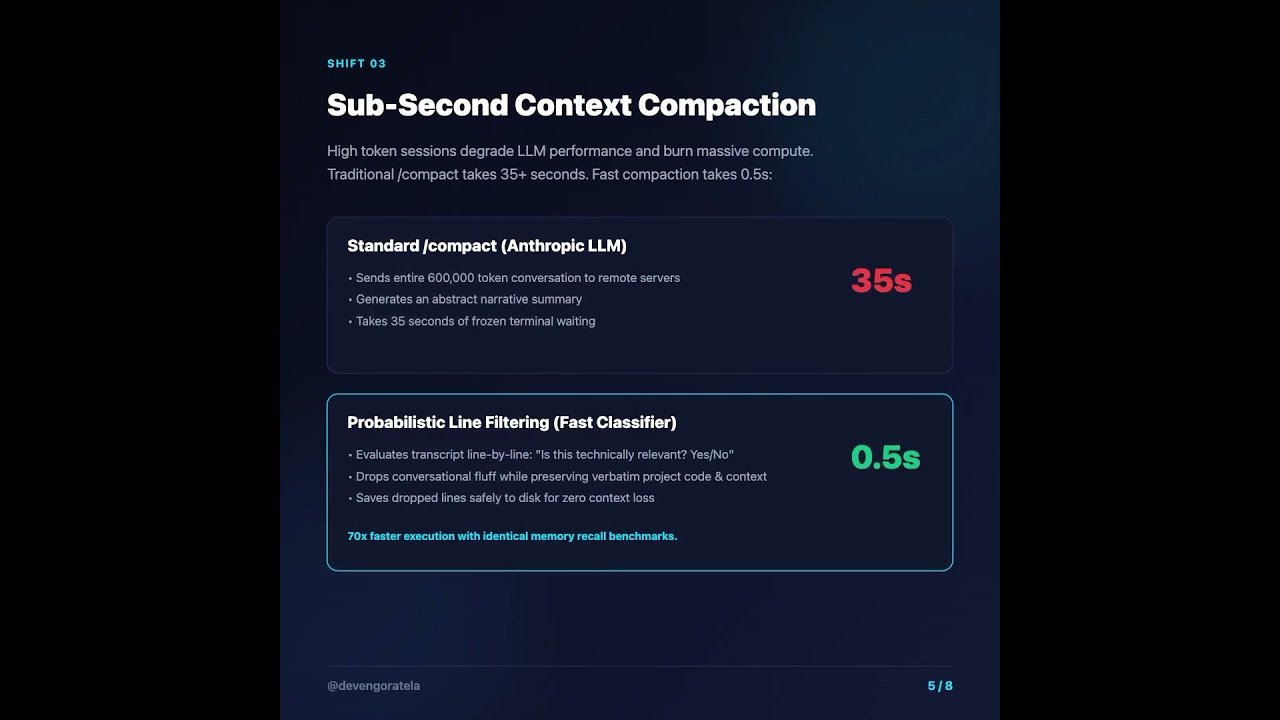
4️⃣ Shift 03: Sub-second context window compaction (0.5s token filtering vs 35s frozen terminals)
5️⃣ Shift 04: Audit your skills and hooks to uncover hidden decision bottlenecks
6️⃣ Shift 05: Build a 100ms AIOS model router across tiers (Tier 1 local, Tier 2 synthesis, Tier 3 Opus)
7️⃣ Key Rules to Remember: Fast classifiers decide WHO executes; frontier models execute with full focus.
Which repetitive decision in your current tech stack is still burning expensive tokens? Drop your thoughts below 💬
♻️ Repost this carousel to help fellow engineers design faster, cost-efficient AI workflows.
➕ Follow Deven Goratela for practical insights on AI systems architecture, agentic loops, and engineering frameworks.
#AIArchitecture #ClaudeCode #LLMOps #WorkflowAutomation #PromptEngineering #ArtificialIntelligence
Video Source
About the Author