Why Every Production AI Agent Needs a Background Task Engine
GitHub Repo link — https://github.com/jitu028/agyqueue
How AgyQueue brings non-blocking execution, MCP-native workflows, Google ADK integration, and production-grade orchestration to modern AI agents.
The last two years have transformed how software is built.
We have gone from asking LLMs simple questions to building autonomous AI agents capable of reasoning, planning, coding, debugging, deploying infrastructure, analyzing security vulnerabilities, and even collaborating with other agents.
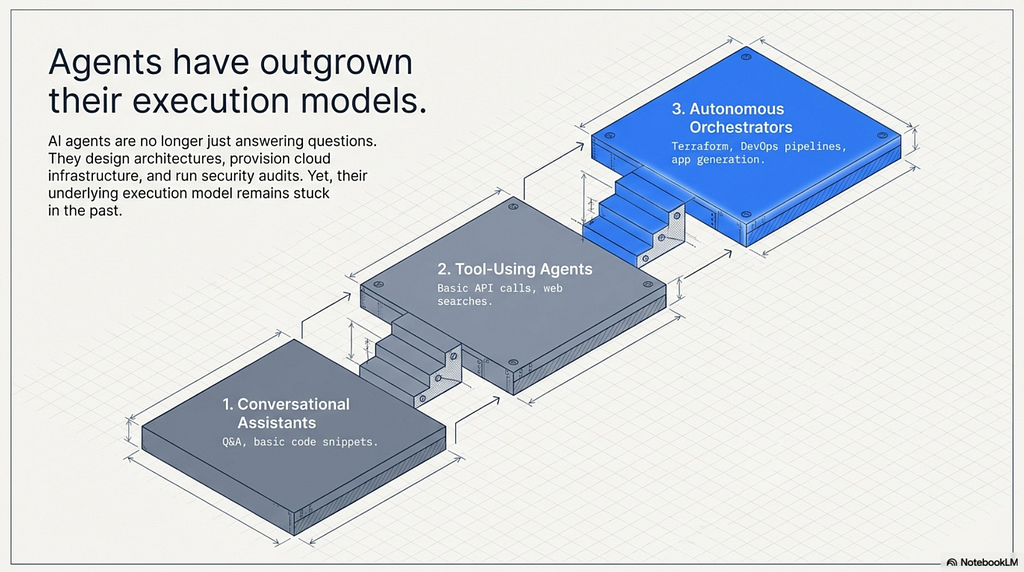
Frameworks like Google ADK, LangGraph, CrewAI, OpenAI Agents SDK, and Model Context Protocol (MCP) have dramatically accelerated this evolution. Today, building an AI agent is no longer the difficult part — running one reliably in production is.
As these systems become more autonomous, one architectural limitation keeps surfacing across almost every implementation:
Most AI agents are still fundamentally synchronous.
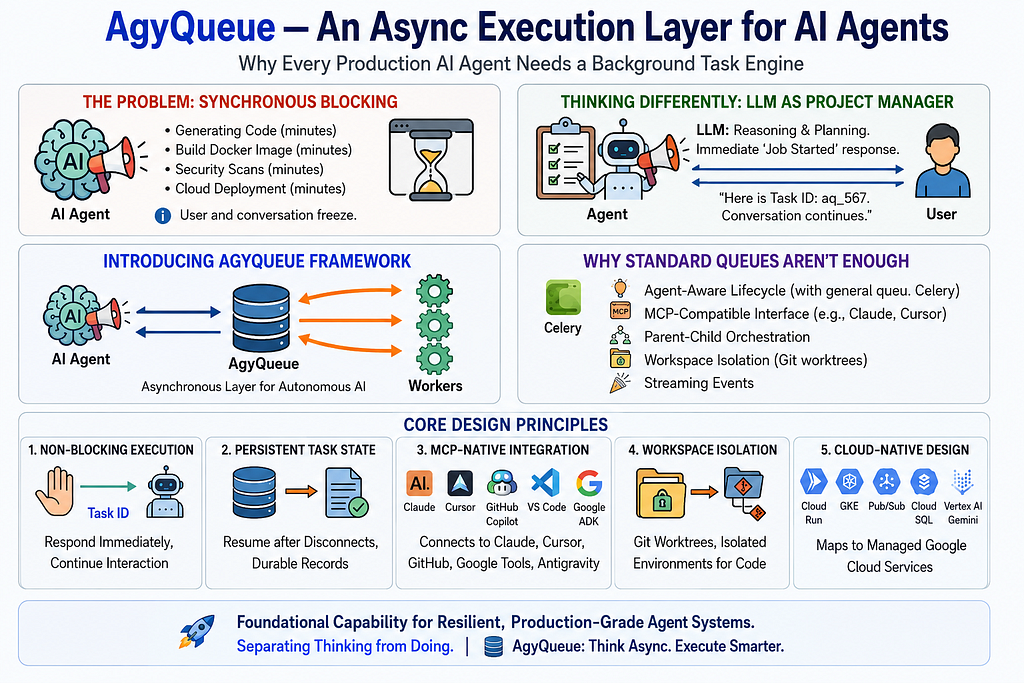
That design works well for quick interactions, but it quickly breaks down when agents begin executing long-running tasks such as:
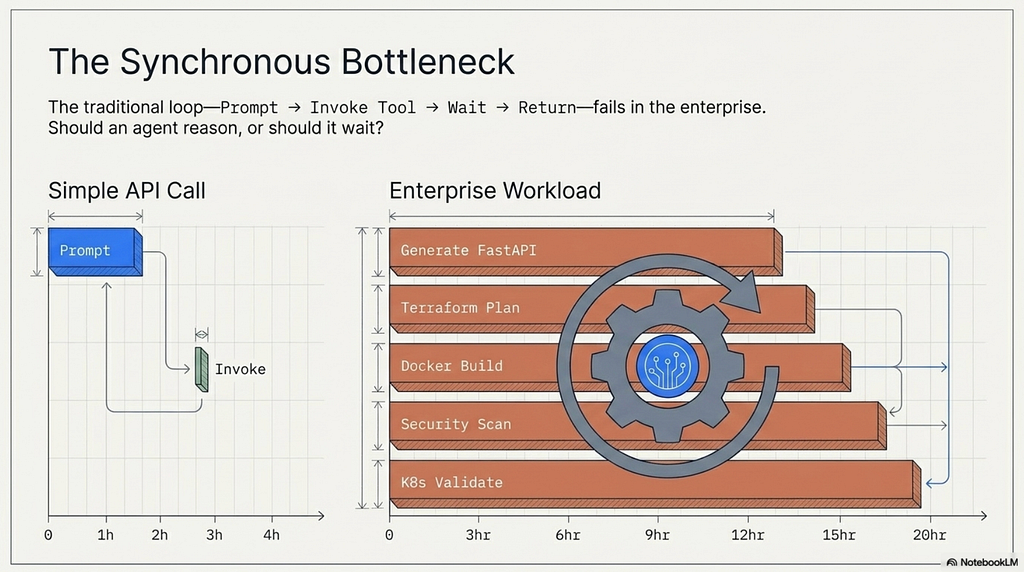
- Generating thousands of lines of production-ready code
- Building and testing Docker images
- Running Terraform plans
- Executing Kubernetes validations
- Performing security scans
- Running compliance workflows
- Generating documentation
- Deploying applications
- Coordinating multiple sub-agents
These tasks often take several minutes — or even longer — to complete.
Yet many agent implementations simply wait.
The LLM blocks
The client waits
The conversation freezes
Eventually, users hit refresh, close the browser, or assume something has failed.
At that point, the issue isn’t model quality anymore.
It’s architecture.
The Missing Layer in Agentic Systems
Most production systems already solved this problem years ago.
Traditional web applications don’t execute expensive work directly inside the HTTP request.
Instead, they push long-running operations into background workers using systems like:
- Google Cloud Tasks
- Amazon SQS
- Celery
- RabbitMQ
- Redis Queue (RQ)
- Sidekiq
This allows the application to respond immediately while background workers continue processing asynchronously.
Surprisingly, many AI agent implementations still haven’t adopted this pattern.
Instead, the LLM remains responsible for both reasoning and execution.
That creates several challenges:
- Conversation timeouts
- Lost execution state
- Poor user experience
- No recovery after disconnects
- Limited scalability
- Difficult orchestration
The problem becomes even more apparent when using the Model Context Protocol (MCP).
An agent might invoke an MCP tool that performs infrastructure provisioning, executes CI/CD pipelines, or scans an entire codebase.
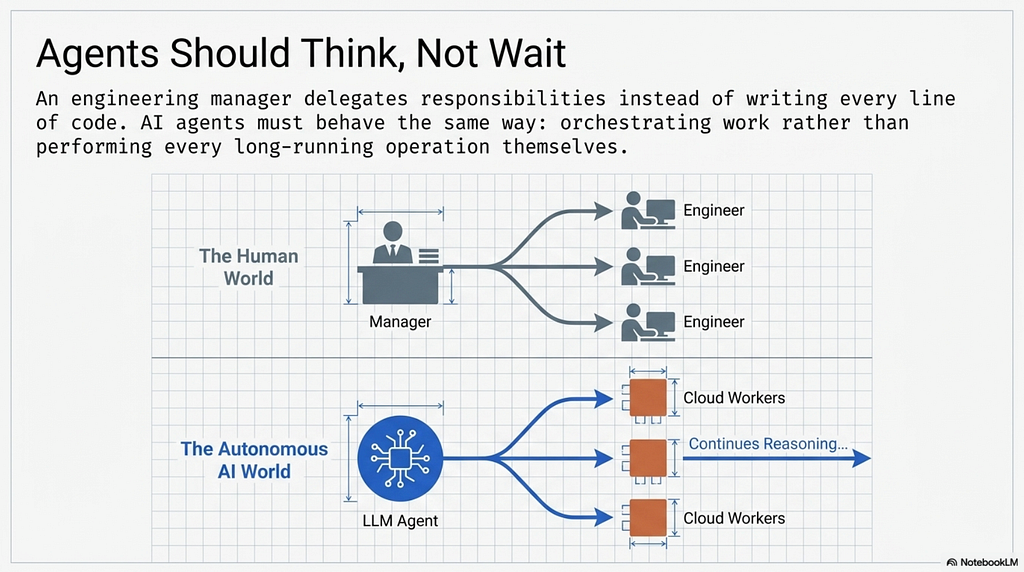
Those operations shouldn’t occupy the agent’s reasoning loop.
Instead, the agent should simply delegate the work and continue the conversation.
Thinking Differently
While experimenting with Google ADK, Agent Engine, MCP servers, and Antigravity, one recurring observation stood out.
- LLMs excel at making decisions
- They are not optimized to wait
- An AI agent should behave like a project manager rather than a worker
Imagine asking:
“Generate a production-ready FastAPI service, containerize it, run security analysis, execute unit tests, and deploy it.”
A traditional implementation often performs these steps sequentially while the conversation remains blocked.
A more scalable architecture would instead respond:
“I’ve started the job. Here is your Task ID. You can continue chatting while I work in the background.”
That seemingly small change fundamentally transforms the user experience. It also introduces a new architectural component:
An asynchronous execution layer designed specifically for AI agents.
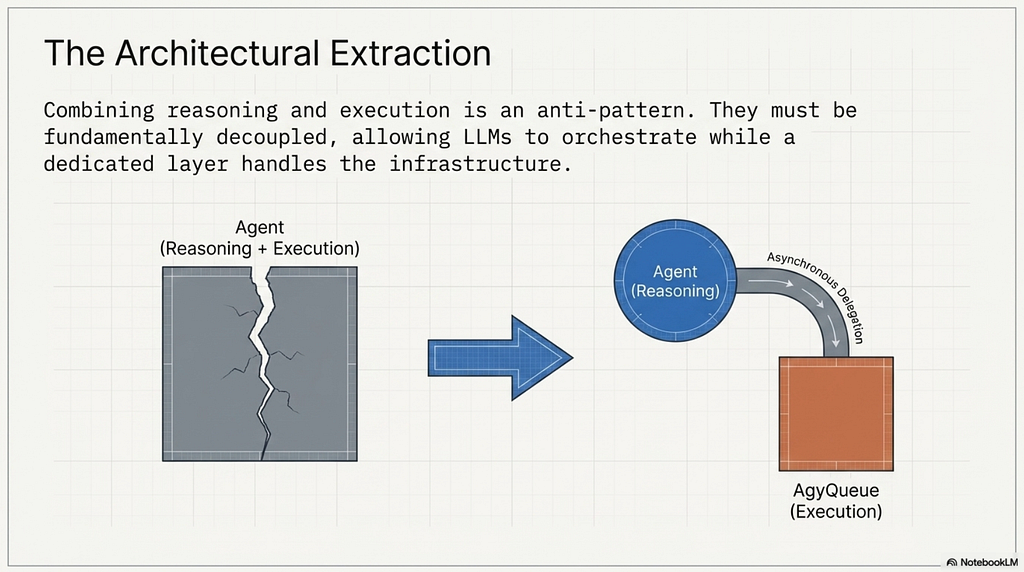
That idea became AgyQueue.
Introducing AgyQueue
AgyQueue is a lightweight asynchronous execution framework built specifically for autonomous AI systems.
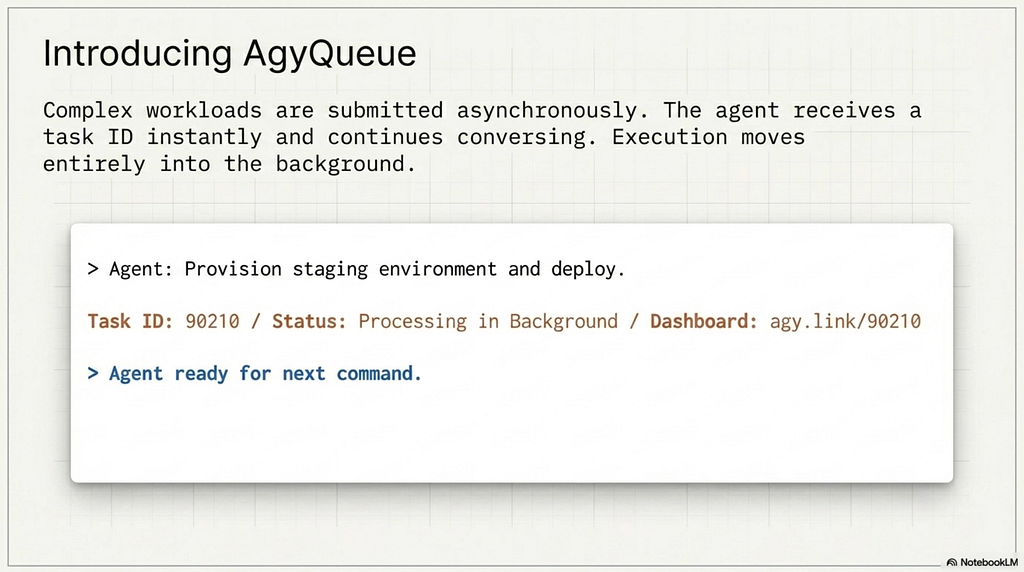
Instead of treating long-running execution as part of the reasoning process, it separates the two responsibilities.
The agent reasons
Workers execute
This distinction allows AI agents to remain responsive while complex workloads continue independently.
Rather than waiting for completion, an agent immediately returns a unique task_id, enabling users—or even other agents—to monitor progress asynchronously.
Conceptually, the workflow looks like this:
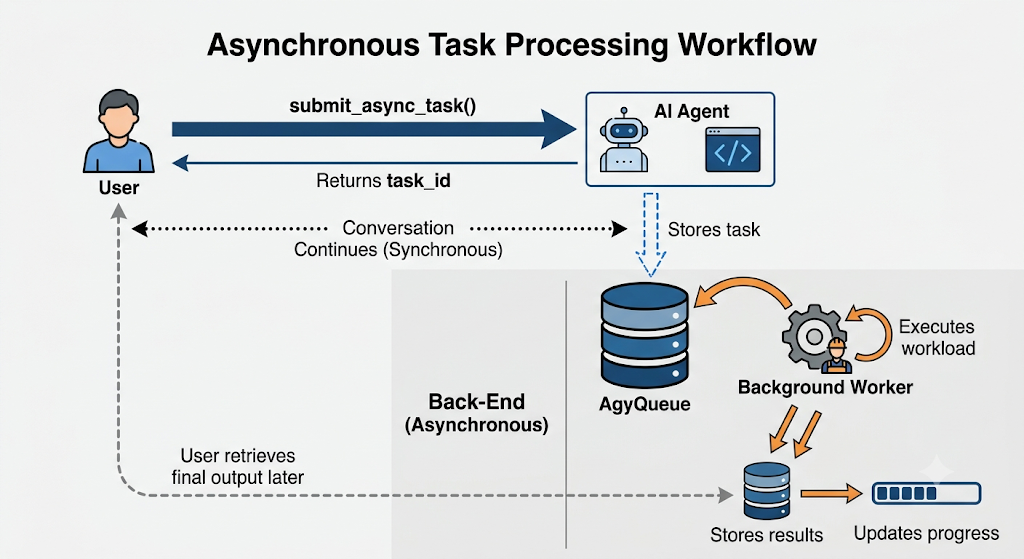
This non-blocking approach dramatically improves responsiveness while laying the foundation for resilient, production-ready agent systems.
Why Existing Task Queues Aren’t Enough
At first glance, one might ask:
“Why not just use Celery?”
Celery is an excellent distributed task queue — but it was designed long before AI agents, MCP servers, or multi-agent reasoning became common architectural patterns.
AI agents introduce requirements that traditional task queues don’t address natively:
- Agent-aware task lifecycle
- MCP-compatible interfaces
- Parent–child agent orchestration
- Human approval checkpoints
- Workspace isolation for generated code
- Streaming execution events
- Persistent conversational state
- Integration with modern agent frameworks such as Google ADK
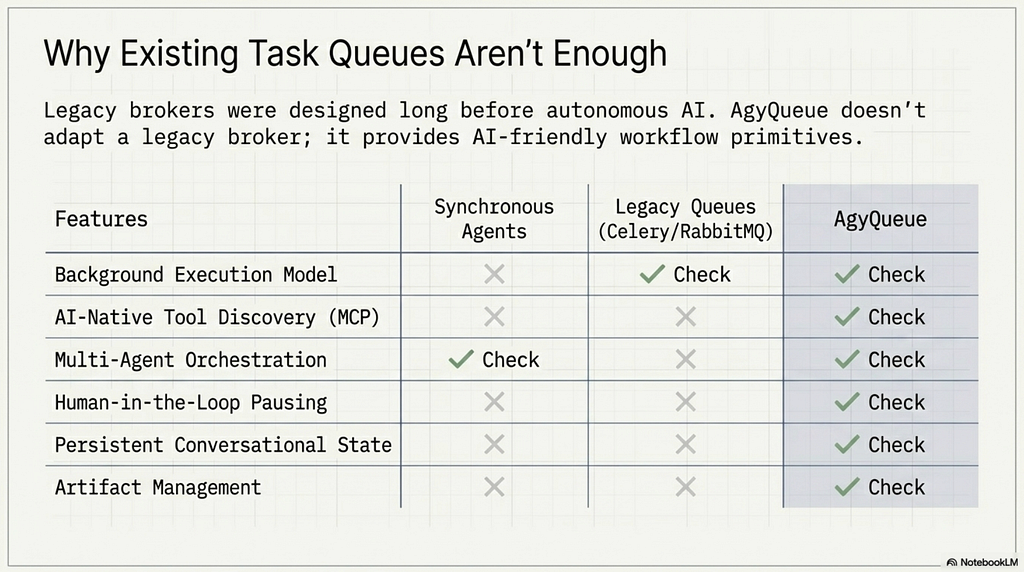
AgyQueue focuses on these requirements from the ground up rather than adapting a general-purpose task queue.
Core Design Principles
Several architectural goals guided the design of AgyQueue.
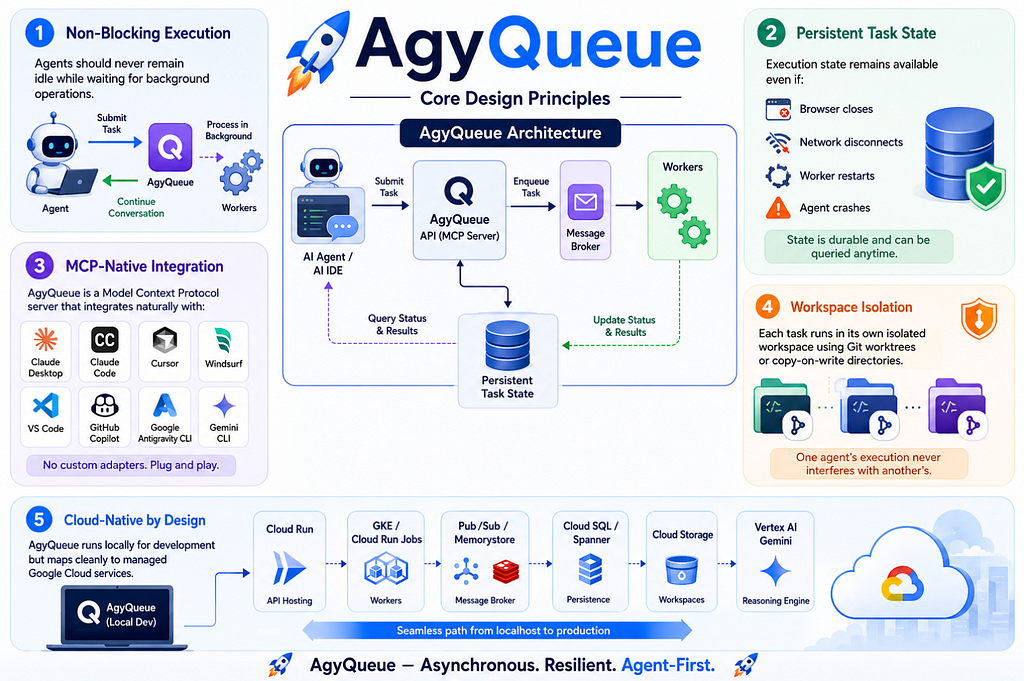
1. Non-Blocking Execution
Agents should never remain idle while waiting for background operations.
Instead, they submit work and immediately continue interacting with users.
2. Persistent Task State
Every task maintains a durable execution record.
Even if:
- the browser closes
- the network disconnects
- the worker restarts
- or the agent crashes
the execution state remains available and can be queried later.
3. MCP-Native Integration
Instead of exposing proprietary interfaces, AgyQueue is designed to function as a Model Context Protocol server.
That means it can integrate naturally with modern AI development environments including:
- Claude Desktop
- Claude Code
- Cursor
- Windsurf
- VS Code
- GitHub Copilot
- Google Antigravity CLI
- Gemini CLI
without requiring custom adapters.
4. Workspace Isolation
Running AI-generated code directly inside a shared repository is risky.
To avoid conflicts between concurrent executions, each task operates within its own isolated workspace, using Git worktrees or copy-on-write directories. This ensures one agent’s execution doesn’t interfere with another’s.
5. Cloud-Native by Design
Although AgyQueue runs locally for development, its architecture maps cleanly to managed Google Cloud services:
- Cloud Run for API hosting
- GKE or Cloud Run Jobs for workers
- Pub/Sub or Memorystore as the message broker
- Cloud SQL or Spanner for persistence
- Cloud Storage for workspaces
- Vertex AI Gemini as the reasoning engine
This allows teams to move from a laptop prototype to a production-grade deployment without redesigning the architecture.
Decoupling Reasoning from Execution
One of the most important architectural ideas behind AgyQueue is separating thinking from doing.
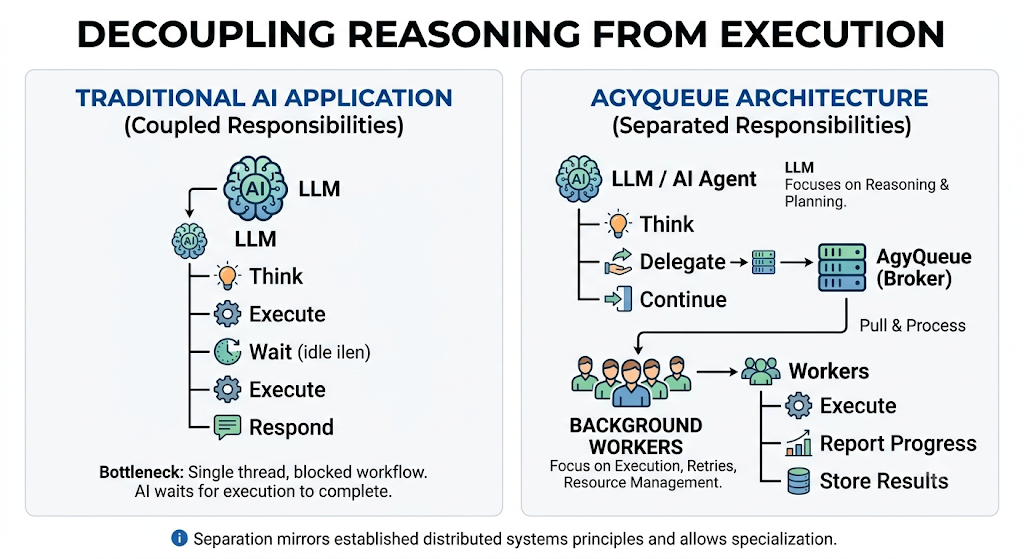
This separation mirrors established distributed systems principles and allows each component to specialize in what it does best.
The LLM focuses on reasoning, planning, and orchestration.
Background workers focus on execution, retries, resource management, and long-running operations.
What’s Next
In the next part of this series, I’ll dive deeper into the internal architecture of AgyQueue, covering:
- End-to-end request lifecycle
- Task persistence and recovery
- Background worker design
- Google ADK integration
- Model Context Protocol (MCP) implementation
- Multi-agent parent–child orchestration
- Human-in-the-loop approval workflows
- Google Cloud production deployment with Cloud Run, GKE, Pub/Sub, Cloud SQL, and Vertex AI
- Lessons learned while building a production-ready execution layer for AI agents
This article is the first step toward understanding why asynchronous execution is becoming a foundational capability for modern AI platforms — not just an optimization, but a necessity.
References
- Scale your agents | Gemini Enterprise Agent Platform | Google Cloud Documentation
- Google Antigravity
- Agent Development Kit (ADK)
- What is the Model Context Protocol (MCP)? – Model Context Protocol
About Me
I’m an Enterprise Cloud & AI Architect with 13+ years of experience in the IT industry, helping organizations design and scale enterprise-grade cloud, AI, and automation solutions.
My current work focuses on building enterprise-scale AIOps platforms, accelerating customers’ AI-first transformation journeys, driving FinOps adoption, and developing production-ready Generative AI applications that create measurable business impact.
I’m deeply passionate about bridging architecture, platform engineering, and AI innovation to solve real-world enterprise challenges at scale.
If you have questions around Cloud Architecture, AIOps, Generative AI, or FinOps, feel free to connect with me on LinkedIn or X (Twitter) @jitu028 — my DMs are always open, and I’m happy to help.
For personalized 1:1 mentoring, architecture guidance, career discussions, or enterprise solution consulting, you can also schedule a session with me on Topmate: https://www.topmate.io/jitu028
Building AgyQueue — An Asynchronous Execution Layer for AI Agents (Part 1) was originally published in Google Cloud – Community on Medium, where people are continuing the conversation by highlighting and responding to this story.
Source Credit: https://medium.com/google-cloud/building-agyqueue-an-asynchronous-execution-layer-for-ai-agents-a9eb054042f4?source=rss—-e52cf94d98af—4
About the Author