The Strategic Paradigm Shift: From Bespoke AI Agents to Universal Agent Skills for Enterprises
Approach Paper on Architecting High-ROI, Modular Agentic Workflows with Universal Agent Platforms and Google Cloud
Target Audience: Enterprise IT Leadership, CTOs, Platform Engineering Heads, and Software Architecture Directors
Executive Summary & The current AI Landscape
In mid-2026, enterprise IT transitioned from experimental generative AI copilots to autonomous AI Agents integrated directly into their core business workflows. Organizations across finance, healthcare, and software engineering are relying on agentic automation to handle complex reasoning, multi-step problem-solving, and process execution.
However, as organizations scale their agentic initiatives — particularly within Developer Productivity Improvement (DPI) and internal software engineering workflows — a significant structural bottleneck has emerged: The Friction of Bespoke Agent Development.
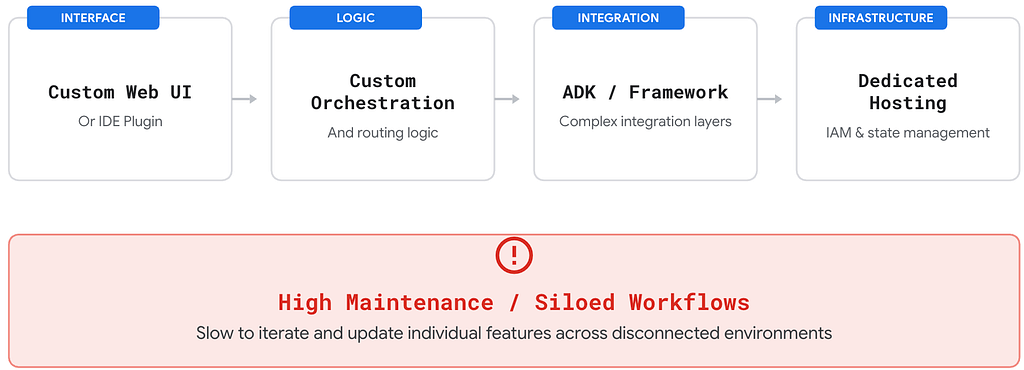
Historically (2024–2025), building an AI agent required treating it as a standalone software application. Engineering teams spent months developing custom web UIs or IDE plugins, integrating with foundational Agent Development Kits (ADKs), orchestrating complex state management loops, and provisioning enterprise security and hosting infrastructure. While this “Agent-as-an-Application” model works well for external, consumer-facing products with static requirements, it fails in agile developer productivity environments where workflows evolve weekly, tooling changes rapidly, and context is fragmented across dozens of systems.
The Universal Agent & Skill Advantage
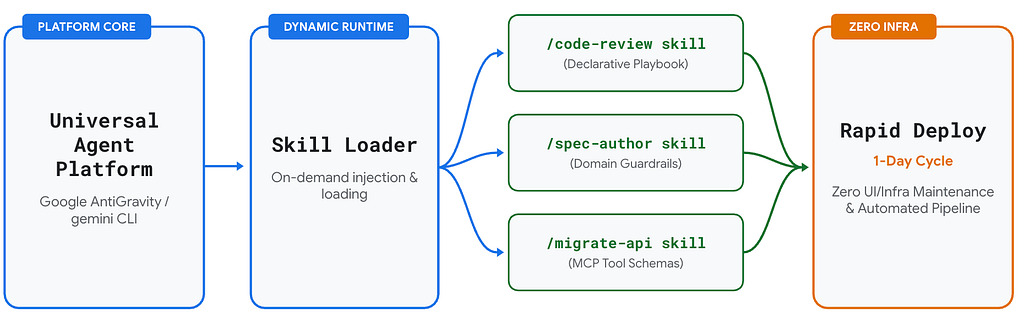
Today, enterprise platforms such as Google AntiGravity, Vertex AI Universal Runtimes, Gemini Enterprise and next-generation IDE assistants act as Universal Agents. These platforms provide an always-available, secure, context-aware cognitive engine capable of executing complex agentic loops out-of-the-box.
Instead of rebuilding the underlying agent application for every developer task, engineering teams now are shifting to Agent Skills — lightweight, declarative, version-controlled packages of domain expertise, standard operating procedures (SOPs), and Model Context Protocol (MCP) tool definitions.
The Strategic Imperative: Decouple the Cognitive Engine (the Universal Agent platform) from Domain Expertise (modular Agent Skills). This architectural shift reduces time-to-value by 85%, lowers Total Cost of Ownership (TCO) by eliminating redundant infrastructure, and enables instantaneous sharing of specialized agent capabilities across internal teams, customers, and ecosystem partners.
The Friction of Bespoke Agent Development in Developer Productivity
Developer productivity improvement is arguably one of the highest-leverage applications for AI agents. Yet, internal platform engineering teams attempting to build custom agents for developer tasks repeatedly encounter severe friction that erodes expected ROI.
Deconstructing the Bespoke Agent Bottleneck
When building a custom agent from scratch to automate a developer workflow (e.g., automated architectural RFC reviews or complex database refactoring), engineering teams must traverse a lengthy development cycle:
- UI & UX Engineering Overhead: Developing custom chat playgrounds, web portals, or IDE extensions requires dedicated frontend engineering. These interfaces must be constantly updated to support new rendering requirements, markdown tables, diff viewers, and interactive terminal prompts.
- ADK & Orchestration Complexity: While modern open-source frameworks and Google Cloud’s Agent Development Kit (ADK) simplify multi-agent routing, sequential chains, and human-in-the-loop (HITL) patterns, writing and debugging bespoke orchestration code for every internal use case introduces significant boilerplate and regression risk.
- Infrastructure, Security & IAM Governance: A standalone agent application requires enterprise-grade hosting (serverless runtimes or Kubernetes), persistent conversational memory (e.g., Cloud Firestore), robust identity management, and continuous vulnerability patching against prompt injection and data exfiltration.
- The “Agent Sprawl” Crisis: As different engineering squads build custom agents for their specific needs, enterprises end up with dozens of disconnected, single-purpose agent microservices. These fragmented tools lack shared workspace context, cannot communicate with one another, and create a massive maintenance burden for central IT.
The Diminishing Returns of Custom Internal Agents: When the engineering effort required to build, secure, and maintain a custom agent exceeds the time saved by the developers using it, the project becomes a net drain on productivity. For internal developer workflows, the 3-month cycle of bespoke agent development is fundamentally incompatible with the 1-week evolution of software engineering practices.
The Universal Agent Paradigm & Modular Skill Architecture
To overcome the limitations of bespoke agent development, the enterprise architecture standard adopts a modular skill-based approach, leveraging Universal Agent platforms as the foundational runtime.
Defining the Core Components
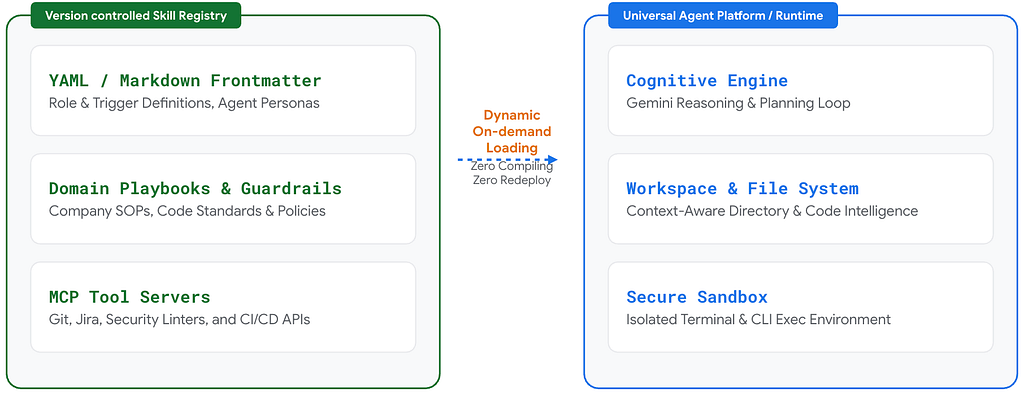
- The Cognitive Engine (Universal Agent): Platforms like Gemini Enterprise, AntiGravity provide a persistent, highly secure, multi-modal agent runtime powered by advanced reasoning models (such as Gemini 3x family and Gemini Next). The Universal Agent inherently understands workspace structures, file systems, Git state, syntax ASTs, and terminal execution. It manages the autonomous agentic loop — perceiving, planning, tool execution, and self-correction — without requiring developer-written routing logic.
- The Expertise (Agent Skills): An Agent Skill is a self-contained, declarative module (typically structured as Markdown with YAML frontmatter, SKILL files, or JSON schemas) that instructs the Universal Agent how to perform a specialized task according to organizational standards. A skill defines:
- Procedural Guardrails & SOPs: Exact step-by-step instructions, coding styles, and verification checklists.
- Grounding & RAG References: Pointers to enterprise data stores, architectural decision records (ADRs), and API documentation via Vertex AI Search.
- Tool Capabilities: Tool definitions and connectors powered by the Model Context Protocol (MCP) or OpenAPI schemas, allowing the agent to interact deterministically with external systems (Jira, GitHub, CI/CD pipelines, internal security scanners).
Deep-Dive Comparison: Bespoke Agents vs. Modular Agent Skills
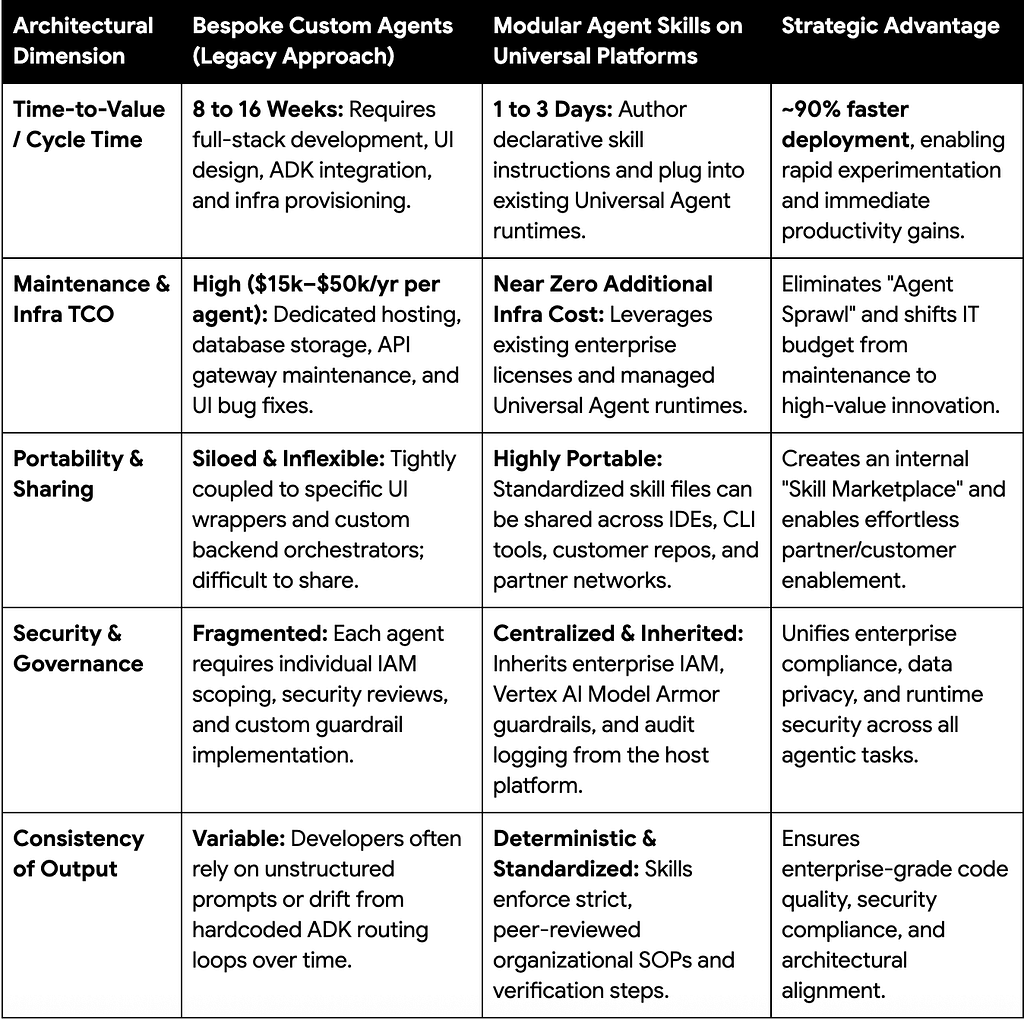
High-Impact Use Cases in Developer Productivity
Shifting to Agent Skills transforms how internal engineering teams address complex, repetitive developer workflows. Below are three representative use cases illustrating how skills outperform bespoke agents in enterprise environments.
Use Case A: Automated RFC & Architecture Specification Generation (/spec-author)
The Challenge: Writing comprehensive Requests for Comments (RFCs) and Technical Design Documents (TDDs) slows down senior engineers. Existing general-purpose AI chat tools produce generic, unaligned specifications that ignore internal architectural standards.
The Bespoke Approach: Building a custom “Design Doc Generator App” requires integrating RAG pipelines with Confluence/Google Docs, building a text-editor UI, and writing orchestration code to query internal APIs — taking ~10 weeks to ship.
The Skill Approach: A developer authors a 60-line /spec-author skill file. When invoked within Google AntiGravity or their IDE:
- The Universal Agent dynamically loads the company’s official RFC template and architectural guardrails from the skill definition.
- Via integrated MCP tools, the agent scans the current workspace, reads relevant data models, and queries internal Vertex AI Data Stores for existing dependency documentation.
- The agent drafts an exhaustive specification — complete with Mermaid architecture diagrams, threat models, and rollback plans — directly into the developer’s workspace in under 3 minutes.
Use Case B: Enterprise Code Review & Security Guardrails (/sec-review)
The Challenge: Conducting thorough security and architectural code reviews across thousands of pull requests (PRs) strains principal engineers and delays merge cycles.
The Bespoke Approach: Developing a custom GitHub App that listens to PR webhooks, spins up ephemeral ADK containers, runs LLM evaluations, and posts comments back to the UI. This pipeline requires continuous maintenance to handle webhook failures and rate limits.
The Skill Approach: Engineering leadership publishes an enterprise-wide /sec-review skill to the internal Git registry.
- When a developer is ready to submit code, they invoke /sec-review locally or in their cloud IDE.
- The Universal Agent inherits the skill’s strict Open Web Application Security(OWASP) Top 10 checklist, company-specific cryptography standards, and custom static analysis tool schemas.
- The agent reviews the local git diff, flags potential SQL injections or unhandled null states, and interactively proposes inline fixes before the PR is ever published.
Use Case C: Legacy API Migration & Refactoring Playbooks (/migrate-api)
The Challenge: Enterprise IT frequently undertakes massive modernization projects (e.g., migrating from legacy REST endpoints to gRPC (Google’s Remote Procedure Call framework), or upgrading core framework versions across 50+ repositories).
The Bespoke Approach: Writing custom Abstract Syntax Tree (AST) migration scripts or building specialized refactoring agents that inevitably fail when encountering edge cases or undocumented repo structures.
The Skill Approach: Platform architects distribute a /migrate-api-v2 skill to all engineering squads.
- The skill defines the exact syntactic mapping, deprecation rules, and verification testing procedures.
- As developers open legacy repositories in Google AntiGravity, the Universal Agent applies the skill autonomously: analyzing call sites, refactoring methods, generating unit tests for the new endpoints, and executing local build verification tools to guarantee zero regressions.
Ecosystem & Partner Enablement: Because Agent Skills are self-contained files rather than complex applications, software vendors and system integrators can distribute verified skills directly to their clients. For example, a cloud infrastructure provider can share a /optimize-cloud-infra skill with enterprise customers, instantly empowering the customer’s internal Universal Agents to audit and remediate Terraform configurations according to vendor best practices.
Enterprise Approach & Strategic Implementation Roadmap
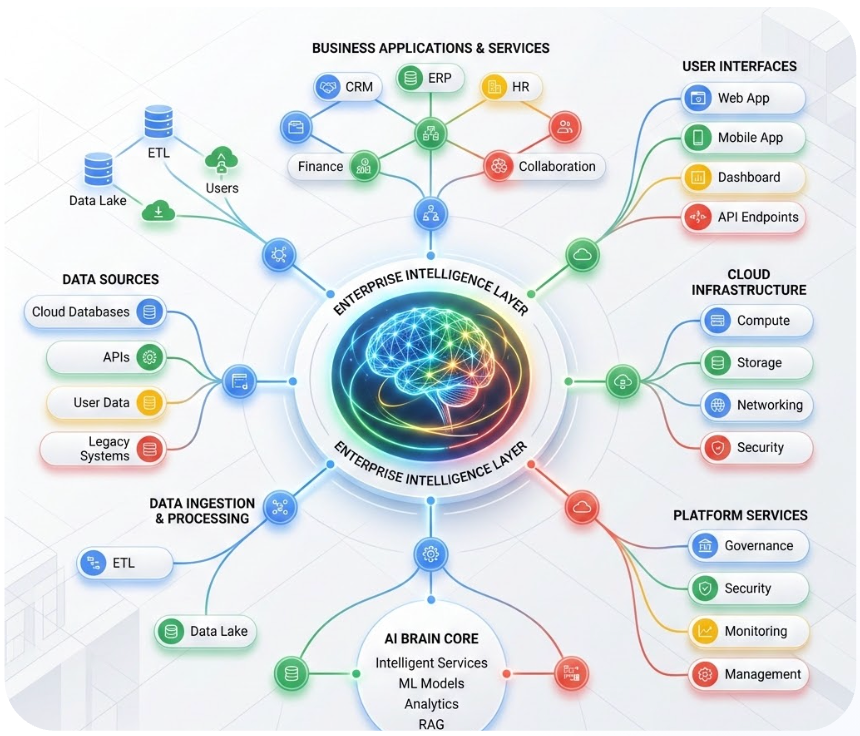
For organizations looking to transition from legacy custom agents to a scalable, skill-first architecture, we recommend a phased, 4-step implementation blueprint.
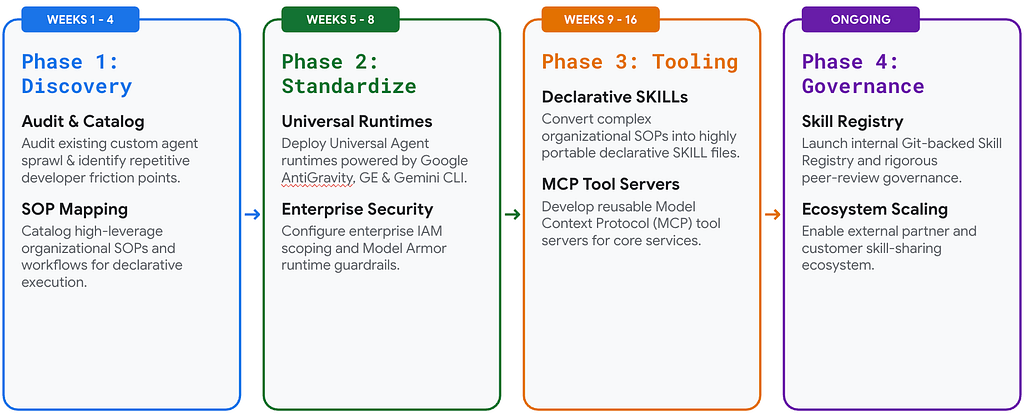
Phase 1: Discovery & Deconstruction
Audit Existing Initiatives: Inventory all internal AI developer tools, bespoke agent prototypes, and custom ADK scripts across engineering squads.
Identify Bottlenecks: Pinpoint custom agents suffering from high maintenance costs, low adoption, or UI rot.
Catalog High-Leverage Workflows: Interview principal engineers to identify the top 5 repetitive tasks that consume developer hours (e.g., PR reviews, integration test boilerplate, release note generation, and internal API consumer onboarding).
Phase 2: Platform Standardization & Security Governance
Standardize Universal Runtimes: Establish enterprise-wide access to secure Universal Agent platforms, such as Google AntiGravity, Gemini Enterprise, Gemini Code Assist, and Vertex AI Universal Runtimes.
Configure Identity & Guardrails: Implement enterprise IAM scoping, ensuring that the Universal Agent executes with the exact permissions of the authenticated developer.
Enable Runtime Security: Activate Google Cloud’s Model Armor and Vertex AI observability to ensure real-time filtering of PII, secrets, and prompt injection attempts across all agent interactions.
Phase 3: Skill Authoring & MCP Tooling Integration
Author Core Enterprise Skills: Convert existing organizational SOPs, style guides, and RFC templates into standardized declarative skill files (e.g., /enterprise-code-review, /generate-unit-tests, /create-adr).
Build Reusable MCP Servers: Develop centralized Model Context Protocol (MCP) tool servers that securely connect the Universal Agent to internal enterprise systems:
- Git/VCS MCP: For diff inspection, branch management, and commit staging.
- Issue Tracker MCP: For querying Jira/Linear ticket acceptance criteria.
- Knowledge Base MCP: For grounding agents against Confluence, Notion, or Vertex AI Data Stores.
Pilot & Iterate: Deploy the initial skill suite to a pilot group of 50–100 developers; gather feedback and refine skill instructions based on real-world edge cases.
Phase 4: Skill Marketplace, Governance & Ecosystem Expansion (Ongoing)
Launch Internal Skill Registry: Establish a centralized, Git-backed “Skill Marketplace” where internal teams can discover, install, and contribute agent skills — operating similarly to an internal npm or PyPI package registry.
Institute Peer-Review Governance: Require PR reviews by platform architecture and security teams before new skills or tool connectors are promoted to the enterprise-wide registry.
Partner & Customer Sharing: Extend the skill ecosystem externally. Share verified integration skills with external customers to accelerate their onboarding onto your enterprise APIs, and adopt vendor-published skills to optimize your internal cloud infrastructure.
Conclusion & The Strategic Outlook
The AI agent landscape is defined by modularity, portability, and rapid time-to-value. While bespoke, custom-built AI agents played a crucial role in validating early agentic concepts, their heavy development cycles, infrastructure overhead, and maintenance friction make them obsolete for agile internal workflows like Developer Productivity Improvement.
By standardizing on Universal Agent Platforms (such as Google AntiGravity) and transitioning to Modular Agent Skills, enterprise engineering organizations can:
- Slash Development Cycles by 90%, turning month-long custom agent projects into single-day skill authoring tasks.
- Eliminate Infrastructure TCO, bypassing custom hosting and security sprawl in favor of managed, enterprise-secure runtimes.
- Runaway LLM Token Waste. Unconstrained chat loops and pasting entire codebases or documents into prompts drain cloud budgets. Skills optimize token usage by injecting concise guardrails and fetching only targeted symbols via MCP tools, cutting token consumption by 60% to 75%.
Call to Action for Engineering Leadership: Stop building siloed agent applications for every internal workflow. Deconstruct your custom agent pipelines, invest in reusable Model Context Protocol (MCP) tooling, and empower your engineering squads to author, share, and scale declarative Agent Skills on a universal runtime.
The Strategic Paradigm Shift: From Bespoke AI Agents to Universal Agent Skills for Enterprise… was originally published in Google Cloud – Community on Medium, where people are continuing the conversation by highlighting and responding to this story.
Source Credit: https://medium.com/google-cloud/the-strategic-paradigm-shift-from-bespoke-ai-agents-to-universal-agent-skills-for-enterprise-22ae5bbca8f3?source=rss—-e52cf94d98af—4
About the Author