
Let’s be honest: when a production system crashes, our natural, raw human instinct is to look for a scapegoat.
Imagine a high-traffic payment gateway goes down for 45 minutes on a Friday afternoon. The Slack channels are absolute chaos, the product manager is panicking, and the company is actively losing millions of shillings. Once the fire is finally put out, the traditional corporate reaction is to find the developer who pushed the buggy code, blame them, and require “more manual approvals” before anyone can deploy again.

But in Site Reliability Engineering (SRE), we do the exact opposite. We write a Blameless Postmortem.
If you want to build resilient, self-healing software, you must treat every production outage as a valuable, high-signal systems failure rather than a personal human mistake.
Based on Google’s official SRE guidelines on Postmortem Culture(Chapter 15) and their actual internal Example Postmortem, here is the exact, uncompromised blueprint for how we conduct, write, and enforce postmortems in modern cloud organizations.
1. Blamelessness
A Blameless Postmortem is built on a non-negotiable operational assumption: Every engineer acted in good faith with the best intentions and the information they had at the time.
If an engineer manually runs an unvalidated SQL script that drops your production database, a blame-based culture asks: “Why was this developer so careless?” and revokes their permissions.
An SRE-driven culture asks: “Why did our database architecture allow a single, un-peer-reviewed script to execute directly on our production instances without an automated dry-run, a safety gate, or an instant rollback policy?”
The Business Impact of Blamelessness
If your culture punishes people for making mistakes, engineers will actively hide their errors, delay reporting outages to protect themselves, and write vague, useless incident reviews.
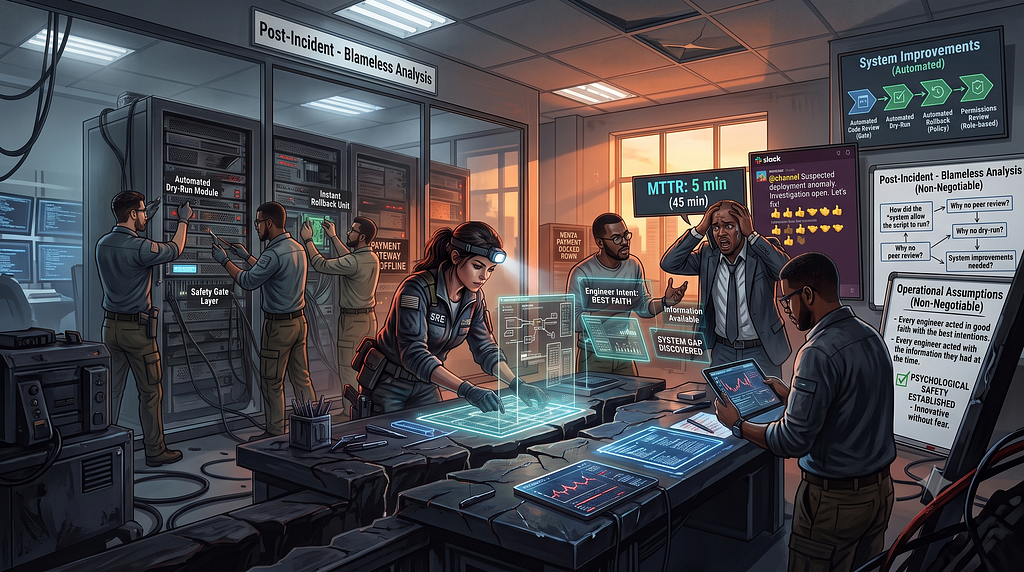
When your culture is blameless, engineers will instantly raise their hands the second they suspect their deployment triggered an anomaly. This dramatically reduces your MTTR (Mean Time to Recovery), saves the business money, and builds a psychological safety net that allows your team to innovate without fear.
2. The Standard Postmortem Triggers
You do not write a postmortem for every minor bug or typo. That is a source of operational toil. Google SRE guidelines specify that a postmortem is mandatory under these strict conditions:
- Any user-visible downtime or service degradation that violates your designated SLO.
- Any event that results in data loss or permanent data corruption.
- Any incident requiring manual intervention from an on-call engineer (e.g., executing a rollback or running an emergency script).
- Any time the active mitigation and resolution time (MTTR) exceeds a pre-determined duration threshold.
3. What Went Well, What Went Poorly, Where We Got Lucky
One of the most valuable aspects of Google’s postmortem framework is forcing the team to reflect on the structural realities of the incident through three specific lenses:
- What Went Well: Real-time actions or systems that worked exactly as designed (e.g., “Our monitoring alerted us within 2 minutes; our automated rollback completed in under 60 seconds.”)
- What Went Poorly: Systemic bottlenecks and friction points (e.g., “Our runbook was outdated, forcing the engineer to spend 15 minutes searching for the correct DB-restart command.”)
- Where We Got Lucky: Structural luck (e.g., “The database lock happened at 3:00 AM on a Sunday when user traffic was at its lowest; if this had happened during peak hours, our customer impact would have been 10× higher.”)
Acknowledging “luck” is a critical SRE metric because it exposes latent vulnerabilities that we survived purely by chance.
4. The Priority Matrix (Action Items)
A postmortem without actionable tickets is just a useless piece of paper. Most developer blogs write a flat, unprioritized “To-Do List,” which looks highly amateurish.
To ensure complete systemic protection, Google SREs categorize action items into four distinct, functional buckets with strict ownership and deadlines:
- Prevent (P0): Structural code or infrastructure changes to ensure this specific failure mode can never happen again.
- Mitigate (P1): Actions to reduce the duration or blast radius of the incident next time (e.g., “Add a circuit breaker to the external API gateway”).
- Detect (P1): Improving monitoring alerts to detect the issue faster (e.g., “Create a log-based metric for connection pool timeouts”).
- Process (P2): Operational and documentation updates (e.g., “Update the database failover playbook and run a simulated incident drill”).
Every action item must have one explicit owner and a deadline. If an action item is left unowned, the postmortem has failed because the underlying system vulnerability will never be fixed.
5. The Google-Standard Postmortem Template
Here is a clean, markdown-compliant, and production-ready postmortem template directly modeled on Google’s actual internal schema:
# INCIDENT POSTMORTER<" [Incident Name / Date]
## 1. METADATA
*   **Incident Owner**: [Name]
*   **Date of Incident**: [YYYY-MM-DD]
*   **Total Downtime / Duration**: [HH:MM:SS]
*   **Impacted Services**: [e.g., billing-api, database]
*   **SLO Impact**: [e.g., 0.05% of monthly Availability budget consumed]
## 2. EXECUTIVE SUMMARY
A 2-3 sentence overview of what broke, why it broke, how it was mitigated, and what was done to prevent it from happening again.
## 3. IMPLICATIONS & IMPACT
*   **User Impact**: [e.g., Number of affected active users]
*   **Data Integrity**: [e.g., Was there any data corruption or loss?]
*   **Financial Impact**: [e.g., Estimated transaction loss]
## 4. CHRONOLOGY / TIMELINE (UTC)
*   **[HH:MM]** - [Event / Deployment / Anomaly triggered]
*   **[HH:MM]** - [Alert fires / On-call paged]
*   **[HH:MM]** - [Active investigation begins]
*   **[HH:MM]** - [Mitigation action executed (e.g., rollback, scale-up)]
*   **[HH:MM]** - [System fully stabilized and restored]
## 5. ROOT CAUSE ANALYSIS (THE FIVE WHYS)
1.  Why...
2.  Why...
3.  Why...
4.  Why...
5.  Why...
## 6. POST-INCIDENT REFLECTION
### What Went Well
*   [Detail what worked as designed]
### What Went Poorly
*   [Detail system bottlenecks or slow mitigation steps]
### Where We Got Lucky
*   [Detail fortunate external factors that limited the impact]
## 7. ACTION ITEMS (PREVENTING RECURRENCE)
### Prevent (P0)
*   **[ ] Action Item 1**: [Description] - **Owner**: [Name] - **Deadline**: [YYYY-MM-DD]
### Mitigate (P1)
*   **[ ] Action Item 2**: [Description] - **Owner**: [Name] - **Deadline**: [YYYY-MM-DD]
### Detect (P1)
*   **[ ] Action Item 3**: [Description] - **Owner**: [Name] - **Deadline**: [YYYY-MM-DD]
### Process (P2)
*   **[ ] Action Item 4**: [Description] - **Owner**: [Name] - **Deadline**: [YYYY-MM-DD]
Summary of Postmortem Best Practices
- Always remain blameless: Focus entirely on why the system allowed the human mistake to occur, never on the human.
- Verify your action items: Every ticket must have a single owner and a strict, enforceable deadline.
- Share the learnings: Google SRE teams publish completed postmortems openly in a centralized internal directory. They even run a “Postmortem of the Month” newsletter to share lessons across different divisions. Sharing failures is how your entire organization builds collective systems intelligence.
Case Study Read
Postmortem Checklist
The SRE Postmortem: Rebuilding Systems on the Scars of Production Failures was originally published in Google Cloud – Community on Medium, where people are continuing the conversation by highlighting and responding to this story.
Source Credit: https://medium.com/google-cloud/the-sre-postmortem-rebuilding-systems-on-the-scars-of-production-failures-5c42942b6238?source=rss—-e52cf94d98af—4
About the Author