Executive Summary
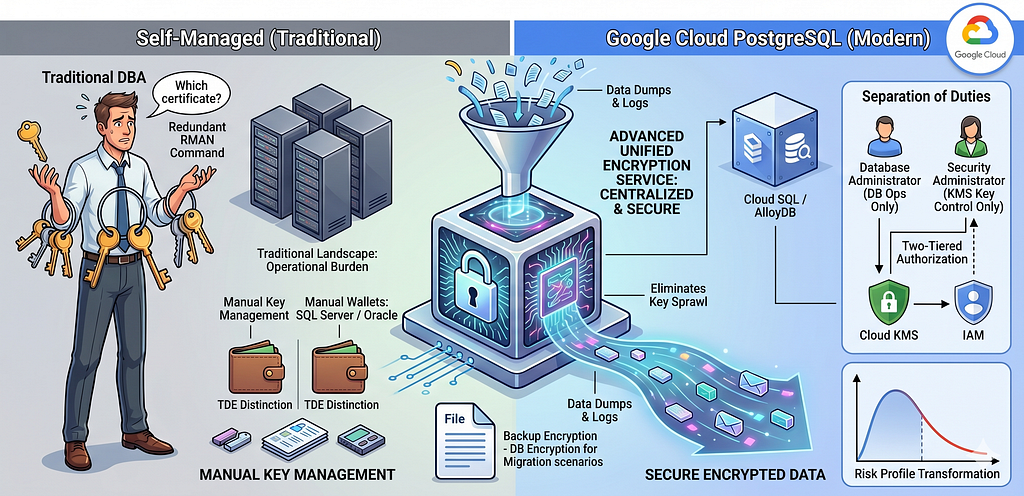
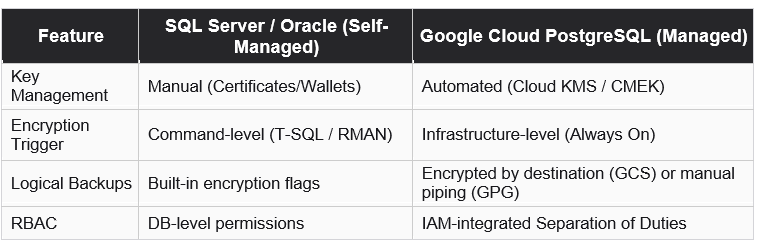
Transitioning from self-managed engines (SQL Server/Oracle) to Google Cloud PostgreSQL (Cloud SQL/AlloyDB) transforms backup encryption from a manual operational burden into an automated infrastructure standard. This shift eliminates the risk of human error in key management while enforcing a strict “Separation of Duties” via Cloud KMS, ensuring compliance-ready security by default.
Understanding Backup Encryption
Backup encryption secures database dumps, WAL (Write-Ahead Logs), and snapshots by encrypting the data stream before it reaches the storage layer. This is a critical requirement for compliance frameworks such as HIPAA and PCI-DSS. It provides a vital safety net against data exfiltration, ensuring that if an attacker bypasses the live database to target secondary storage or network shares, the data remains unreadable.
The Traditional Landscape: SQL Server & Oracle
In self-managed environments, DBAs are responsible for orchestrating encryption. A key challenge is understanding the interplay between backup encryption and TDE.
SQL Server
SQL Server allows encryption during the backup process, but its necessity depends on the database state:
- Mechanism: Users specify an algorithm (e.g., AES_256) and a certificate/asymmetric key within the BACKUP DATABASE T-SQL command.
- The TDE Distinction: If a database is already protected by TDE, backups are encrypted by default using the TDE certificate. Standalone backup encryption commands are redundant in these cases.
Oracle
Oracle utilizes Recovery Manager (RMAN) and Data Pump to secure physical and logical exports:
- Mechanism: RMAN supports “Password Mode” and “Transparent Mode” (via Oracle Wallet/Keystore). DBAs set the algorithm (e.g., SET ENCRYPTION ALGORITHM ‘AES256’) during the backup run.
- The TDE Distinction: Tablespaces protected by Oracle Advanced Security TDE remain encrypted in RMAN backups automatically. Explicit RMAN encryption is only required for data that is unencrypted in the live database or when using Data Pump for logical exports.
The Cloud-Native Shift: PostgreSQL on Google Cloud
Community PostgreSQL does not include a native “backup encryption” command equivalent to traditional database engines. For logical exports using utilities like pg_dump, there is no built-in encryption flag; DBAs must pipe the output through external utilities like gpg or openssl.
Google Cloud abstracts this complexity for physical backups through automated automation, while securing logical exports at the storage layer when targeting Google Cloud Storage (GCS).
Cloud SQL and AlloyDB for PostgreSQL
When migrating to Google Cloud, the operational burden of managing certificates and backup passwords disappears:
- Default Protection: All automated backups, snapshots, and Point-in-Time Recovery (PITR) logs are encrypted at rest using AES-256 by default.
- Customer-Managed Encryption Keys (CMEK) & Separation of Duties: For organizations with strict regulatory requirements, Cloud SQL and AlloyDB integrate with Cloud KMS. This model enforces a modern separation of duties: the Database Administrator manages the database operations, while a dedicated Security Administrator manages the cryptographic keys. A DBA cannot restore a database backup if the Security team instantaneously revokes or restricts access to the KMS key, providing a robust, two-tiered authorization model.
Risk Profile Transformation
Moving to Google Cloud PostgreSQL services shifts the risk profile by reducing architectural complexity. While mature on-premises environments already utilize enterprise secret vaults and offsite replication, migrating to managed services consolidates these fragmented workflows:
- Eliminates “Key Sprawl”: Reduces reliance on fragmented tools like CyberArk or Vault by consolidating keys within native Cloud KMS.
- Unified Security Boundary: Eliminates the “handoff” risk where data moves between different encryption standards across local networks and cloud storage.
Audit Simplicity: Compliance auditors only need to check one set of IAM and Cloud KMS logs, rather than hunting through various DBA-managed scripts and certificates.
Modernizing Backup Encryption: Transitioning from Self-Managed Engines to Google Cloud PostgreSQL was originally published in Google Cloud – Community on Medium, where people are continuing the conversation by highlighting and responding to this story.
Source Credit: https://medium.com/google-cloud/modernizing-backup-encryption-transitioning-from-self-managed-engines-to-google-cloud-postgresql-f2623b1f6e8d?source=rss—-e52cf94d98af—4
About the Author